

Last Updated: October 27, 2026
Quick Summary
To restring vertical blinds, remove the blind from the window, take off the slats, open the headrail, and photograph the cord path before cutting the old cord free. Thread the new cord through each carrier and around the end pulleys, then knot it at the control end and test the traverse before rehanging.
- A vertical blind headrail is the track at the top that holds the carriers, pulleys and cord mechanism.
- Cord and chain headrails and wand control headrails are not interchangeable, so identify your system first.
- Measure blind width end to end of the headrail, not the fabric, and measure length from headrail top to slat bottom.
- If the old cord snapped, run garden twine through the same path, mark it at the knot point and measure it.
- Replace the headrail if the track is bent, the cord lock has gone, or most carriers are cracked.
Table of Contents
- Before You Start: Identify Your Blind and Headrail Type
- Tools, Safety and Measuring Your Blind
- How to Replace Vertical Blind Cord: Step-by-Step
- Vertical Blind Headrail Repair: Fixing Carriers and Pulleys
- Vertical Blind Repair Cost: Repair or Replace?
- Testing, Adjusting and Maintaining Your Restrung Blinds
- Ordering Replacement Parts and Headrails from Just Blinds
- Frequently Asked Questions
Before You Start: Identify Your Blind and Headrail Type
Learning how to restring vertical blinds starts with knowing exactly what you have on the wall, and the same applies when you restring vertical blinds yourself. Most restringing jobs fail before they begin because the owner bought the wrong cord or forced the wrong headrail apart.
A vertical blind headrail is the metal or plastic track at the top of the blind that holds the carriers, pulleys and cord mechanism.
Look at the control end of your blind. That tells you which system you own.
Cord and Chain vs Wand Control Headrails
Cord and chain headrails use a looped cord to open and close the slats, plus a separate chain to tilt them. Wand control headrails replace the cord with a rigid wand, and the tilt chain often runs through the wand itself.
The two systems are not interchangeable. A cord and chain unit needs a cord that runs a continuous loop through the track. A wand unit uses a different internal layout and often a shorter cord run.
Check for these identifying marks before ordering anything:
- A looped cord hanging at one end: cord and chain control
- A plastic or metal wand clipped to the last carrier: wand control
- A single chain only, no cord: tilt-only or wand-assisted tilt
- Brand stamp on the underside of the track: note it down
If you own a cord and chain blind, our replacement cord and chain headrail is made to measure to fit your existing setup. Wand owners need the wand control headrail instead.


Tools, Safety and Measuring Your Blind
Now measure. Accuracy here decides whether your new cord is the right length.
Measure the blind width from end to end of the headrail, not the fabric. Then measure the blind length from the top of the headrail to the bottom of the slats. Write both down. If the headrail is already off the wall, measure it flat on the floor, a track measured while hanging can read short if it is bowed.
Working Out the Replacement Cord Length
If the old cord snapped and you cannot measure it, the string-along-the-route method is the fallback: run a length of garden twine through the same path, mark it at the knot point, and measure the twine.
How to Replace Vertical Blind Cord: Step-by-Step
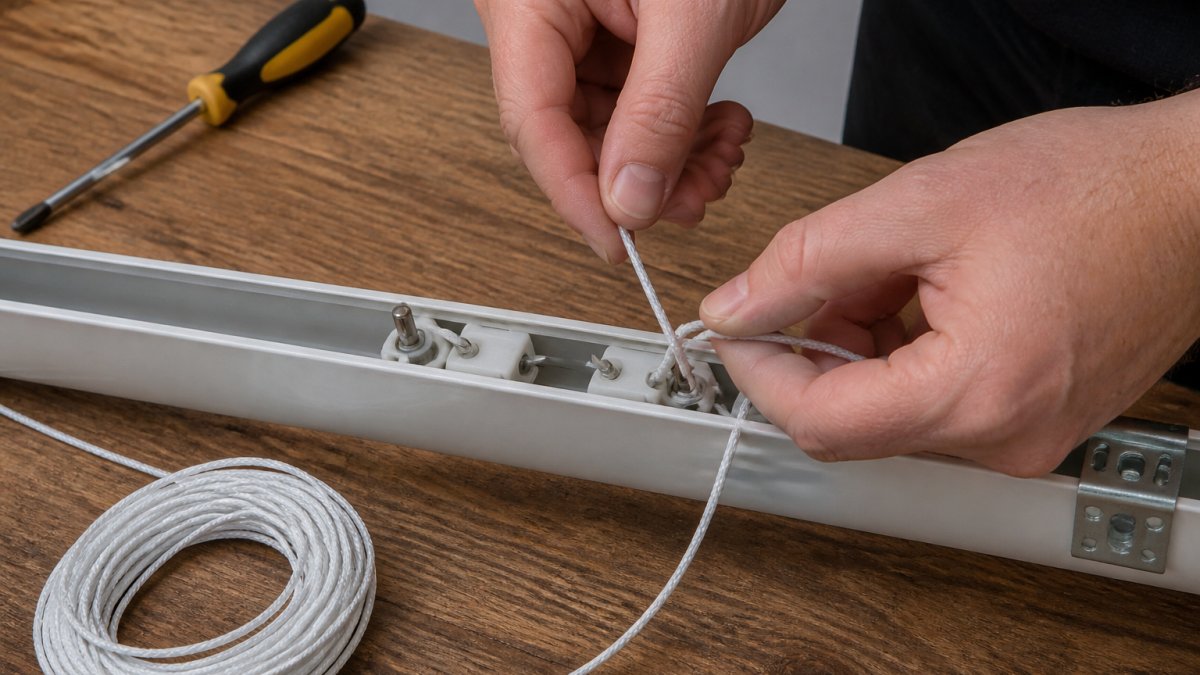
Step 1: Remove the blind from the window. Unclip the headrail from its brackets, or unscrew the brackets if the track is fixed. Lay the blind flat on a clean floor or table.
Step 2: Take off the slats. Slide each vane off its carrier stem. Keep them in order so they go back the same way.
Step 3: Open the headrail. Most tracks have end caps that pop off with a flat-head screwdriver. Some have a cover strip along the front that unclips. Work slowly; the plastic gets brittle with age.
Step 4: Note the cord path before removing anything. Take a photo. This single step saves the most time on reassembly.
Step 5: Pull out the old cord. Cut it free at the knot and draw it out through the carriers and pulleys.
Step 6: Thread the new cord. Follow the same route the old one took, through each carrier and around the end pulleys.
Replacement Vertical Blind Headrail (Wand Control) →
Step 7: Tie off and test. Knot the cord at the control end, refit the end caps, and test the traverse before hanging the blind back up.
Threading the Cord Through Carriers and Pulleys
The cord path is where most people get stuck. On a standard cord and chain track, the cord runs from the control end, through the hole in each carrier, around the pulley at the far end, and back along the track to form a loop.
Feed the cord through one carrier at a time. Keep the carriers evenly spaced as you go, because a bunched-up carrier will jam the traverse later. When you reach the end pulley, loop the cord around it and bring it back along the track.
A split draw blind opens from the centre. Its cord path is different: the cord runs to a central pulley rather than an end one, so trace that route carefully before threading.
Here is the restringing sequence at a glance, from taking the blind down to testing the traverse.
| Step | What to do |
|---|---|
| 1 | Remove the blind from the window and lay it flat |
| 2 | Slide each vane off its carrier stem, keeping order |
| 3 | Open the headrail by popping end caps or cover strip |
| 4 | Photograph the cord path before removing anything |
| 5 | Cut the old cord free at the knot and pull it out |
| 6 | Thread the new cord through each carrier and end pulleys |
| 7 | Knot at the control end, refit caps, test the traverse |
Vertical Blind Headrail Repair: Fixing Carriers and Pulleys
Not every problem is a broken cord. Sometimes the cord is fine and the headrail itself is the fault. Before you buy cord or start dismantling the track, run a short diagnosis, it is the step most guides skip, and it decides whether restringing will actually fix your blind.
Diagnose the Fault Before You Restring
A quick test: unhook the blind, lay the track flat, and pull the cord by hand. If the carriers glide evenly, the cord path is sound and the fault is elsewhere. If they bunch or stop, note exactly where, that points to the failed component.
The Three Common Headrail Failures
Failed cord lock. The cord slips and the blind drifts open. The lock mechanism needs replacing, or the whole track does if the lock is moulded into the housing. This is the fault most often misdiagnosed as a stretched cord.
When to Stop Repairing and Replace the Track
Use this rule of thumb: if the headrail is straight, the pulleys turn and only the cord or a couple of carriers have failed, repair it. If the track is bent, the cord lock has gone, or most carriers are cracked, replace the headrail. Replacement headrails are inexpensive compared with a whole new blind, and they let you keep slats that are still in good condition.
Vertical Blind Repair Cost: Repair or Replace?
Replacement headrails are inexpensive compared with a whole new blind, and they let you keep slats that are still in good condition. That is usually the smarter spend.
Testing, Adjusting and Maintaining Your Restrung Blinds
A little maintenance goes a long way:
- Vacuum the track every few months to clear dust from the pulleys
- Never force the cord if it sticks; find the cause
- Keep cords clipped up and out of reach of children (Blind cord safety)
Ordering Replacement Parts and Headrails from Just Blinds
At Just Blinds, we supply made-to-measure headrails and spare parts.
Free UK delivery applies on orders over £175.
At Just Blinds, we offer made-to-measure blinds and replacement slats compatible with most rails, including Hilarys, Argos and Dunelm. Shop with Just Blinds today.
Frequently Asked Questions
How much does it cost to restring vertical blinds?
If the headrail itself has failed, a replacement cord and chain control headrail from Just Blinds costs £11.00, while a wand control headrail is £21.84.
How do you thread a replacement cord through a vertical blind headrail?
Feed the cord in at the control end and follow the same path the old cord took, passing it over each pulley and through the hole in every carrier. Keep the carriers evenly spaced as you go so the cord sits in the right groove. Once the cord reaches the far end, tie it off at the tensioner or anchor point, then test the draw before refitting the headrail to the brackets.
Is it worth repairing vertical blinds or should I replace them?
A pack of ten hangers for 89mm slats is £2.50.
How can you tell whether a vertical blind cord or mechanism is broken?
Pull the draw cord gently and watch the carriers. If the cord moves but the slats stay put, the cord has snapped or slipped off a pulley. If the cord is jammed solid, a carrier or pulley has failed inside the headrail. Broken carriers usually show as slats hanging at an angle or refusing to traverse. Diagnosing the fault first tells you whether you need a new cord, new hangers or a complete headrail.

