
Table of Contents
- Vertical Blinds vs Venetian Blinds: The Living Room Verdict
- Side-by-Side Comparison: Vertical vs Venetian at a Glance
- Vertical Blinds Pros and Cons for a Living Room
- Venetian Blinds Pros and Cons for a Living Room
- Best Blinds for Living Room Light Control and Privacy
- Choosing the Best Blinds for a Living Room: A Decision Guide
- Measuring, Fitting and Living With Your Blinds
- Frequently Asked Questions
Last Updated: October 20, 2026
Vertical Blinds vs Venetian Blinds: The Living Room Verdict
Choosing between vertical blinds vs venetian blinds for a living room comes down to one question: what is the room doing all day?

At Just Blinds we make and supply both, and the pattern repeats: vertical blinds suit the big opening but feel clumsy on a small bay, while venetians across a three-metre patio door mean tilting 25mm slats one by one.
Below we break down slat orientation, light control, privacy, materials, cleaning and cost.
Side-by-Side Comparison: Vertical vs Venetian at a Glance
| Criterion | Vertical Blinds | Venetian Blinds |
|---|---|---|
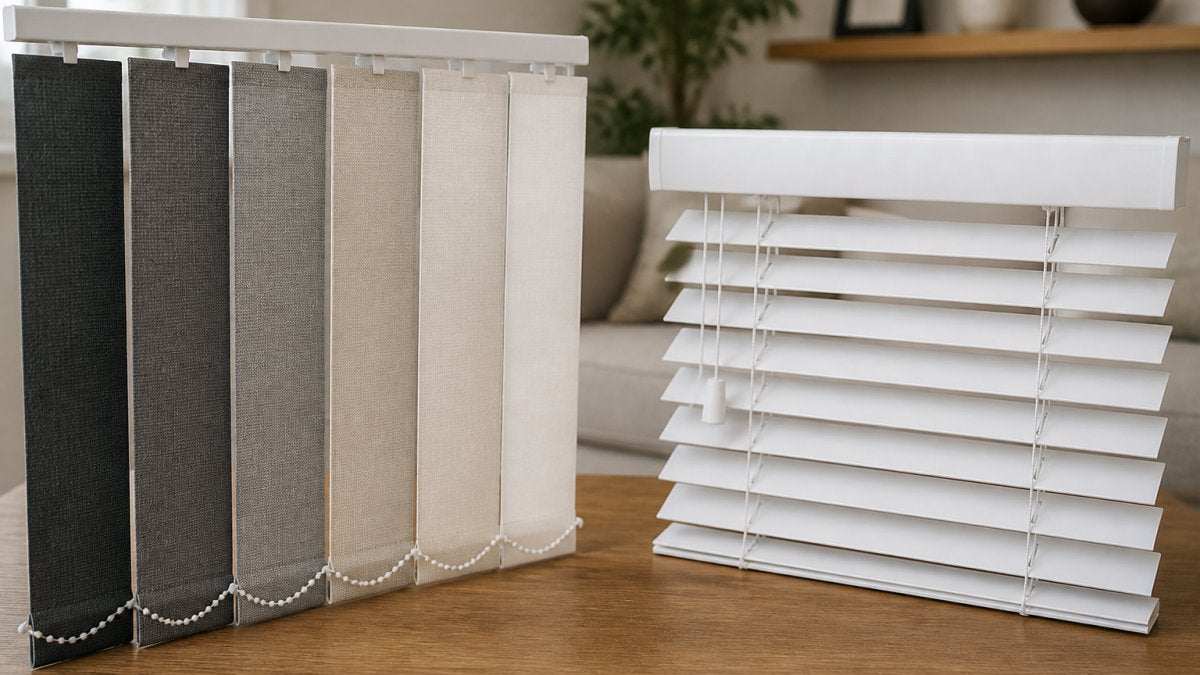
| Slat orientation | Vertical vanes, usually 89mm wide | Horizontal slats, typically 25mm or 50mm |
| Best for | Patio doors, wide windows, floor-to-ceiling glass | Standard windows, smaller bays, precise light control |
| Light control | Good, with tilt and pull-back | Excellent, fine tilt adjustment |
| Privacy | Strong when closed; gaps possible between vanes | Strong when closed; tighter light seal |
| Operation | Chain and cord, or child-safe wand | Cord tilt and lift |
| Stacking | Vanes gather to one or both sides | Slats stack at the top |
| Cleaning | Wipe each vane; fabric can be spongeable | Dust each slat; fewer, narrower surfaces |
| Typical materials | Fabric, PVC | Aluminium, faux wood, real wood |
| Glare on screens | Moderate | Very good |
| Style fit | Modern, minimal, functional | Warm, traditional to contemporary |
Vertical slats handle width and doorways; horizontal slats handle precision. Most living rooms need one or the other.

Vertical Blinds Pros and Cons for a Living Room
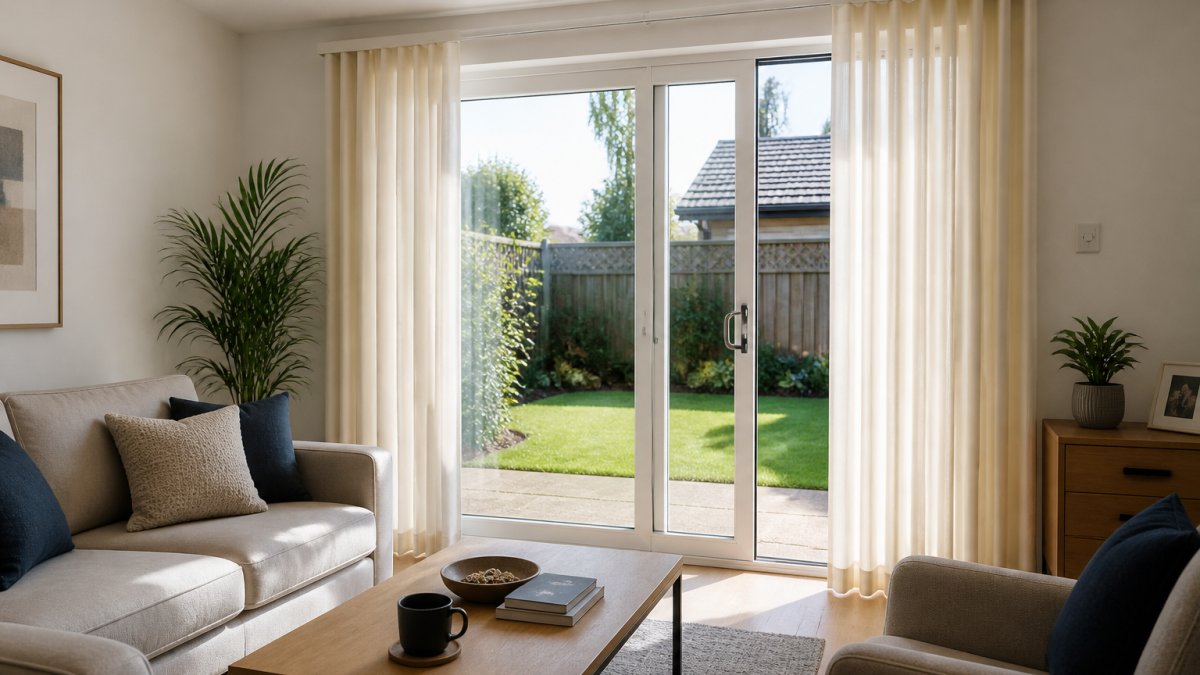
Vertical blinds suit wide glass and doors because the vanes run floor to ceiling and slide sideways rather than stacking upward, so a three-metre opening needs no deep top box and you can walk through a patio door with the blind partly drawn.
Pros:
- Cover wide windows and patio doors without a bulky headrail
- Vanes tilt to control daylight while keeping the view
- Pull back fully to one or both sides for an open doorway
Cons:
- Vanes can swing and clatter in a draught when a door is open
- Less precise light control than horizontal slats
- The vertical lines suit modern rooms better than period ones
Where Vertical Slats Win: Patio Doors and Wide Windows
A patio door is the clearest case: vertical vanes tilt closed for privacy at night, then rotate flat and slide aside so you can step out, with no lift cord dangling at head height.
Wide windows benefit too: a two-metre run of glass is awkward for horizontal slats, which need a long headrail and a lot of lift cord, while vertical vanes divide the width into manageable sections and stack neatly at the edges.
The Trade-offs: Style, Stacking and Slat Movement
Vertical blinds read as functional: in a room styled with warm wood, textiles and layered lighting, the crisp vertical lines can feel clinical. Fabric vanes in a soft cream or neutral tone soften this, but the geometry is still vertical.
Movement is the other issue: leave a patio door open on a breezy day and the vanes sway. A weighted bottom chain or wand control helps.
Glare, Screens and Daylight in a Living Room
Vertical blinds are often called poor for screen glare, but tilting the vanes to a shallow angle cuts side-on sun without closing the room down, so a television set at an angle to a patio door can be shielded while the rest of the opening stays clear.
What they cannot do is fine-tune top-to-bottom light fall the way horizontal slats can. Screen facing the window directly: venetians win. Screen to one side: vertical vanes are more capable than their reputation suggests.
Safety, Children and Pets
Most modern vertical systems offer a child-safe wand control that replaces the looped chain with a rigid wand, the option to specify with young children.
Cats treat vertical vanes as a gap to push through and can bend or detach one, but replacement vanes are inexpensive and easy to fit. If a pet is likely to push through, choose a fabric vane with a weighted bottom chain rather than lightweight PVC.
Cost Factors for Vertical Blinds
Vertical blinds are generally more economical across a wide opening because the headrail and vanes scale predictably. Cost drivers are width, vane material, control type and made-to-measure sizing; price rises with width rather than the number of windows.
Venetian Blinds Pros and Cons for a Living Room
Venetian blinds give the finest light control of any blind type: a small twist of the cord tilts every horizontal slat at once, letting you dial daylight up or down with real precision.
Pros:
- Precise tilt control over daylight and glare
- Excellent privacy when slats are closed
- Aluminium, faux wood and real wood options suit most interiors
Cons:
- Long lift cords on wide windows can be awkward
- Horizontal slats collect dust on their upper faces
- Real wood needs more careful cleaning
Precision Light Control and Glare on Screens
This is where venetian blinds earn their place: tilting slats to a shallow angle blocks direct sun while letting softer daylight through, which matters if the television faces a window or you work from a sofa with a laptop.
A common mistake is closing venetians fully to fight glare, turning a bright room dim. A partial tilt, roughly halfway between open and closed, cuts the harsh reflection without losing the room's light.
Materials, Finishes and Durability
Venetian blinds come in three practical families. Aluminium is the lightest and most affordable. Faux wood looks like timber and shrugs off moisture, suiting a living room that opens into a kitchen. Real wood brings warmth and weight but needs gentler cleaning.
Our Matt Textured White Aluminium venetian blind uses 25mm slats and a colour-matched headrail, and starts at £41.95. For a warmer look, the Sunwood Gloss White Real Wood Venetian Blind offers 50mm slats from £23.38. If moisture resistance matters more than grain, the Dream Stone White Faux Wood Venetian Blinds start at £13.36.
Matt Textured White Aluminium venetian blind →

Best Blinds for Living Room Light Control and Privacy
For light control and privacy together, venetians are stronger on a standard window and vertical blinds across a wide opening: horizontal slats overlap tightly when closed, while vertical vanes meet edge to edge and can leave slim gaps.
That gap matters at night: vertical vanes closed flat still let thin slivers of light and view through the joins, while horizontal slats tilted closed seal more completely.
For genuine darkness, such as a projector room, neither type is the best answer, a blackout roller or blackout vertical fabric does that job better. For adjustable daylight with solid privacy, venetians are the pick.
Screen Glare: The Living-Room Test Most Comparisons Miss
Glare is the practical test that separates the two types. Venetians win because a partial tilt cuts harsh screen reflection without dimming the room; the slats act like small shelves, bouncing light away from eye level.
Vertical blinds manage glare less precisely: a shallow tilt blocks side-on sun if the television sits at an angle to a patio door, but if the screen faces the window directly, the vanes struggle.
Privacy by Day and Night
By day both types rely on the same trick: tilt the slats or vanes so you can see out but the room cannot be seen clearly from outside.
A living room is often lit brightly in the evening while the street outside is dark, exactly when gaps between vertical vanes become visible from outside. Facing a pavement or neighbour, venetians give a more reliable night-time seal; facing a garden, the gap matters far less.
Insulation, Heat and Seasonal Comfort
Neither type substitutes for double glazing, but both affect comfort: a closed blind creates a still air layer that reduces winter draughts, and closing it during the hottest part of the day reduces solar gain if the slats or vanes block direct sun.
Venetian slats, particularly 50mm wood or faux wood, give finer control as the sun moves, while vertical fabric vanes filter light rather than block it.
Safety and Household Considerations
Cords are the safety issue to plan for. Both types can be specified with child-safe operation: a wand control for vertical blinds, a cordless or tensioned lift for venetians.
Pets affect privacy and light control: a cat pushing through vertical vanes leaves gaps that undermine night-time privacy, while a dog brushing past venetian slats can bend them.
Cost and Long-Term Value
Cost is driven by width, material and control type rather than blind type alone. Vertical blinds tend to be more economical across a wide opening; venetians can be more economical on a standard window, but a wide window needs a long headrail and more slats, narrowing the gap. Real wood costs more than aluminium or faux wood.
Choosing the Best Blinds for a Living Room: A Decision Guide
Work through these questions in order. The first one that applies usually settles it.
- Is the glass a door you walk through? Choose vertical blinds.
- Is the window wider than about 1.8 metres? Choose vertical blinds.
- Does the television or a screen face the window? Choose venetian blinds.
If two answers conflict, for example a wide window that also faces a television, fit vertical blinds for coverage and add a sheer curtain or a blackout roller behind them for the screen.
Measuring, Fitting and Living With Your Blinds
Living with them comes down to small habits. Vacuum venetian slats with a brush attachment every few weeks rather than wiping, which pushes dust into the joins.
For a patio door, our Cameo White Vertical Blinds use 89mm sewn louvres on a powder-coated aluminium headrail from £4.92, with a chain and cord or child-safe wand control. The Cameo Cream Vertical Blinds offer the same build in a softer neutral.
The hardest part of this decision is not the comparison, it is the measurement.
At Just Blinds, we make every blind to your exact sizes, which removes the guesswork once you have the numbers.
Frequently Asked Questions
Are vertical blinds or Venetian blinds better for a living room?
It depends on the window. Vertical blinds suit wide living-room windows and patio doors because the 89mm louvres stack neatly to one side and tilt to filter daylight without blocking the view. Venetian blinds give finer control over light and glare thanks to narrower slats, which helps if you watch TV or work near the window. For a standard square window, Venetian blinds often look sharper; for a full-width glass door, vertical blinds are usually the practical pick.
Which style gives better light control and privacy in a living room?
Venetian blinds win on precision. Tilting 25mm or 50mm slats lets you cut glare on a screen while keeping some daylight, and closing them fully gives solid privacy at eye level. Vertical blinds are better at covering large glazed areas, and tilting the louvres still filters light while stopping passers-by seeing in. If your living room faces a street or a neighbour, both work, but Venetian slats let you fine-tune the angle more closely.
Are vertical blinds suitable for wide living-room windows and patio doors?
Yes. Vertical blinds are built for wide spans and full-height glazing, which is why they are common on patio doors. The 89mm louvres run on a powder-coated aluminium headrail and pull back to one side, so you keep clear access to the door. Just Blinds makes the Cameo White and Cameo Cream vertical blinds to measure, with a chain and cord control or a child-safe wand system, and the louvres are sewn rather than glued.
Are wooden or faux wood Venetian blinds better for a living room?
Real wood gives a warmer, high-shine finish, like the Sunwood Gloss White 50mm real wood Venetian blind, and suits a living room where looks matter. Faux wood, such as the Dream Stone White 50mm composite PVC blind, is easier to wipe clean and copes better with moisture and knocks, so it holds up well in busy rooms. If the living room opens onto a kitchen or gets condensation, faux wood is the lower-maintenance choice.
