
Table of Contents
- Why Moisture-Resistant Blinds Matter in Bathrooms
- PVC vs Faux Wood: Which Material Wins for Bathrooms
- Roller Blinds vs Venetian Blinds for Bathroom Humidity
- Top Moisture-Resistant Bathroom Blinds: Our Recommendations
- How to Clean Bathroom Blinds and Prevent Mould
- No-Drill Bathroom Blinds: Installation Without Damage
- Waterproof vs Moisture-Resistant: What's the Difference
- Style and Design Options for Damp Bathrooms
Last Updated: August 21, 2026
Why Moisture-Resistant Blinds Matter in Bathrooms
Bathrooms are uniquely hostile environments for window coverings. Steam from showers, condensation, and constant humidity destroy ordinary fabric blinds within months. Moisture-resistant bathroom blinds use materials engineered to withstand damp air without warping, cracking, or developing mould. Material choice determines whether your blinds last five years or five months.
Mould growth on fabric blinds releases spores into your bathroom air, affecting indoor air quality and creating health risks, particularly for children and people with respiratory sensitivities (the CDC). Moisture weakens mechanical components, cords fray, mechanisms jam, and the blind becomes unsafe to operate. Moisture-resistant bathroom blinds eliminate these risks because they're designed to shed water rather than absorb it.
| Blind Type | Best Material | Durability | Light Control | Maintenance |
|---|---|---|---|---|
| Vertical blinds | PVC | 5+ years | Excellent | Wipe-clean |
| Venetian blinds | Faux wood or aluminium | 4-6 years | Good | Regular dusting |
| Roller blinds | PVC-backed fabric | 3-5 years | Varies | Spot-clean |
PVC vs Faux Wood: Which Material Wins for Bathrooms
PVC and faux wood are the two dominant moisture-resistant materials. PVC is a thermoplastic polymer that sheds water completely and absorbs virtually no moisture, making it genuinely waterproof. Faux wood, typically made from wood-polymer composites, is moisture-resistant rather than waterproof; it resists swelling and warping far better than real wood but can still absorb small amounts of water over time.

PVC wins on durability and maintenance. You can wipe PVC slats clean with a damp cloth without worrying about damage. The material flexes without cracking, doesn't swell in humidity, and won't develop mould because water runs off. PVC vertical blinds from Just Blinds start from £20.17, making them an affordable moisture-resistant option.
Faux wood offers aesthetic advantages PVC can't match. It looks and feels like real timber, adding warmth and sophistication to a bathroom. For homeowners prioritising style alongside functionality, faux wood delivers that balance. The trade-off is slightly more maintenance, regular dusting and avoiding standing water, but the visual payoff appeals to many.
Aluminium is a third option for Venetian blinds. It's lightweight, doesn't absorb moisture, and offers a modern aesthetic. However, aluminium conducts heat and cold, making it feel uncomfortable to touch in temperature-sensitive bathrooms.
Roller Blinds vs Venetian Blinds for Bathroom Humidity
Roller blinds use a continuous fabric panel that rolls up and down, simple, clean, and excellent for blackout applications. Venetian blinds have individual horizontal slats that tilt for precise light adjustment, offering more flexibility but more surface area for moisture to contact.
For bathrooms, roller blinds win on simplicity. There are fewer moving parts, less dust accumulation, and easier cleaning. A PVC-backed roller blind can be wiped down quickly without fussing with individual slats. The limitation is that roller blinds are either fully open or fully closed; you can't adjust light without rolling the entire blind up or down.
Venetian blinds excel when you need partial light control and privacy simultaneously. Tilting the slats lets you adjust sunlight without losing privacy, and individual slats can be replaced if damaged. For bathrooms with skylights or high windows where you want to control light without full blackout, Venetian blinds are better.
The moisture resistance difference is minimal if you choose the right material for either type. Your decision should come down to how you want to control light, not which type is "better" for moisture.
Top Moisture-Resistant Bathroom Blinds: Our Recommendations
1. Samba Frost White PVC Blackout Vertical Blinds
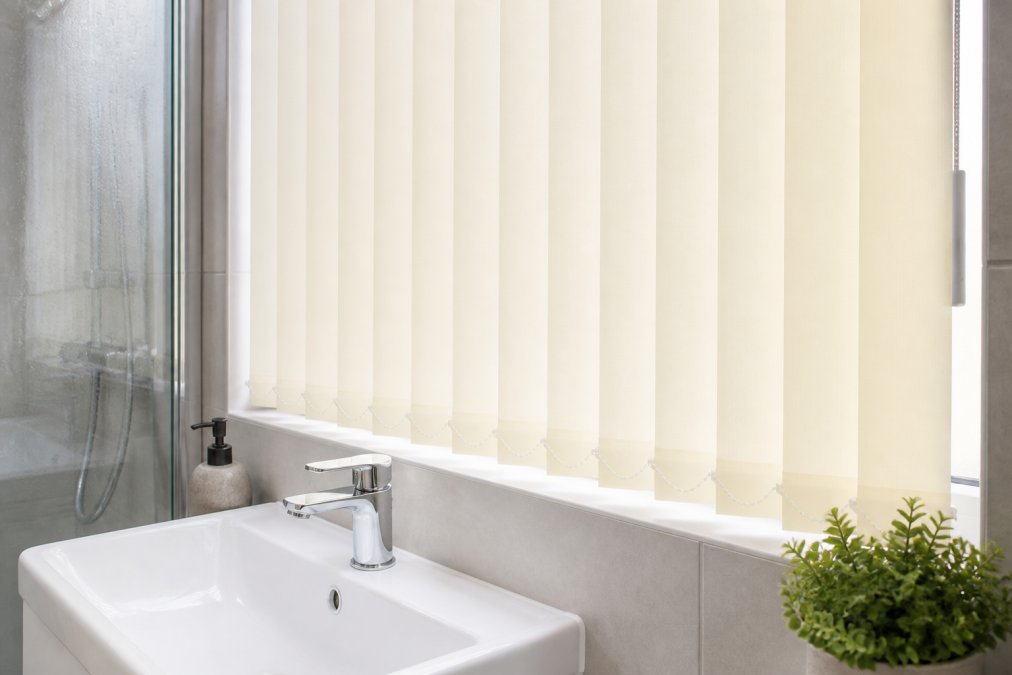
The Samba Frost White is a strong choice for bathrooms because it combines total blackout capability with genuine waterproof construction. Made from 89mm PVC fabric, these vertical blinds deliver complete light blocking while remaining wipe-clean and mould-resistant. At £22.12 per blind, they're affordable without sacrificing quality.
The PVC is flexible enough to operate smoothly without cracking, yet rigid enough to hold its shape against humidity and temperature fluctuations. Just Blinds manufactures these as made-to-measure, meaning they fit your exact window dimensions with no gaps or light leakage.
During maintenance, spray the slats with a damp cloth, wipe, and you're done. No special cleaners, no drying time, no risk of water damage.
Pros:
- Total blackout for privacy and light control
- Genuinely waterproof; water beads off rather than soaking in
- Made-to-measure fit eliminates light gaps
- Child-safe wand option available
- Affordable at £22.12
Cons:
- Vertical blinds take up more wall space than roller blinds
- Requires accurate window measurement
Just Blinds made-to-measure vertical blinds
2. Metz Black PVC Blackout Vertical Blinds
The Metz Black offers the same waterproof performance as the Samba Frost but with a darker aesthetic. At £22.12, it delivers a bolder visual statement in modern bathrooms. The deep black colour absorbs light completely, making it a strong choice if you prioritise total darkness alongside moisture resistance.

Black PVC works particularly well in contemporary bathrooms with chrome or stainless steel fixtures. Like all Just Blinds vertical blinds, the Metz Black uses 89mm PVC.
The black finish shows dust and water spots more visibly than lighter options, so weekly wiping rather than monthly is recommended. For homeowners who prioritise aesthetics and don't mind routine maintenance, this trade-off is worthwhile.
Pros:
- Maximum light blocking with dramatic aesthetic
- Same waterproof durability as lighter options
- Made-to-measure precision fit
- Contrasts beautifully with modern bathroom fixtures
Cons:
- Shows dust and water spots more visibly
- Requires more frequent wiping than lighter colours
How to Clean Bathroom Blinds and Prevent Mould
Cleaning frequency determines whether your moisture-resistant blinds stay fresh or develop mould. In high-humidity bathrooms, weekly cleaning is realistic; in bathrooms with good ventilation, fortnightly cleaning usually suffices.
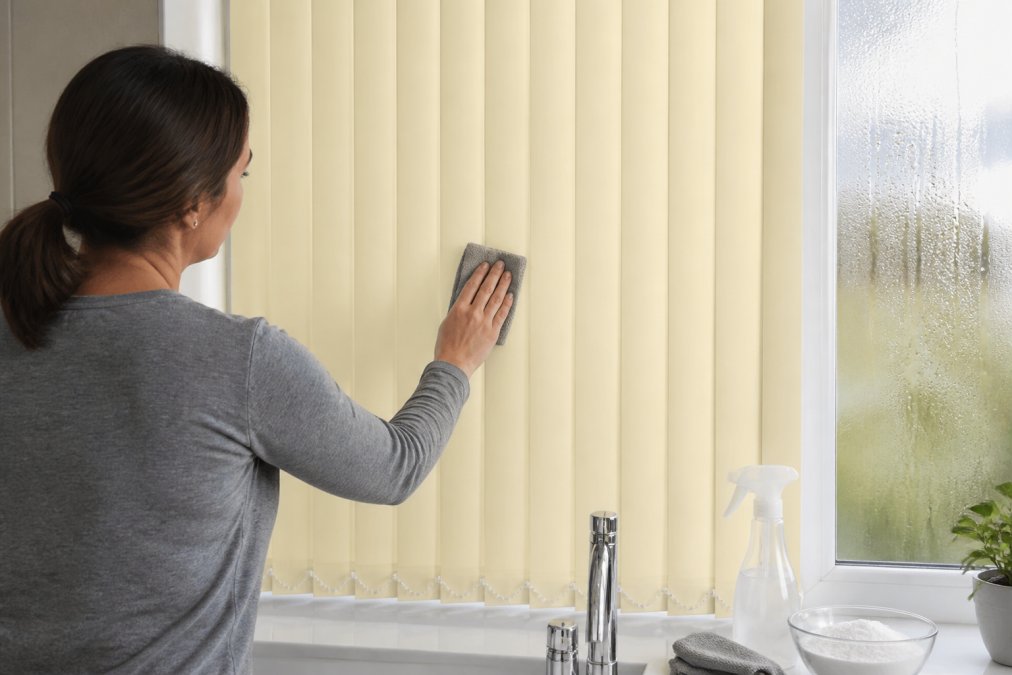
For PVC blinds, mix warm water with mild detergent. Dip a soft cloth into the solution, wring it out so it's damp but not dripping, and wipe each slat from top to bottom. Dry immediately with a clean cloth. This removes dust, soap residue, and condensation before mould spores can establish.
Ventilation is your primary defence against mould. Run your bathroom extractor fan during and for 20 minutes after every shower (the EPA). If you don't have an extractor fan, open a window to allow steam to escape. Mould thrives in stagnant, humid air; moving air dries surfaces quickly and prevents colonisation.
Check your blinds monthly for discolouration or soft spots, particularly in bottom corners where water collects. For PVC blinds, discolouration is usually dust or mineral deposits; a quick wipe removes it. Soft spots indicate mould growth; address these immediately with a cloth dampened in a solution of one part white vinegar to three parts water.
For faux wood blinds, use a slightly drier cloth to avoid oversaturating the material, and allow more drying time.
No-Drill Bathroom Blinds: Installation Without Damage
Many renters and homeowners worry that installing blinds will damage bathroom walls. No-drill mounting solutions address this concern by using adhesive strips or tension rods instead of screws and brackets.
Adhesive mounting strips (typically 3M Command strips rated for bathroom use) work well for lightweight roller blinds but struggle with heavier vertical blinds. Bathroom humidity can gradually weaken the adhesive over time. If you choose adhesive mounting, inspect the strips monthly and replace them if they begin to peel.
Tension rods offer a better solution for vertical blinds. These rods fit between the top and bottom of your window frame, held in place by spring tension rather than fasteners. They work only on windows with clear, unobstructed frames, but when they fit, they're genuinely damage-free. The downside is that tension rods can slip slightly if the blind is operated roughly.
For permanent installations, drilling remains the most reliable method. A single screw into a tile or drywall, properly anchored, causes minimal damage and can be filled with silicone if you ever remove the blind.
Just Blinds supplies made-to-measure blinds with mounting brackets included, and installation guides clearly show options for installation.
Waterproof vs Moisture-Resistant: What's the Difference
These terms are often used interchangeably, but they describe different levels of water resistance.
Waterproof means the material repels water completely and will not allow water to penetrate under any circumstances. PVC is genuinely waterproof; water beads on the surface and runs off without being absorbed.
Moisture-resistant means the material resists water absorption and swelling but may allow some moisture penetration over extended exposure. Faux wood is moisture-resistant; it won't swell dramatically in humidity, but it can absorb small amounts of water if exposed to standing liquid for hours.
For bathrooms, waterproof (PVC) is superior to merely moisture-resistant materials. A waterproof blind looks and functions identically to the day it was installed. A moisture-resistant blind may show subtle swelling at the edges, slight colour changes, or the beginning of mould growth if ventilation is poor.
The cost difference is minimal. PVC vertical blinds start from £20.17 at Just Blinds, which is competitive with moisture-resistant alternatives. Given the performance advantage, waterproof PVC is the logical choice for high-humidity bathrooms.
Style and Design Options for Damp Bathrooms
Moisture-resistant blinds don't require you to sacrifice aesthetics. Modern PVC and faux wood options come in a range of colours and finishes that complement contemporary bathroom design.
PVC vertical blinds offer neutral tones, cream, white, black, grey, and marble finishes, that work with virtually any bathroom colour scheme. Cream tones add warmth to cool-tiled bathrooms. White options brighten small bathrooms and create a spa-like aesthetic. Black makes a bold statement in modern bathrooms with chrome or matte black fixtures.

Marble finishes bridge the gap between neutral and statement-making. They add visual interest without overwhelming the space and work particularly well in bathrooms with natural stone or patterned tiles.
For homeowners prioritising style, faux wood Venetian blinds deliver the warmth and elegance of real timber without moisture vulnerability. They work beautifully in traditional or transitional bathrooms where you want a softer aesthetic than PVC provides.
The key to successful bathroom blind styling is choosing a colour that complements your existing fixtures and tiles. Light filtering options (available in some faux wood ranges) allow soft light through while maintaining privacy, useful if your bathroom has a window facing a garden rather than the street.
Choosing the right moisture-resistant bathroom blinds comes down to three decisions: material (PVC for waterproof durability, faux wood for aesthetics), blind type (vertical for simplicity, Venetian for light control), and colour (neutral for versatility, bold for statement). Just Blinds manufactures made-to-measure options in all these combinations, starting from £20.17, with free UK delivery on orders over £175. The investment in proper moisture-resistant blinds pays for itself within two years through durability alone. Your bathroom deserves window coverings engineered for the environment, not compromised designs that fail in humidity. Get started with Just Blinds and ensure your bathroom blinds stay fresh, mould-free, and functional for years to come.
Frequently Asked Questions
Q: What are the best moisture-resistant bathroom blinds?
A: PVC vertical blinds and faux wood options are the top choices for bathrooms. PVC blinds like the Samba Frost White (£22.12) offer total waterproofing and are wipe-clean, making them ideal for high-humidity areas. Faux wood resists swelling and warping better than real wood. Both materials handle steam and condensation without deteriorating, unlike fabric or standard wooden blinds.
Q: Are faux wood blinds bathroom pros and cons worth the investment?
A: Faux wood offers excellent durability in damp environments, it won't warp, crack, or swell like real wood. The main advantage is longevity; most faux wood blinds last 5+ years in bathrooms. The downside is they're typically more expensive upfront than PVC options and slightly heavier to install. For budget-conscious buyers, PVC vertical blinds deliver similar moisture resistance at a lower price point.
Q: How do I know if blinds are truly waterproof or just moisture-resistant?
A: Waterproof blinds are completely sealed against water and won't absorb any moisture; splash-proof or moisture-resistant blinds resist humidity and light water spray but may absorb minimal moisture over time. Bathroom blinds should be at least moisture-resistant. Check product descriptions for terms like 'wipe-clean PVC' or 'splash-proof', these indicate proper bathroom-grade protection. PVC vertical blinds are splash-proof; faux wood is moisture-resistant.
Q: What's the easiest way to install no-drill bathroom blinds?
A: No-drill blinds use adhesive strips or tension rods instead of screws. Adhesive strips work best on smooth, clean surfaces above window frames. Tension rods fit inside the window recess without drilling. For bathrooms, adhesive strips may loosen over time due to humidity, so tension rods are more reliable. Always measure twice before installing, and ensure the surface is dry and dust-free for adhesive application.
Q: How often should I clean bathroom blinds to prevent mould and mildew?
A: Clean bathroom blinds every 2-4 weeks to prevent mould buildup. Wipe slats with a damp cloth and mild detergent, then dry thoroughly. In high-humidity bathrooms (like those with frequent showers), monthly cleaning is best. PVC blinds are easiest to maintain, they simply wipe clean. Ensure good ventilation after showers to reduce condensation on blinds. If mould appears, use a dilute vinegar solution (1:1 with water) to clean affected areas.
This article was written using GrandRanker
