
Table of Contents
- Why Made to Measure Blackout Blinds Beat Off-the-Shelf Options
- Blackout vs Dimout Blinds: Which One Do You Actually Need?
- How to Measure for Roller Blinds and Vertical Blinds Accurately
- Our Made to Measure Blackout Blind Range: Fabrics and Prices
- Child Safety Regulations for Blinds: What You Must Know
- Thermal Efficiency, UV Protection, and Energy Saving Benefits
- Cleaning, Maintenance, and Troubleshooting Common Issues
- Conclusion
Last Updated: August 16, 2026
Off-the-shelf blinds are one of the most common sources of buyer regret in home décor. The gap between the edge of a standard blind and your window frame is where light creeps in, privacy disappears, and the entire point of buying a blackout blind is lost. At Just Blinds, we manufacture made to measure blackout blinds cut to your exact millimetre, so there are no gaps, no guesswork, and no returns. This guide covers everything you need to choose the right fabric, measure accurately, and order with confidence.
Why Made to Measure Blackout Blinds Beat Off-the-Shelf Options
The biggest problem with standard-size blinds is the fit. Retail blinds come in fixed widths and drops, which means you are always choosing the closest size rather than the correct one. For a blackout blind, that compromise is fatal. Any gap between the blind and the window frame lets light through, which defeats the entire purpose.
Made to measure blackout blinds are cut to your exact window dimensions. The blind width and drop length match your recess or frame precisely, which means the blackout fabric sits flush and delivers genuine light exclusion. For nurseries, shift workers' bedrooms, or home cinemas, this is not a luxury. It is a functional requirement.
Custom fit also extends durability. A blind that fits properly puts less strain on the roller mechanism and control system, which extends its working life considerably. You also select the exact fabric, colour, and control system for your room rather than accepting whatever the nearest standard size happens to come in.
Blackout vs Dimout Blinds: Which One Do You Actually Need?
Blackout blinds are window treatments fitted with a fabric or coating that blocks all or virtually all light transmission. A true blackout fabric carries an opaque backing that prevents light from passing through the material itself. Combined with a close-fitting custom frame, the result is a room that stays dark even in full summer daylight.
Dimout blinds use a tightly woven fabric that significantly reduces light but does not eliminate it. They soften harsh sunlight and provide privacy, but a dim glow will still be visible through the fabric in bright conditions.
| Feature | Blackout Blinds | Dimout Blinds |
|---|---|---|
| Light exclusion | Total (fabric blocks all light) | Partial (reduces glare, not dark) |
| Best for | Nurseries, bedrooms, shift workers, home cinemas | Living rooms, offices, sun-facing rooms |
| Privacy level | Complete | Good, not total |
| Fabric weight | Heavier, opaque backing | Lighter, semi-opaque weave |
| Thermal insulation | Higher | Moderate |
| UV protection | Full | Partial |
The common mistake is buying a dimout blind for a nursery or child's bedroom because it looks softer. Dimout fabric is fine for a living room where you want to cut afternoon glare without losing daylight entirely. For any room where genuine darkness is needed for sleep, a blackout fabric is the only option worth ordering.
How to Measure for Roller Blinds and Vertical Blinds Accurately
Accurate measuring is the single step most people get wrong, and unlike a shirt or a pair of trousers, a blind cut to the wrong size cannot simply be taken in. Use a steel tape measure rather than a fabric one. Steel does not flex or sag, which means your measurements stay true across the full width of the window.
Measure in millimetres throughout. Rounding to the nearest centimetre introduces errors that compound across the blind width and drop length. Take every measurement three times and use the smallest reading. Window frames are rarely perfectly square, and the narrowest point is the one that determines whether the blind will fit.
Measuring Inside the Window Recess
An inside-recess fit gives the cleanest finish and the best light exclusion because the blind sits within the frame rather than overlapping it. Measure the internal width of the recess at the top, middle, and bottom. Use the smallest of the three figures as your blind width. For the drop, measure from the top of the recess to the windowsill. Deduct 10mm from the width measurement to allow the blind to move freely without catching on the sides.
Measuring Outside the Window Recess
An outside-recess fit is used when the window recess is too shallow to accommodate the headrail, or when you want the blind to cover a larger area for improved light exclusion and insulation. Add at least 50mm to each side of the frame for the blind width, giving a total overlap of 100mm or more. For the drop, measure from where you plan to fix the mounting brackets down to the sill, then add 50mm below the sill for a full coverage finish.
Royal Institute of British Architects guidance on window measurement standards
Our Made to Measure Blackout Blind Range: Fabrics and Prices
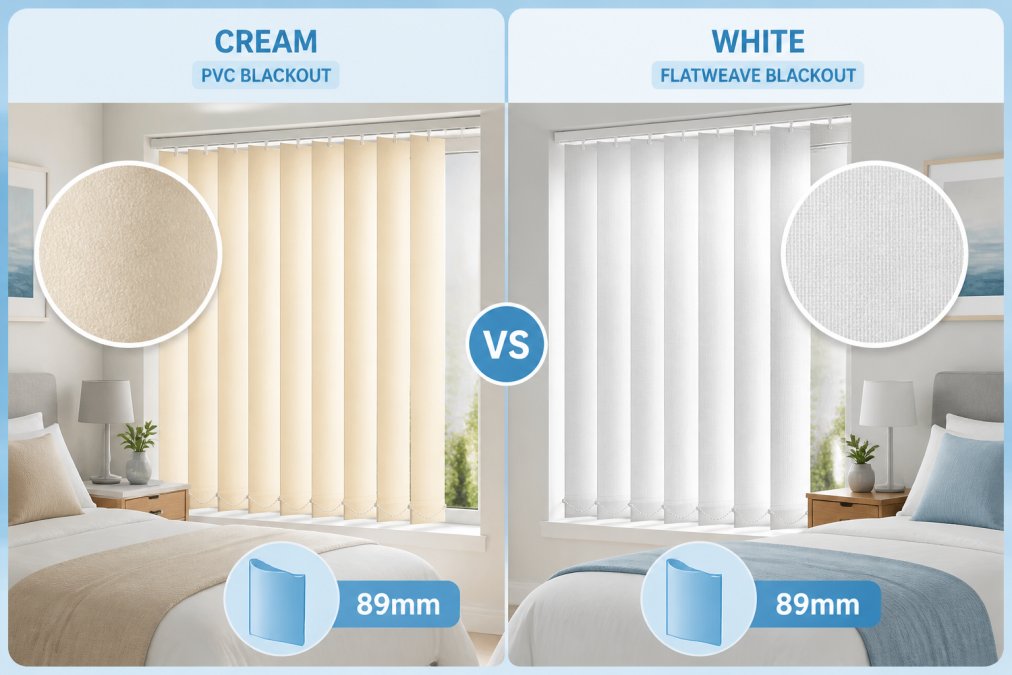
Just Blinds manufactures two distinct families of blackout fabric for vertical blinds: PVC and flatweave. Each has a different surface, ideal environment, and aesthetic.
PVC Blackout Fabrics: Best for Damp Rooms
PVC blackout vertical blinds are the practical choice for kitchens, bathrooms, utility rooms, and any space where moisture, steam, or condensation is a regular feature. The flexible 89mm louvres are wipe-clean, waterproof, and will not warp or discolour in humid conditions. Every PVC blind in the Just Blinds range is made to measure to your exact sizes, with all louvres sewn rather than glued for long-term durability. The headrail is powder-coated aluminium, which resists corrosion in damp environments.
The current PVC blackout range includes:
- Unilux Cream PVC Blackout Vertical Blinds from £20.17
- Metz Black PVC Blackout Vertical Blinds from £22.12
- Sahara White PVC Blackout Vertical Blinds from £22.12
- Samba Frost White PVC Blackout Vertical Blinds from £22.12
- Samba Steel Grey PVC Blackout Vertical Blinds from £22.12
- Metz Ash Marble Silver PVC Blackout Vertical Blinds from £23.25
- Marble White PVC Blackout Vertical Blinds from £23.25
- Metz Ivory PVC Blackout Vertical Blinds from £23.25
Flatweave Blackout Fabrics: Best for Bedrooms and Living Rooms
Flatweave blackout fabric has a softer, textile appearance that suits bedrooms, living rooms, and any space where you want the blind to feel like a considered part of the interior. The Bella range uses a spongeable 89mm flatweave fabric with a 100% blackout coating applied to the reverse, so the face of the blind looks clean and neutral while the backing blocks all light transmission.

- Bella Snow White Blackout Vertical Blinds from £22.12
- Bella Plain Cream Blackout Vertical Blinds from £21.17
The Bella range is the better choice for nurseries and children's bedrooms because the softer fabric texture suits a domestic interior, while the blackout coating still delivers the total darkness that good sleep requires.


Child Safety Regulations for Blinds: What You Must Know
Child safety regulations for blinds are not optional guidance. They are a legal requirement. Looped blind cords present a strangulation risk to young children, and the relevant legislation in Great Britain is enforced through the UK General Product Safety Regulations and the specific blind cord safety standard BS EN 13120, which mandates that all blinds sold for domestic use must either be cordless or fitted with a safety device that prevents the cord from forming a loop accessible to a child.
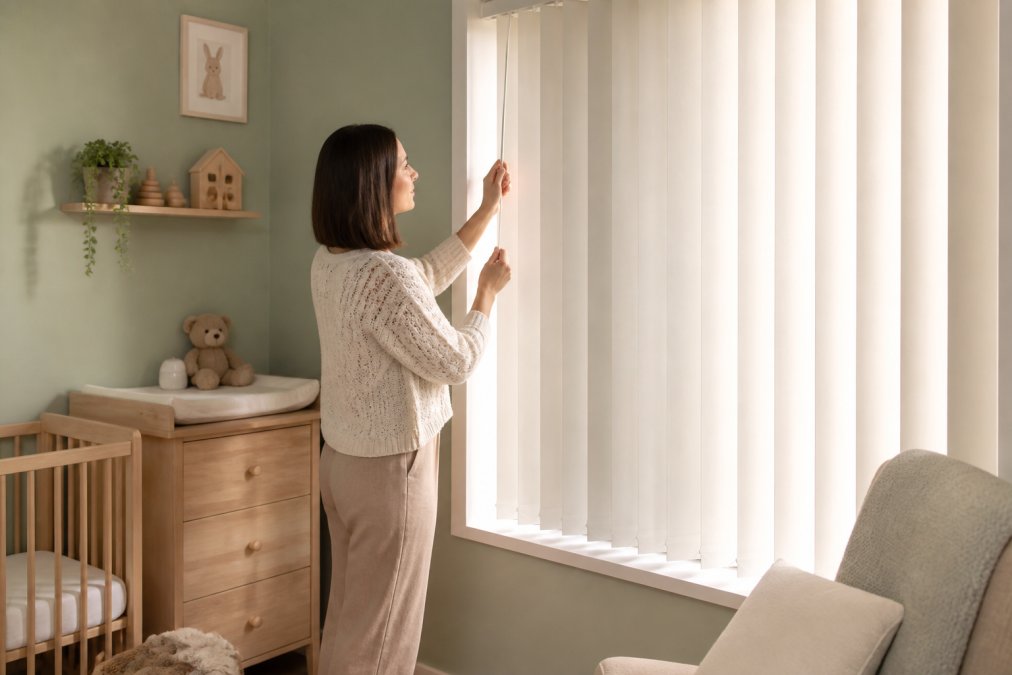
The practical implications for anyone ordering blackout blinds for a nursery, child's bedroom, or any room a child can access are straightforward:
- Choose a wand control system rather than a chain and cord system wherever possible
- If a chain and cord system is used, ensure a breakaway safety device is fitted to the chain
- Fix any loose cords to the wall using a cord cleat positioned out of reach of children
- Cordless and spring-loaded blinds eliminate the hazard entirely
The Just Blinds Samba Frost range offers a child-safe wand control system as an option. For nurseries specifically, the wand system is the cleaner and safer choice.
According to the Royal Society for the Prevention of Accidents guidance on blind cord safety, blind cord strangulation incidents involving young children continue to be reported annually. Fitting the correct control system at the point of purchase is significantly easier than retrofitting safety devices later.
Thermal Efficiency, UV Protection, and Energy Saving Benefits
Blackout blinds do more than block light. A well-fitted blackout blind creates an additional layer of insulation between the glass and the room, which reduces heat loss in winter and limits solar heat gain in summer. The result is a more stable room temperature and less demand on your heating or cooling system.
The thermal efficiency of a blackout blind depends primarily on how well it fits. An inside-recess fit that covers the full window opening traps a layer of still air between the glass and the fabric, which acts as insulation. Outside-recess installation with generous overlap achieves a similar effect by covering the entire frame.
UV protection is a secondary but genuine benefit. Blackout fabric blocks the ultraviolet radiation that causes fading in flooring, furniture, and soft furnishings. Rooms that receive strong direct sunlight see the most benefit, particularly south-facing bedrooms and living rooms.
For anyone concerned about energy saving, the Energy Saving Trust guidance on window treatments and heat loss notes that window coverings contribute meaningfully to reducing heat loss, particularly in older properties with single or early double glazing. The combination of light exclusion, insulation, and UV protection makes blackout blinds one of the more versatile window treatments available.
Cleaning, Maintenance, and Troubleshooting Common Issues
How you clean and maintain a blind determines whether it lasts three years or ten.
PVC blackout louvres are the easiest to maintain. Wipe them down with a damp cloth and a mild detergent. Do not use abrasive cleaners or solvents, which can strip the surface and affect the blackout coating. For grease or steam residue in kitchens, a solution of washing-up liquid in warm water works well. Dry the louvres with a soft cloth rather than leaving them to air-dry.
Flatweave blackout louvres require slightly more care. The Bella fabric is spongeable, which means spot-cleaning with a damp cloth is fine for most marks. Avoid soaking the fabric or submerging the louvres in water, as this can affect the blackout coating on the reverse. Do not tumble dry or iron blackout-coated fabric.
Common issues and fixes:
- Light leakage at the sides: Usually caused by the blind being too narrow for the recess. Recheck your measurements and confirm whether the blind was ordered for inside or outside recess fitting.
- Louvres not rotating evenly: Check the chain or cord control for tangles. On vertical blinds, louvres can occasionally slip out of the carrier clips at the bottom; re-seating them is straightforward and does not require tools.
- Headrail sagging in the middle: More common on very wide blinds. Add a centre support bracket to the headrail to correct the bow.
- Stiff cord or chain: Apply a small amount of silicone spray to the roller mechanism. Avoid oil-based lubricants, which attract dust and can gum up the mechanism over time.
- Louvres discolouring near a window: On south-facing windows, prolonged direct sunlight can affect some fabric colours over time. PVC fabrics are generally more resistant to this than flatweave.
For replacement louvres, Just Blinds supplies individual slats compatible with most standard headrail systems, including rails from major high-street suppliers.
| Issue | Likely Cause | Fix |
|---|---|---|
| Light leaking at sides | Blind too narrow for recess | Remeasure and reorder with correct width |
| Louvres not rotating | Tangled cord or slipped carrier clip | Check control system; re-seat clips |
| Headrail sagging | Span too wide without centre support | Fit a centre support bracket |
| Stiff cord or chain | Dust in roller mechanism | Apply silicone spray to mechanism |
| Fabric discolouring | Prolonged direct UV exposure | Rotate louvres closed when room is unused |
Frequently Asked Questions
How do I measure my windows for made to measure blackout blinds?
Measure the width and drop of your window recess using a steel tape measure, taking readings at three points across the width and three down the drop, then use the smallest figure. For an inside-recess fit, deduct 10mm from the width so the blind sits cleanly without binding. For an outside-recess fit, add at least 50mm to each side to prevent light leakage around the edges. Always measure in millimetres for the most accurate custom fit.
Are blackout blinds effective at keeping heat out?
Blackout blinds with a coated or PVC fabric do reduce solar heat gain by blocking direct sunlight through the glass. The light exclusion layer also acts as a basic insulating barrier, which can help maintain room temperature in summer and reduce heat loss in winter. For the best thermal efficiency, choose a blind that fits the window recess closely, as gaps around the edges allow warm or cool air to bypass the fabric entirely.
What are the disadvantages of blackout blinds?
The main drawback is light leakage around the edges, particularly with standard roller or vertical blinds that do not use side channels. A custom fit reduces this significantly compared to ready-made sizes. Some blackout fabrics can also feel warmer in summer if they absorb rather than reflect heat. Dimout fabrics are a better choice where total darkness is not essential, as they tend to offer a softer, more diffused light rather than complete light block.
What child safety rules apply to made to measure blinds in the UK?
The UK's Furniture and Furnishings (Fire Safety) Regulations and the British Standard BS EN 13120 govern blind safety. Since 2014, all blinds sold in the UK must comply with child safety requirements, meaning looped cords must either be inaccessible to children or fitted with a safety device such as a breakaway connector or cord clamp. Cordless or wand-operated blinds remove the looped cord risk entirely and are the recommended choice for nurseries and children's bedrooms.
How much do made to measure blackout blinds cost?
Prices vary by fabric type and window size. Just Blinds' made to measure blackout vertical blinds start from £20.17 for the Unilux Cream PVC fabric, with most PVC and flatweave options ranging from £21 to £23.25 at standard sizes. Bespoke manufacturing means the final price scales with the blind width and drop length you specify. Free UK delivery is available on orders over £175, which makes ordering multiple blinds in one go the most cost-effective approach.
Choosing the wrong blind for your window is easy to do and expensive to undo. Just Blinds manufactures blackout blinds to your exact measurements, with PVC and flatweave fabrics suited to every room from a damp kitchen to a nursery requiring total darkness. Free UK delivery is available on orders over £175, and the full range of made to measure blackout blinds is available to order directly from the Just Blinds shop. Shop Now and get the custom fit your windows actually need.
This article was written using GrandRanker
