
Table of Contents
- Vertical Blinds vs Venetian Blinds: Head-to-Head Comparison
- Light Control, Privacy, and Thermal Efficiency
- Best Blinds for Patio Doors 2026
- Pros and Cons of Vertical Blinds
- Venetian Blinds: Strengths, Limitations, and 2026 Design Trends
- How to Clean Venetian Blinds (and Vertical Blinds Too)
- Child Safety, Smart Home Integration, and Durability
- Which Vertical or Venetian Blind Should You Choose?
Last Updated: August 15, 2026
Vertical Blinds vs Venetian Blinds: Head-to-Head Comparison
Choosing between vertical blinds vs venetian blinds 2026 is one of those decisions that looks simple until you're standing in front of a floor-to-ceiling patio door wondering which way to go. At Just Blinds, we manufacture and supply both types daily, and the honest answer is that neither is universally better. Each wins in specific situations, and getting that call wrong means living with the consequences for years.

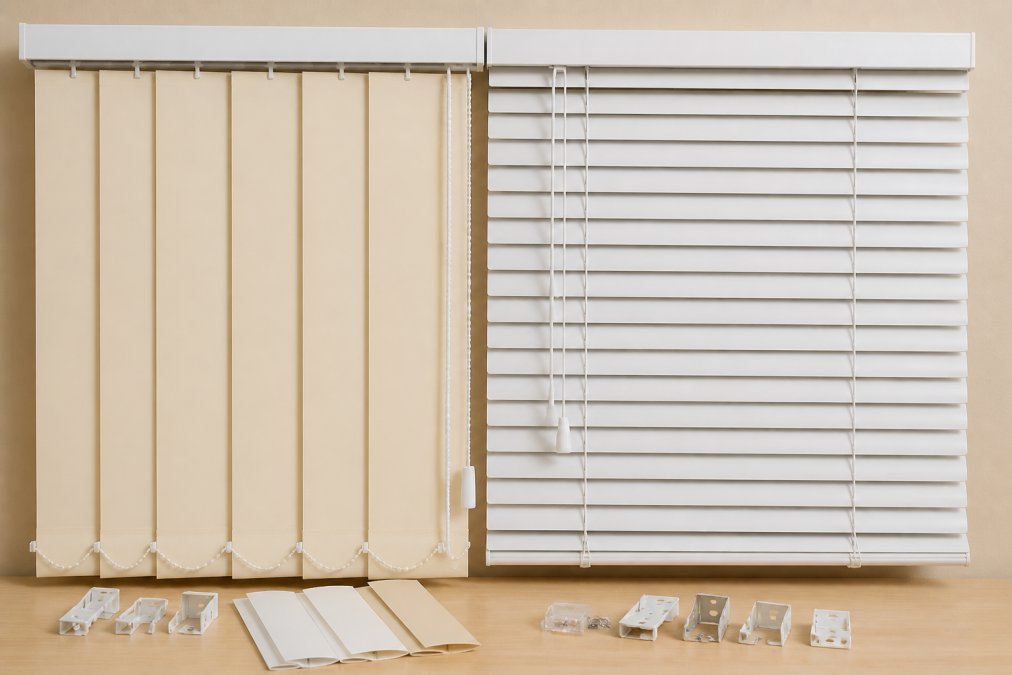
Vertical blinds use long louvres that hang from a top track system and rotate via a tilt mechanism to control light. Venetian blinds use horizontal slats stacked in a headrail that tilt and lift via cord or wand operation. Both offer adjustable light filtration, privacy control, and made-to-measure custom sizing, but they suit very different windows, rooms, and lifestyles.
| Feature | Vertical Blinds | Venetian Blinds | Winner |
|---|---|---|---|
| Best window type | Wide spans, patio doors | Standard windows | Vertical |
| Slat orientation | Vertical louvres (89mm typical) | Horizontal 25mm slats | Depends on use |
| Light control precision | Good, tilt mechanism | Excellent, fine tilt | Venetian |
| Privacy levels | Good when closed | Excellent when closed | Venetian |
| Thermal efficiency | Moderate | Better with aluminium | Venetian |
| Ease of cleaning | Wipe individual louvres | Wipe individual slats | Similar |
| Child safety options | Wand system available | Cordless/wand available | Draw |
| Typical starting price | From £4.92 per louvre | From £41.95 per blind | Vertical |
| Best for large windows | Yes | Less practical | Vertical |
| Contemporary aesthetic | Classic, functional | Versatile, on-trend | Venetian |
The right choice depends almost entirely on window span and room function, not personal taste alone.
Light Control, Privacy, and Thermal Efficiency
Light Filtration and Tilt Mechanism
Venetian blinds offer more precise light diffusion than vertical blinds. The 25mm aluminium slats can be tilted to fine angles, giving granular control over how much light enters and in which direction. Vertical blinds with 89mm louvres rotate in broader arcs and filter light effectively across wide spans, but don't offer the same degree of precision. For rooms where you want to read without squinting, venetians give you more control.

Privacy Levels and UV Protection
Both blind types offer solid privacy when fully closed, but venetian blinds edge ahead for street-level windows. The overlapping horizontal slats create a tighter seal against sightlines from outside. Vertical louvres, when fully rotated, leave a small gap at each join that can allow partial views depending on the angle of approach.
UV protection is broadly similar across both types when made from aluminium or coated fabrics. Quality aluminium venetian slats with an anti-warp finish reflect UV rays effectively, protecting flooring and furniture from fading.
Energy Efficiency and Acoustic Dampening
Aluminium venetian blinds with weighted slats and a close-fitting recess create a modest but measurable air buffer between the glass and the room. According to the Energy Saving Trust guidance on window treatments, window coverings that fit snugly within the recess can reduce heat loss noticeably compared to bare glazing, particularly on single-glazed windows.
Vertical blinds cover larger window spans, including patio doors and bay windows, where a close recess fit contributes to draught reduction across a much greater surface area. Fabric vertical blinds absorb some sound energy, making them better for rooms adjacent to busy roads or open-plan spaces where echo is an issue. Aluminium venetians reflect sound rather than absorbing it.
Best Blinds for Patio Doors 2026
Vertical blinds are the clear winner for patio doors and large window spans.
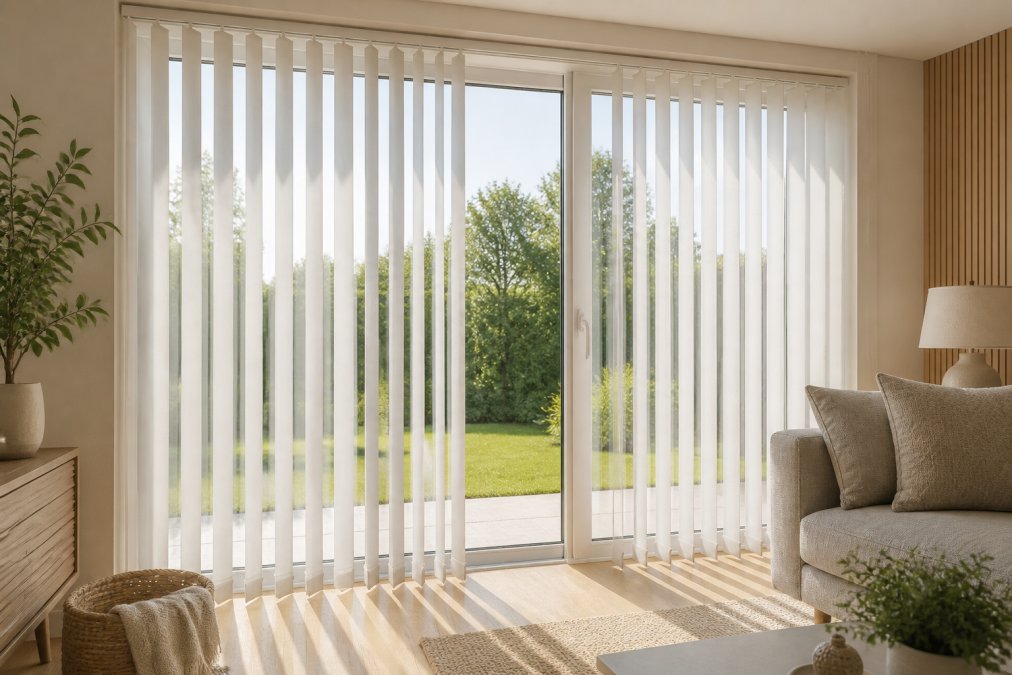
Patio doors and bi-fold doors typically span 1.8 metres to 3.6 metres wide. A venetian blind at that width becomes impractical: the stacking width when raised is substantial, the weight of the headrail increases significantly, and operating a cord lift across a 3-metre span is cumbersome. The track system on a vertical blind handles wide spans naturally, with louvres that stack neatly to one side or split centrally when the door is in use.

The Just Blinds Cameo White Vertical Blinds are made to measure in 89mm flatweave fabric with a powder-coated aluminium headrail and are ideal for patio doors. The chain and cord control or child-safe wand system means you can choose the operation method that suits your household.
For a contemporary neutral scheme, the Cameo Cream Vertical Blinds offer the same construction in a warm cream tone that works well with timber decking and garden-facing rooms.
The one scenario where a venetian blind suits a patio door: a narrow French door pair under 1.5 metres wide, where you want very precise light control and the door is not opened frequently. For anything wider or used as a main access point, vertical blinds are the practical choice.
Pros and Cons of Vertical Blinds
Pros:
- Suited to large windows and patio doors where venetians become impractical
- 89mm louvres provide good light filtration without full blackout
- Spongeable flatweave fabrics are easy to clean and moisture-resistant
- Made-to-measure sizing means a precise recess fit with no gaps
- Child-safe wand operation removes cord hazards
- Lower entry price point, starting from £4.92 per louvre
- Track system allows louvres to stack to one side, keeping the door clear
Cons:
- Less precise light control than venetian slats at fine angles
- Individual louvres can twist or become misaligned over time with heavy daily use
- Traditional aesthetic may not suit all contemporary interiors
- Privacy is slightly lower than venetians when louvres are at partial angles
Venetian Blinds: Strengths, Limitations, and 2026 Design Trends
Venetian blinds have moved firmly back into focus, particularly aluminium venetians in statement finishes and textured whites.
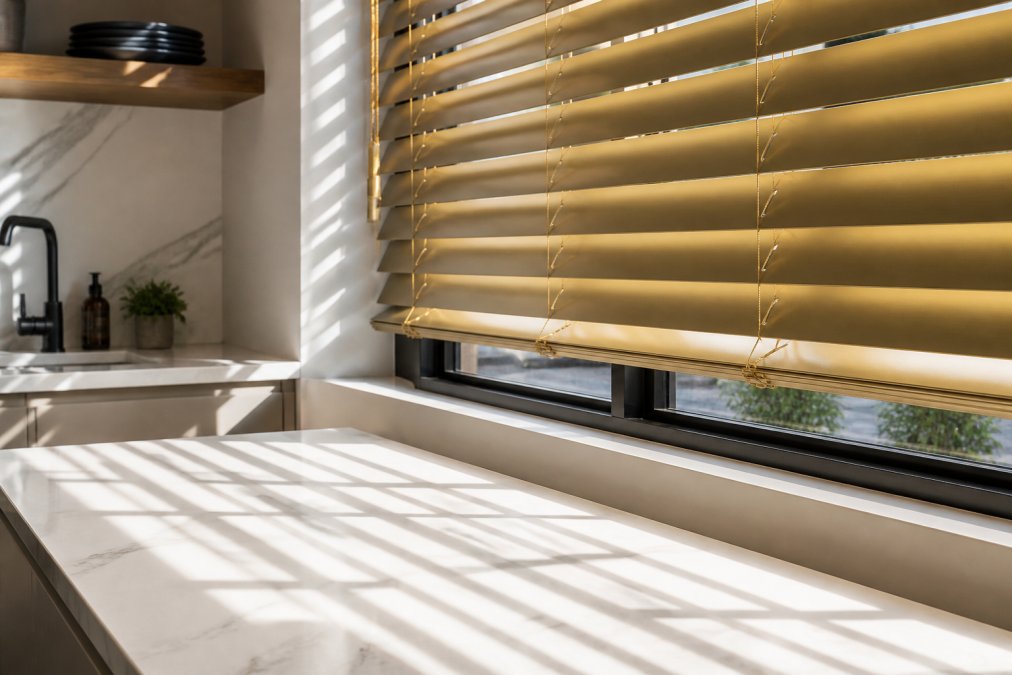
The Gold Shimmer Aluminium Venetian Blind in Glam from Just Blinds is a good example of where the category has moved. Crafted from 25mm aluminium slats in a gold shimmer finish, it comes with colour-coded headrail, bottom bar, and ladder strings. Paired with matte plaster walls and warm timber furniture, it fits the maximalist-leaning interiors trend that has continued into 2026.
The Matt Textured White Aluminium Venetian Blind and White Gloss Aluminium Venetian Blind offer the opposite approach: clean, minimal, and suited to Scandi-influenced or all-white schemes.
Strengths:
- Precise tilt mechanism for fine-grained light regulation
- Excellent privacy levels with fully closed slats
- Aluminium construction with anti-warp finish resists humidity, suits kitchens and bathrooms
- Wide range of finishes suits both traditional and contemporary interiors
- Durable materials with good longevity when maintained correctly
- Compact stacking width when raised on standard windows
Limitations:
- Less practical for wide window spans over 2 metres
- Cord operation requires more care around young children and pets
- Dust accumulates on horizontal slats more readily than on vertical louvres
- Mounting depth requirements for the headrail need checking before ordering
According to the British Blind and Shutter Association's guidance on blind selection, aluminium venetian blinds remain one of the most popular blind types for kitchens and offices due to their moisture resistance and ease of maintenance.
How to Clean Venetian Blinds (and Vertical Blinds Too)
Knowing how to clean venetian blinds properly extends their lifespan significantly.
Cleaning venetian blinds:
- Close the slats fully in one direction and dust with a microfibre cloth, working from top to bottom
- Reverse the slat angle and repeat on the other side
- For sticky residue or grease, dampen a cloth with warm water and mild washing-up liquid, then wipe each slat individually
- Dry the slats immediately to prevent water marks on aluminium
- For a deeper clean, remove the blind from the headrail and lay flat in a bathtub with warm soapy water, rinse thoroughly, and hang to dry before re-hanging
Cleaning vertical blinds:
- Dust louvres in place using a soft brush or vacuum on a low setting with an upholstery attachment
- For spongeable fabrics like the Cameo range, wipe individual louvres with a damp cloth and mild detergent
- Remove stubborn marks by taking the louvre off the track and laying it flat to clean
- Allow to dry fully before re-hanging to prevent the fabric from stretching
Monthly dusting prevents build-up that requires more intensive cleaning methods. For office environments where blinds are adjusted frequently, a quarterly wipe-down keeps the slats and track system operating smoothly.
Child Safety, Smart Home Integration, and Durability
Child and pet safety is a statutory concern. The Child Accident Prevention Trust guidance on blind cord safety highlights that looped cords on window blinds present a strangulation risk to young children. Both vertical and venetian blinds are available with cordless operation or wand control systems. The Just Blinds Cameo vertical range includes a child-safe wand system as a standard option. For venetian blinds, cordless lift mechanisms and wand tilt controls are available on made-to-measure orders. If you have children under five or pets that interact with window coverings, specify cordless or wand operation at the point of ordering.
Smart home integration is increasingly relevant for 2026 buyers. Motorized blinds with wireless control modules can be integrated with home automation systems including those compatible with voice assistants and app-based scheduling. Motorized vertical blinds suit large patio door spans particularly well, where manual operation becomes inconvenient. Neither type is inherently more compatible with smart home systems; the motorization is a hardware addition to either blind type.
Durability separates quality blinds from budget options over a two-to-three year horizon. The most common failure points are louvre or slat warping due to heat or moisture exposure, cord fraying from frequent operation, and headrail track wear. Aluminium venetian slats with an anti-warp finish resist heat and humidity well, making them more durable for kitchens and south-facing rooms. Vertical blind louvres in sewn flatweave fabric are more durable than glued alternatives. Powder-coated aluminium headrails on both types resist corrosion better than painted or plastic alternatives.
Which Vertical or Venetian Blind Should You Choose?
The choice between vertical blinds vs venetian blinds 2026 comes down to three variables: window size, room function, and how much precision you need over light.
| Situation | Best Choice | Reason |
|---|---|---|
| Patio door or window over 2m wide | Vertical blinds | Track system handles wide spans; practical stacking |
| Standard window, kitchen or bathroom | Venetian blinds | Moisture resistance; precise tilt mechanism |
| Room with heavy direct sunlight | Venetian blinds | Fine slat angle control reduces glare precisely |
| Household with young children | Either, with wand/cordless | Child-safe operation available on both types |
| Contemporary interior, statement finish | Venetian blinds | Wider finish range; on-trend aluminium options |
| Office or commercial space | Venetian blinds | Durable materials; professional appearance |
| Budget-conscious, large window area | Vertical blinds | Lower per-unit cost across wide spans |
| Smart home integration | Either with motorization | Both types support motorized blind hardware |
Vertical blinds solve the large window problem that venetians cannot. Venetian blinds solve the precision light control problem that verticals approximate but don't perfect. Most homes need both: vertical blinds on patio doors and venetians on adjacent standard windows.
Start with your window dimensions. If the span exceeds 1.8 metres, vertical blinds are almost always the right call. Below that threshold, venetians give you more control, more finish options, and better thermal efficiency per window.
Choosing the right window dressing requires weighing light control, privacy, safety, and longevity all at once. Just Blinds manufactures both vertical and venetian blinds to measure, with made-to-measure sizing for precise recess fit or face fit, child-safe wand systems, and free UK delivery on orders over £175. Whether you need the Cameo White Vertical Blinds for a patio door or the Gold Shimmer Venetian for a kitchen window, the range covers both types at quality that holds up. Shop Now at Just Blinds and get the exact fit your windows need.
Frequently Asked Questions
Are vertical blinds still in style in 2026?
Vertical blinds have seen a strong revival in 2026, particularly in contemporary and minimalist interiors. Modern fabrics, cordless operation, and wider slat widths have updated the look considerably. They remain the go-to choice for patio doors and large window spans, and the clean vertical drop suits open-plan spaces well. Far from outdated, today's vertical blinds are available in textured flatweave fabrics that complement both traditional and modern rooms.
Which blind type offers better light control: vertical or Venetian?
Venetian blinds offer more precise light regulation. The horizontal louvres and tilt mechanism let you angle slats to direct light exactly where you want it, making them ideal for offices and south-facing rooms. Vertical blinds provide good light filtration and privacy, but their light diffusion is less granular. For rooms where you need fine-tuned brightness control throughout the day, aluminium Venetian blinds with a cord tilt system are the stronger choice.
Are Venetian blinds easier to clean than vertical blinds?
Both types require regular dusting, but the method differs. Venetian blind slats accumulate dust on horizontal surfaces, so they need wiping more frequently, especially in kitchens. Vertical blind louvres hang vertically, meaning dust settles less readily. Many vertical blind fabrics, including spongeable flatweave options, can be spot-cleaned in place. Aluminium Venetian slats wipe down quickly with a damp cloth. Neither type is difficult to maintain with a consistent routine.
Which is more cost-effective for large patio doors: vertical or Venetian blinds?
Vertical blinds are generally the more cost-effective option for wide patio doors and large window spans. The track system scales to wide widths without the stacking width issues that can affect wider Venetian blinds. Made-to-measure vertical blinds from Just Blinds start from £4.92, making them an affordable choice for covering large openings. Venetian blinds start from £41.95 and are better suited to standard-width windows where precise light control matters more than span.
Do Venetian blinds provide more privacy than vertical blinds?
Both blind types offer solid privacy when closed, but they work differently. Venetian blinds can be tilted to block sightlines while still admitting some light, giving you flexible privacy levels throughout the day. Vertical blinds, when fully closed, create a consistent barrier across wide openings. For rooms facing a street or neighbouring property, either type works well; the choice comes down to whether you prioritise adjustable light diffusion or wide-span coverage.
This article was written using GrandRanker
