
Table of Contents
- Repair or Replace: What to Do With Damaged Vertical Blind Slats
- Measuring Vertical Blind Slats for the Perfect Replacement
- What You'll Need Before You Start
- How to Replace Vertical Blind Slats: Step-by-Step Installation
- How to Trim Vertical Blind Slats to the Right Drop Length
- Fitting Vertical Blind Bottom Weights and Chains
- Choosing the Right Fabric When You Replace Vertical Blind Slats
- Troubleshooting Common Fitting Issues
Last Updated: August 13, 2026
Replacing a single damaged louvre can feel like a bigger job than it is. At Just Blinds, we hear from customers every week who've snapped a slat, faded a vane, or bent a carrier clip and assumed they needed to replace the entire blind. Most of the time, they don't. This guide walks you through exactly how to replace vertical blind slats from start to finish, covering measurement, installation, trimming, and the compatibility questions that trip most people up.
Repair or Replace: What to Do With Damaged Vertical Blind Slats
Before you order anything, run through this quick assessment:
- Single broken slat: Replace just that vane. One replacement louvre is far cheaper than a full set.
- Multiple cracked or yellowed slats: Replace the full set of vertical blind slats. Mixing old and new fabric creates a patchy, mismatched look.
- Slat won't hang straight: Check the carrier clip and stem first. If the hook is bent or the stem is cracked, you need a new carrier assembly, not a new slat.
- Headrail mechanism is jammed or broken: This is the one case where full replacement often makes more sense than repair.
- Fabric is warped, shrunk, or badly faded: Replace the slats entirely. Warping rarely affects just one vane.
The real difference between a repair job and a replacement job comes down to the headrail. If the rail, controls, and carriers are all functioning correctly, you're almost certainly looking at a slat replacement rather than a full blind overhaul. That distinction saves most homeowners a significant amount of money.
Measuring Vertical Blind Slats for the Perfect Replacement
You need two figures: the width of each individual slat and the drop length (the height from the bottom of the carrier clip to the hem pocket at the bottom of the vane).
To measure the drop length accurately:
- Remove one existing slat from the headrail.
- Lay it flat on a hard surface.
- Measure from the top hole (where the hook passes through) to the bottom edge.
- Note this measurement in millimetres.
For width, measure across the face of the slat at its widest point.
Standard Slat Sizes: 89mm vs 127mm Louvres
Vertical blind slats come in two standard widths: 89mm and 127mm. The 89mm louvre is by far the most common in residential properties. The 127mm vane is wider and typically used on larger commercial or floor-to-ceiling glazing.
If you're unsure which size your existing blind uses, measure across one slat. If it measures roughly 89mm, you have the standard size. If it's closer to 127mm, you have the wider louvre. Ordering the wrong width means the slats won't hang correctly.
Checking Headrail Compatibility Before You Order
Not all replacement vertical blind slats are compatible with every headrail. The key compatibility factors are:
| Factor | What to Check | Why It Matters |
|---|---|---|
| Slat width | 89mm or 127mm | Must match carrier clip spacing |
| Hook style | Flat hook vs. split hook | Affects how the vane attaches to the stem |
| Stem length | Short or long | Determines how far the slat sits below the rail |
| Fabric weight | Light filtering vs. blackout | Heavier fabric needs stronger bottom weights |
Just Blinds replacement slats are compatible with most standard headrails, including those from Hilary's, Argos, and Dunelm. According to the British Blind and Shutter Association's guidance on blind components, correct component matching is the most common source of installation problems in DIY blind fitting.
What You'll Need Before You Start
Tools and materials:
- Replacement vertical blind slats (correct width and drop length)
- A soft tape measure or steel rule
- Scissors or a guillotine cutter (for trimming to length)
- A flat-head screwdriver (for some clip types)
- A step ladder or sturdy chair if the headrail is above head height
- A pencil for marking trim lines
No specialist tools are required. The entire process is designed to be completed without drilling, cutting tracks, or rewiring anything.
How to Replace Vertical Blind Slats: Step-by-Step Installation
Replacing vertical blind slats takes around 20-30 minutes for a standard window once you have all the materials to hand.
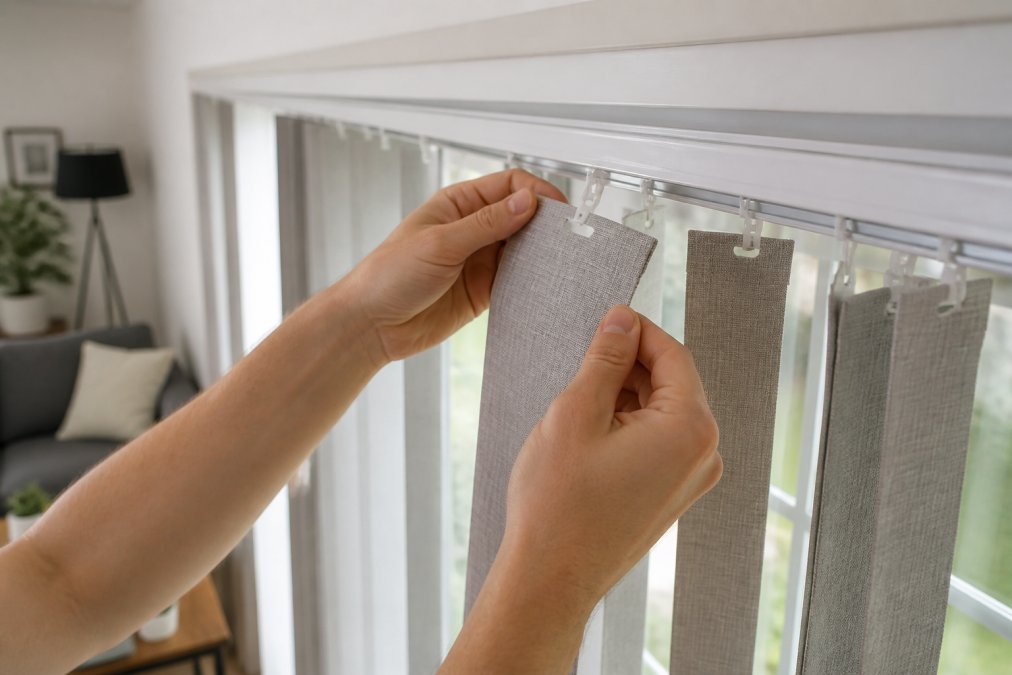
Step 1: Remove the Damaged Slat
Start by rotating the damaged vane to the open position (facing you flat-on, so the narrow edge points towards the window). This makes the top hook accessible.
- Grip the slat near the top with one hand.
- Slide the slat gently upward to release tension on the hook.
- Tilt the top of the slat away from the headrail at a slight angle.
- Unhook the vane from the carrier stem by lifting it clear of the hook.
- Remove the bottom weight from the hem pocket if you plan to reuse it.
If it feels stuck, check whether a stabilising chain is threaded through the bottom weights and unhook the chain from the adjacent slats first.
Step 2: Hang the Replacement Vane
The replacement slat goes in by reversing the removal process.
- Hold the new slat in the open position, top edge facing the headrail.
- Locate the hook hole at the top of the vane.
- Slide the hook through the hole from front to back.
- Lower the slat so the hook seats fully into the carrier stem.
- Gently tug the slat downward to confirm it's secure before releasing it.
If the hook won't pass through the hole cleanly, check that you have the correct slat width for your headrail.
Step 3: Secure and Align the Slats
Once the replacement vane is hung, rotate all the slats together using the control wand or chain. Watch the new slat as it turns: it should move in sync with the others and hang at the same drop length.
Check alignment by standing back and viewing the blind from across the room. If one slat hangs visibly lower or higher than its neighbours, the hook may not be fully seated. Rehang and check again.
How to Trim Vertical Blind Slats to the Right Drop Length
Sometimes replacement slats come slightly longer than your existing vanes. Trimming is straightforward, but precision matters.
To trim a slat to the correct drop length:
- Measure the drop length from an existing slat (top hole to bottom edge).
- Lay the new slat flat and mark the trim line with a pencil.
- Use fabric scissors or a guillotine cutter to cut cleanly across the bottom.
- If the slat has a hem pocket for a bottom weight, fold and re-seal the hem using iron-on hem tape or fabric adhesive.
Always cut from the bottom, never the top. The hook hole at the top is pre-punched to a precise position. Always hang the trimmed slat and verify the drop before cutting the rest of the set.
Fitting Vertical Blind Bottom Weights and Chains
Bottom weights and stabilising chains keep vertical blind slats hanging straight and prevent them from billowing in a draught.
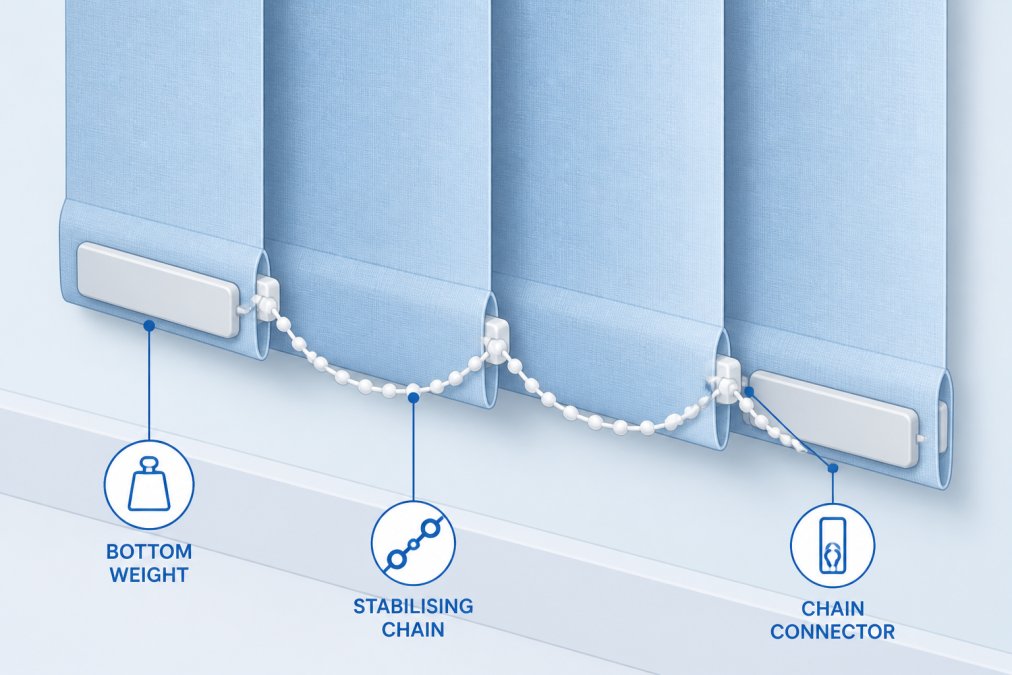
Bottom weights are small plastic or metal inserts that slide into the hem pocket at the base of each slat. They add just enough mass to keep the vane taut and hanging vertically.
To fit a bottom weight:
- Open the hem pocket at the base of the slat.
- Slide the weight into the pocket until it sits centrally.
- Fold the hem closed or secure with hem tape if needed.
The stabilising chain threads through a small hole or loop at the base of each slat, connecting the vanes along their bottom edge. It prevents individual slats from swinging independently in a breeze. According to the Royal Society for the Prevention of Accidents guidance on blind safety, loose blind cords and chains present a strangulation risk to young children, so always ensure chains are kept taut and secured at the correct height.
To refit the stabilising chain:
- Thread the chain through the bottom loop or hole of each slat in sequence.
- Ensure the chain lies flat and isn't twisted between slats.
- Secure the end connectors to the final slats on each side.
Choosing the Right Fabric When You Replace Vertical Blind Slats
The main fabric options are:
- Light filtering fabric: Diffuses sunlight without blocking it entirely. Good for living rooms and offices where you want natural light without glare.
- Blackout fabric: Blocks light completely. The right choice for bedrooms and nurseries. Blackout vertical blind slats are noticeably heavier, so ensure your headrail and carrier clips can handle the additional weight.
- Dim-out fabric: A midpoint between the two. Reduces light significantly without full blackout.
Colour matters beyond aesthetics. Lighter colours reflect more light into the room; darker colours absorb it. If you're replacing slats in a room that already feels dark, a pale fabric in a light filtering weave will make a noticeable difference.
Just Blinds supplies replacement vertical blind slats in a range of fabric types and finishes, compatible with most standard headrails. Checking the fabric weight before ordering ensures your existing carriers and bottom weights will work with the new vanes without modification.
Troubleshooting Common Fitting Issues
Most problems that arise after fitting replacement vertical blind slats have simple causes:
| Problem | Likely Cause | Fix |
|---|---|---|
| Slat won't hang straight | Hook not fully seated in carrier stem | Rehang and pull downward firmly |
| Slat spins freely and won't stay open | Carrier clip damaged or worn | Replace the carrier clip |
| Slat hangs lower than neighbours | Incorrect drop length | Trim to match existing slats |
| Slats billow in draught | Missing or loose bottom weights | Refit weights and check stabilising chain |
| Slats won't rotate together | Stabilising chain is twisted or detached | Rethread the chain through all base loops |
| Slat fabric looks different shade | Mixing old and new fabric batches | Order a full set for consistent colour |
If a replacement slat rotates out of sync with the others, the problem is almost always the stem rather than the slat itself. The stem is the small plastic connector between the carrier and the hook. If it's cracked or worn, it won't grip the slat properly. Replacement stems are inexpensive and widely available.
For further reference on safe blind installation and component compatibility, the British Standards Institution guidance on internal blinds and shutters provides technical specifications that apply to domestic blind fitting.
Replacing damaged vertical blind slats is well within the reach of any confident DIYer, but getting the measurements, fabric weight, and headrail compatibility right before you order saves a great deal of frustration. Just Blinds offers replacement slats compatible with most standard headrails, including Hilary's, Argos, and Dunelm rails, with free UK delivery on orders over £175. Whether you need a single louvre or a full set in blackout or light filtering fabric, visit Just Blinds to find the right replacement for your blind.
Frequently Asked Questions
Can you replace just a few vertical blind slats without buying a whole new blind?
Yes. Replacement vertical blind slats are sold individually or in small packs, so there is no need to replace the entire blind. As long as your new slats match the existing headrail's carrier clip spacing and the standard slat width (typically 89mm or 127mm), they will slot straight in. Check the fabric type and colour too, so the replacements blend with the remaining louvres.
Do I need to measure my old slats before ordering replacements?
Always measure before ordering. Take the drop length from the bottom of the carrier clip to the floor (or your preferred finish point), and confirm the slat width, 89mm and 127mm are the two standard sizes. Ordering without measuring risks slats that are too short or too wide for your headrail. If your existing slats are intact, simply measure one of them as a template.
Will replacement slats work with rails from other suppliers?
Most replacement vertical blind slats are compatible with standard headrails, including those from well-known high-street and catalogue suppliers, provided the carrier clip size and slat width match. Just Blinds replacement slats are designed to fit most standard rails. If you are unsure, check the clip stem size on your headrail before ordering, or contact the supplier with your rail's details.
Are vertical blinds still a practical choice in 2026?
Vertical blinds remain a highly practical option, particularly for wide windows, patio doors, and commercial spaces. Modern fabrics include blackout options for bedrooms and nurseries, moisture-resistant materials for kitchens and bathrooms, and light-filtering weaves for living areas. The ability to replace individual slats rather than the whole blind also makes them cost-effective and less wasteful than many alternatives.
This article was written using GrandRanker
