
Table of Contents
- What Day and Night Blinds Are and How They Work
- Day and Night Blinds Pros and Cons
- Day and Night Blinds vs Roller Blinds
- Day and Night Blinds Privacy at Night
- Day and Night Blinds for Bedrooms
- Measuring, Fitting and Child Safety
- Cost and Made-to-Measure Options
- Frequently Asked Questions
Last Updated: October 18, 2026
What Day and Night Blinds Are and How They Work
Day and night blinds are a dual-layer window covering that lets you switch between filtered daylight and full privacy by aligning or offsetting two sets of horizontal fabric strips. At Just Blinds, we make them to measure because the open-and-close effect only works when the panels line up precisely across the full width of your window.
Alternating Sheer and Opaque Strips
Each blind carries a dual-layer fabric construction: a strip of opaque fabric sits above a strip of sheer fabric (often a fine voile), repeated down the drop.
The mechanism is a roller blind at heart. A remote control version exists, though most buyers stick with manual operation via a side chain.
Day and Night Blinds Pros and Cons
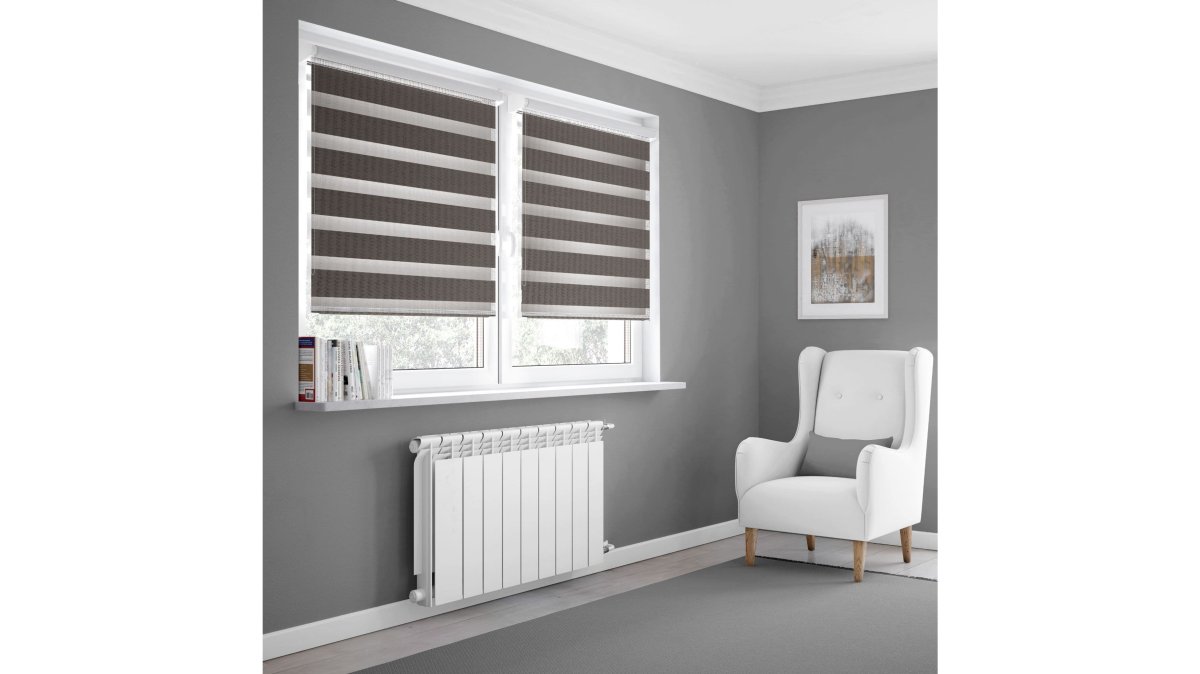
The honest summary: day and night blinds are excellent at flexible light control and daytime privacy, and poor at total darkness. If you want a blackout bedroom, this is not the product.

Pros:
- Adjustable light levels from soft diffusion to near-blockout
- Daytime privacy without losing all your natural light
- Slim horizontal panels suit contemporary style far better than chunky venetians
- Easy cleaning and maintenance: a quick dust with a microfibre cloth
- Made-to-measure sizing keeps the fabric alignment tight
Cons:
- Light still bleeds around the edges, so they are not true blackout
- Night-time privacy depends on closing the panels fully
- Fewer colour options than a plain roller blind
- Fabric alignment must be set correctly at fitting or the effect looks messy
Where They Work Best
Living rooms and kitchens are the natural home. You get glare reduction on a television screen in the afternoon and privacy from the pavement in the evening, without shutting out the day. Bathrooms suit them too, since the fabric resists moisture far better than a fabric Roman. Bedrooms work if you accept filtered rather than total darkness, or pair them with a blackout lining.
Day and Night Blinds vs Roller Blinds
A roller blind is one continuous sheet of fabric: up for light, down for shade. Day and night blinds give you a middle setting a roller simply cannot. That adjustable middle ground is the entire reason to pay for the dual-layer build. But roller blinds are only one alternative, and the honest buying decision usually involves three or four blind types. Here is how day and night blinds compare with the main alternatives across the things that actually matter: privacy, light control, indicative cost, and maintenance.
Day and night vs roller blinds
| Feature | Day and night blinds | Roller blinds |
|---|---|---|
| Light control | Adjustable strips, multiple settings | All or nothing |
| Daytime privacy | Yes, panels offset | Only when fully down |
| Blackout option | Limited | Available as blackout fabric |
| Style | Contemporary, striped | Minimal, plain |
| Cleaning | Dust strips | Wipe fabric |
| Best for | Living rooms, kitchens | Bedrooms needing darkness |
Where a roller wins outright is room darkening. A blackout roller beats any day and night blind for a nursery. Where day and night wins is everyday flexibility, and that is most rooms in most homes.
Day and night vs Venetian blinds
Venetian blinds use rigid horizontal slats, usually aluminium or wood, tilted on a ladder tape or cord. They give fine control over light direction and can be tilted almost closed, but the slats stack into a deep headrail and collect dust on every surface. Day and night blinds use fabric strips rather than rigid slats, so they roll into a slim head box, dust far more easily with a microfibre cloth, and offer a softer, less office-like look.
Day and night vs vertical blinds
Vertical blinds suit wide windows and patio doors, with louvres that slide and tilt. They are the practical choice for a sliding door you need to walk through, because the louvres can be parted. Day and night blinds are made for standard windows and are not designed to be walked through, so for a patio door the vertical blind usually wins on function. For a normal window, day and night blinds give better daytime privacy when partly open and a tidier appearance when raised.
Day and night vs dedicated blackout blinds
A dedicated blackout blind, whether a blackout roller or a blackout pleated blind, is built to exclude light. Day and night blinds filter and soften light but are not a blackout product: light escapes around the edges and through the sheer strips when offset. If total darkness is the requirement, for a nursery, a shift worker's bedroom or a home cinema, choose a blackout blind and accept the loss of the adjustable middle setting. If flexible daylight and daytime privacy matter more, day and night blinds are the better everyday choice.
The practical verdict
There is no single winner. Choose day and night blinds for living rooms, kitchens and home offices where you want adjustable light and daytime privacy without shutting the room down. Choose blackout roller or pleated blinds for bedrooms that must be dark. Choose Venetians where you need to redirect light, and vertical blinds for patio doors and wide glazing.
Day and Night Blinds Privacy at Night
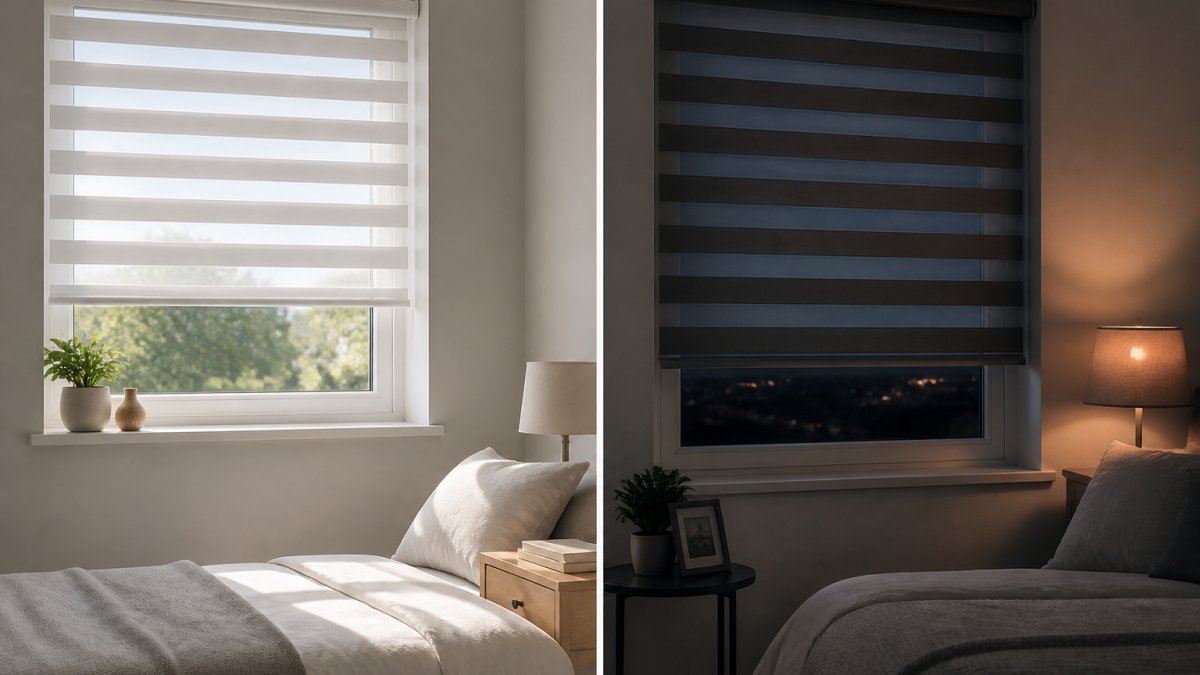
Night-time privacy is the question buyers ask us most, and the answer is more nuanced than a simple yes or no. With the opaque strips fully overlapping, someone outside sees a lit, textured surface rather than your sofa. Offset the strips after dark and a passer-by can see straight in through the sheer sections. That much is straightforward. What determines real-world privacy after dark is a combination of fabric alignment, indoor lighting and window position, and each one changes the answer.
How fabric alignment affects visibility
The closed position works because the opaque strips overlap the sheer ones across the full width of the drop. When the panels are aligned correctly, light from inside the room hits the opaque fabric and is diffused rather than transmitted, so the window reads as a soft glowing panel from the street. The effect depends on the strips lining up precisely: if the blind is slightly out of adjustment, or the fabric has stretched, thin horizontal bands of sheer may remain exposed and a silhouette can be glimpsed through them.
White Day and Night Blinds Made To Measure in Ice White →
The effect of indoor lighting
Bright indoor lighting is the single biggest factor in night-time visibility. A room lit by a strong ceiling light or a television directly facing the window will produce a much stronger silhouette than a room lit by a low lamp. If privacy matters after dark, position lamps away from the window and avoid leaving a bright screen facing the glass. Closing the panels fully at dusk, before the room lights are switched on, is the simplest habit to adopt.
Window position and the edges
Light escapes around the sides and top of any blind, and where light escapes, a silhouette can sometimes be glimpsed. The risk is highest on ground-floor windows facing a street or pavement, where a passer-by is close to the glass and at eye level with the room. It is lower on upper-floor windows, where the angle of view from the street is steeper and the gap around the head box is less visible.
When sheer sections are not enough
Sheer fabric is designed to diffuse light, not to block sightlines. If your window faces a well-lit street, a bus stop or a neighbouring property at close range, the sheer sections may not provide the privacy you expect even when the blind is partly open. In those situations, treat the blind as a daytime privacy product and close it fully after dark, or pair it with a curtain or a blackout lining for the evening.
Day and Night Blinds for Bedrooms
For bedrooms, day and night blinds deliver soft, filtered morning light rather than total darkness. Many parents find that is actually preferable for a child's room, since a completely blacked-out room can make morning wake-ups harder.
Our Grey Day and Night Blinds in Steel Grey at £64.82 suit a calm, modern bedroom, while the Cream Day and Night Blinds at the same price warm up a softer scheme. Both come with a child safe control cleat, which matters in any room a child sleeps in.
Measuring, Fitting and Child Safety
Measure the recess width in three places, top, middle and bottom, and order to the narrowest figure. Do the same for the drop. A blind ordered to the widest measurement will bind against the walls.
Fitting is a two-bracket job: mark, drill, screw, clip the head box in, then set the chain tension. Allow an hour for a first attempt.
On child safety, UK regulations require blinds sold for domestic use to have no accessible looped cords or chains.
Cost and Made-to-Measure Options
Made-to-measure day and night blinds start at £64.82 across our range, whether you choose Ice White, Sand or Black. That is a trade-price build sold direct, not a stock size cut down.


On total cost of ownership, the calculation is simple: a made-to-measure blind fitted correctly lasts years, while a cheap stock blind that gaps at the edges gets replaced.
The British Blind and Shutter Association publishes guidance on measuring and child safety that is worth reading before you order. For broader context on window treatments and energy performance, GOV.UK sets out how window coverings affect home energy use.
Frequently Asked Questions
What are the disadvantages of day and night blinds?
The main drawbacks are that they are not true blackout blinds, so light still enters through the sheer strips and around the edges. Corded versions need careful handling around children, although many now come with child-safe cleats. They also cost more than a basic roller blind, with made-to-measure day and night blinds starting around £64.82.
Are day and night blinds good for privacy?
Yes, when the opaque and sheer strips are aligned in the closed position, they block the view into a room during the day. At night, the effect reverses: with a light on inside, silhouettes can be visible through the sheer strips. Closing the blind fully and using a lined or blackout version improves night-time privacy. For a bedroom or bathroom, check the fabric density before ordering.
Can you see through day and night blinds at night?
You can see shapes and movement through the sheer strips if a room is lit inside and it is dark outside. The opaque strips block a direct view, but they do not create total darkness. If night-time privacy is the priority, keep the blind in the closed position after dark and choose a denser fabric. A blackout roller blind behind the day and night blind gives full coverage.
How much do made-to-measure day and night blinds cost?
At Just Blinds, made-to-measure day and night blinds start at £64.82 per blind in colours including Ice White, Cream, Sand, Steel Grey and Black. Each comes with brackets, a fascia, a two-part aluminium bottom rail and a child-safe control cleat. Free delivery applies on orders over £175. Prices depend on window size, so measure carefully before ordering.
Choosing blinds is really a question of what you need the window to do: flex with the day, or shut it out entirely. If flexibility is the goal, our made-to-measure day and night blinds deliver adjustable light control, daytime privacy and a clean contemporary look, all with child safe controls and free delivery over £175. Browse the full range at Just Blinds and order your fabric samples first.
