
Table of Contents
- Roller Blinds vs Roman Blinds: The Key Differences at a Glance
- Appearance, Style, and How Each Blind Suits Your Home
- Light Control, Privacy, and Blackout Roller Blinds
- Thermal Insulation, Energy Efficiency, and Running Costs
- Best Blinds for Bedrooms: Blackout and Child Safety
- Blinds for Kitchens: Moisture, Grease, and Easy Cleaning
- Cost, Fabric Choice, and Total Cost of Ownership
- Installation, Measuring, and Window Compatibility
- Frequently Asked Questions
Last Updated: October 15, 2026
Roller Blinds vs Roman Blinds: The Key Differences at a Glance
Choosing between roller blinds vs roman blinds pros and cons comes down to one question: do you want a clean, compact covering that disappears into the top of the window, or a soft, layered one that becomes part of the room's look? At Just Blinds, we make both styles to measure, and the honest answer is that neither wins outright. Roller blinds suit busy rooms, tight recesses and wet spaces. Roman blinds suit period properties, large windows and rooms where fabric matters as much as function.
Here is the short version before we break it down room by room:
| Feature | Roller Blinds | Roman Blinds |
|---|---|---|
| Appearance | Flat, modern, minimal | Soft folds, decorative, traditional |
| Light control | Precise, easy to set at any height | Good, but stacks in folds |
| Blackout options | Widely available | Available with lining |
| Thermal insulation | Moderate | Better with lined fabric |
| Cleaning | Often wipeable | Usually vacuum or brush clean |
| Starting cost | Lower | Higher |
| Best for | Kitchens, bathrooms, offices, bay windows | Living rooms, bedrooms, period homes |
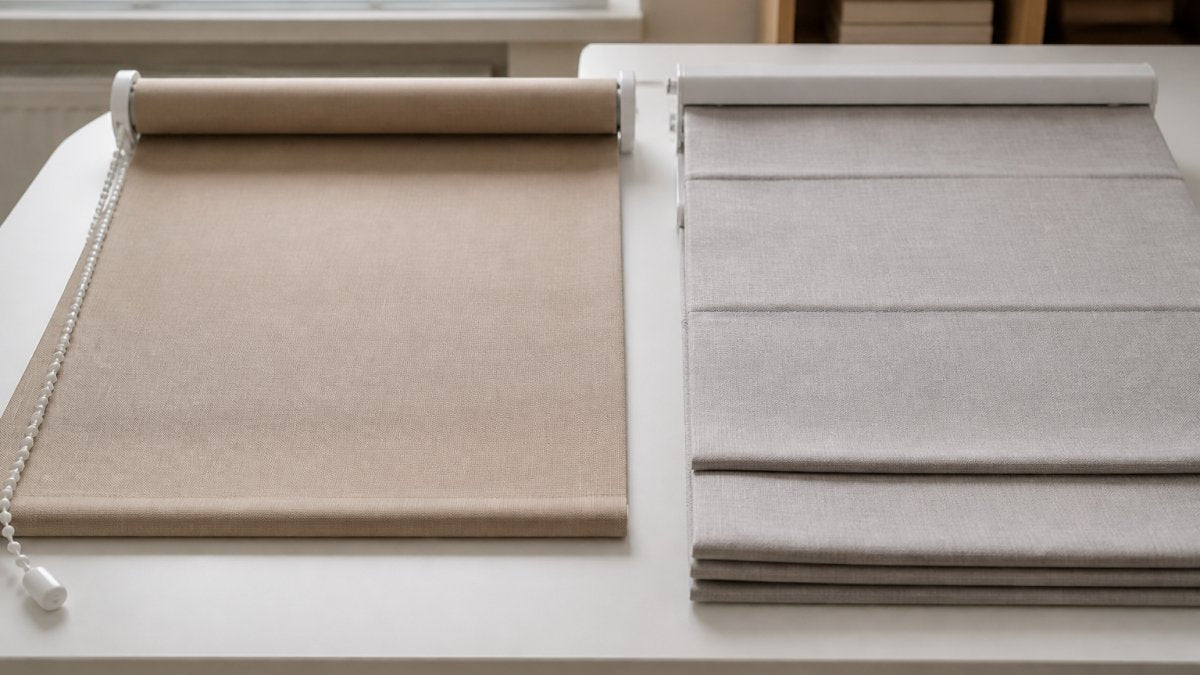
A roller blind is a single flat panel of fabric that rolls around a tube at the top of the window and is raised or lowered by a chain or spring mechanism. A Roman blind is a fabric panel that gathers into horizontal folds as it is pulled up, usually on cords or a chain. Those two mechanisms drive almost every practical difference that follows.
Appearance, Style, and How Each Blind Suits Your Home
Style is where Roman blinds pull ahead, and it is not close. The fabric folds add texture, depth and a sense of warmth that a flat panel simply cannot match. In a period home with high ceilings or a bay window, a Roman blind reads as considered and luxurious.
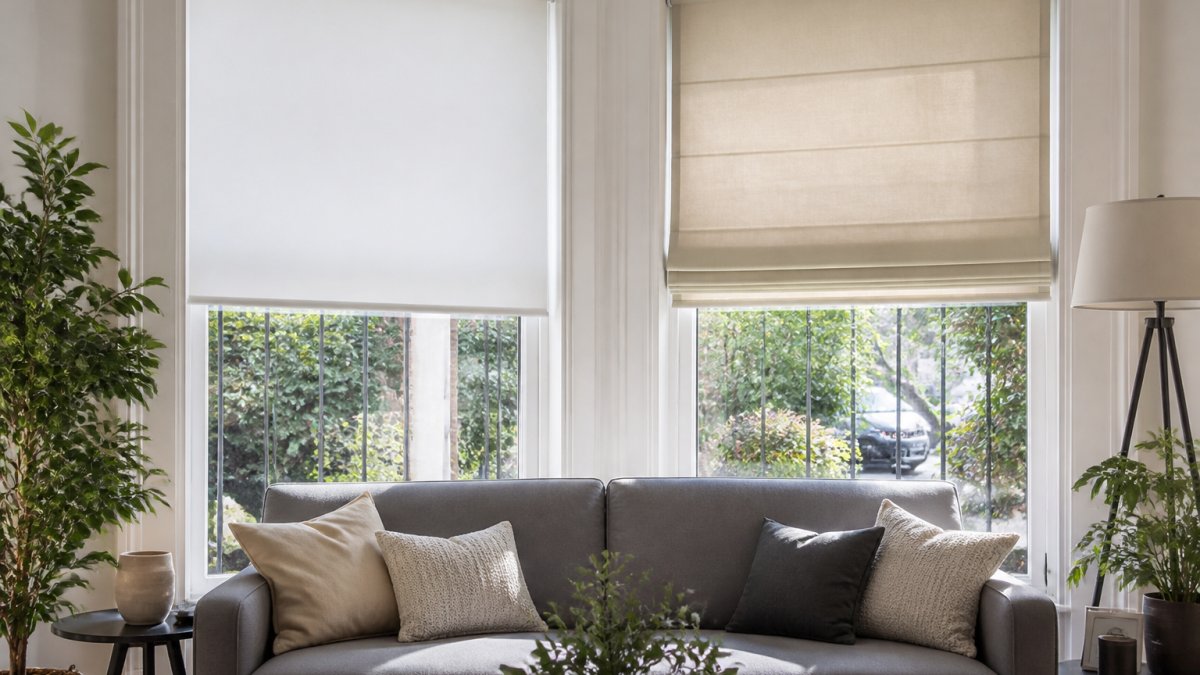
Roller blinds win on versatility. A crisp white roller blind such as our Scope Bare White Roller Blind at £25.64 sits quietly in a modern new build and lets the window do the talking. Where a Roman blind becomes the focal point, a roller blind steps back.

Light Control, Privacy, and Blackout Roller Blinds
Roller blinds give you finer light control. Because the fabric rolls to any height and stays there, you can cut glare off a screen at 10am and still keep the top of the window open. Roman blinds gather into a fixed stack at the top, so the amount of light you let in is less adjustable.
For privacy, both work well when fitted inside the recess. Blackout roller blinds are the more reliable route to a genuinely dark room, because a single flat panel with no folds leaves fewer gaps for light to creep through. Roman blinds can be lined for blackout, but the folds create more edges for light to catch.
Thermal Insulation, Energy Efficiency, and Running Costs
Insulation is where the two styles diverge most, and the difference comes down to three variables: fabric thickness, the air trapped between the blind and the glass, and how tightly the blind seals around the window.
How a Roman blind insulates. A lined Roman blind is effectively two layers of fabric with an interlining between them. When lowered, the horizontal folds create a series of trapped air pockets, and still air is a poor conductor of heat.
How a roller blind insulates. A roller blind is a single flat panel. It has no folds to trap air, so its insulation value comes almost entirely from fabric weight and from how well the sides and bottom seal. A standard lightweight roller blind offers modest resistance.
What actually drives performance. In practice, the fit matters more than the style:
- Inside the recess, the blind sits in the window opening, reducing the cold-air gap. Best for heat retention on both styles.
- Outside the recess, the blind hangs over the wall, leaving a larger pocket of cold air behind it. Looks neater on some windows but insulates less.
- Side gaps, a blind narrower than the recess lets warm air escape around the edges. Side channels or a face-fixed blind wider than the opening reduce this.
- Bottom gap, a blind that stops short of the sill leaves a direct path for draughts. A bottom bar or a sill-level drop closes it.
Running costs. Neither blind is a substitute for double glazing, cavity wall insulation or draught-proofing. Treat them as a supplementary layer.
Summer performance. The same properties work in reverse. A light-coloured roller blind reflects some solar gain and keeps a south-facing room usable without relying on fans or air conditioning. A Roman blind with a reflective lining does the same job, but the folds can trap warm air against the glass if the blind is left partly raised.
Best Blinds for Bedrooms: Blackout and Child Safety
Blackout roller blinds are the best choice for most bedrooms and nurseries. A single flat panel blocks light more completely than folded fabric, and it takes up almost no space, which matters in smaller rooms.
Our Como Bare White Blackout Roller Blind at £26.53 delivers total light block and comes with a child safe control cleat, so the cord is kept tidy and out of reach.

Child safety is worth taking seriously with either style. Roman blinds use cords and chains to operate, and any looped cord is a hazard in a child's room. Roller blinds with a cleat, or a spring-operated version, remove that risk. If you want a Roman blind in a nursery, ask for a tensioned or motorised system rather than a loose cord.
Blinds for Kitchens: Moisture, Grease, and Easy Cleaning
Roller blinds are the practical winner in kitchens and bathrooms. Steam, splashes and cooking grease are hard on fabric, and a wipeable roller blind handles all three with a quick cloth.
PVC roller blinds are the standout here. Our PVC Blackout Plain White Roller Blind at £26.53 uses a waterproof, wipeable fabric that suits kitchens, bathrooms and conservatories. It also blocks light, which is useful in a south-facing kitchen.
Scope Bare White Roller Blind →

Roman blinds can work in a kitchen if you choose a fabric with some moisture resistance and clean it regularly, but grease settles into folds and is far harder to remove. A common mistake is fitting an unlined decorative Roman blind above a hob. It will look tired within a year.
Cost, Fabric Choice, and Total Cost of Ownership
Roller blinds cost less up front. Our roller blinds start at £25.64, while Roman blinds cost more because they use more fabric, a lining, and a more complex headrail and cord system.
But the purchase price is only part of the story. Here is how the two styles compare over their working life:
| Cost factor | Roller blinds | Roman blinds |
|---|---|---|
| Starting price | From £25.64 | Higher, more fabric and mechanism |
| Cleaning | Often wipeable; a damp cloth is usually enough | Vacuum or brush clean; deeper cleaning may need a specialist |
| Replacement fabric | Simple to swap; the mechanism is reusable | More involved; the headrail and cords are usually replaced with the fabric |
| Motorisation | Widely available; adds to the up-front cost | Available; usually a larger premium because of the lifting mechanism |
| Likely lifespan | Long, with few moving parts | Long, but cords and folds are the first things to show wear |
| Installation | Straightforward DIY for most windows | Straightforward, but the folded stack needs clearance |
Cleaning costs. A wipeable roller blind, such as our PVC range, can be cleaned in place with a cloth and a mild detergent.
Replacement costs. When a roller blind fabric wears out, the mechanism is usually fine and only the fabric needs replacing. A Roman blind is more likely to need the whole unit replaced because the cords, rings and headrail are integral to how it hangs.
Motorisation. Both styles can be motorised. Roller blinds are the simpler and cheaper conversion because the tube motor replaces the chain mechanism directly. Roman blinds need a motor that can handle the lifting cords, which typically costs more.
Fabric choice. Textured and decorative fabrics suit Roman blinds, where the folds show off the weave. Roller blinds favour cleaner, plainer fabrics that read well as a single panel.
A note on cheap Roman blinds. The lowest-priced Roman blinds often use lightweight fabric and a basic cord system. They can look tired within a year or two, especially in a kitchen or a sunny room.
Installation, Measuring, and Window Compatibility
Installation is similar for both, but the recess matters. Roller blinds need very little depth because the fabric rolls tight against the tube, so they fit shallow recesses that a Roman blind cannot. Roman blinds need enough room for the folded stack at the top, which can block part of the glass on a short window.
Measuring is where most problems start. Measure the recess width in three places and use the smallest figure, then check the drop. A made-to-measure blind removes the guesswork. All our roller blinds come complete with brackets for fitting to a door, a window or inside a recess, and we deliver anywhere in the UK.
For bay windows, roller blinds are usually easier to fit because each panel stays flat and independent. Roman blinds can work in a bay, but the folds need careful spacing on angled sections.
Roller blinds and Roman blinds both do a good job, but they solve different problems. Roller blinds win on light control, moisture resistance, cost and tight spaces. Roman blinds win on style, warmth and the way they soften a room. If you are weighing up roller blinds vs roman blinds pros and cons for your own windows, Just Blinds makes both to measure, with blackout options, wipeable PVC fabrics, child safe controls and free delivery on orders over £175.
Frequently Asked Questions
Do Roman blinds look better than roller blinds?
Roman blinds usually win on looks because their fabric folds add depth and a decorative, textured feel that suits period homes and traditional interiors. Roller blinds are cleaner and more modern, which works well in new builds and minimal schemes. If style is your priority, Roman blinds often look more luxurious; if you want a neat, unobtrusive finish, roller blinds are the better choice.
Which is better for blackout: roller blinds or Roman blinds?
Roller blinds are generally better for blackout because blackout roller blinds use a single tight fabric panel that sits close to the window, reducing light creep. Roman blinds can be lined for blackout but the folds and side gaps let more light through. For nurseries and shift workers, blackout roller blinds are the more reliable option.
Are Roman blinds more expensive than roller blinds?
Roman blinds typically cost more than roller blinds because they use more fabric and a more complex folding mechanism. For example, a made-to-measure roller blind can start around £25.64, while Roman blinds with similar fabric and lining often cost significantly more. The gap widens if you choose bespoke fabrics, blackout linings, or professional fitting.
Are roller blinds easier to clean than Roman blinds?
Yes, roller blinds are easier to clean. Their flat fabric can be wiped or dusted quickly, and PVC roller blinds are waterproof and wipeable, which suits kitchens and bathrooms. Roman blinds trap dust in their folds and often need professional cleaning or careful vacuuming. If low maintenance matters, roller blinds are the simpler choice.
Which type of blind is best for a small room?
Roller blinds are usually best for small rooms because they take up little space, sit close to the glass, and do not add bulk. Roman blinds can make a small room feel cosier but their folded fabric can crowd a narrow window. If you want to maximise light and space, choose roller blinds; if you want warmth and texture, Roman blinds can still work with a light fabric.
