
Table of Contents
- Why Roller Blinds for Skylights Beat Other Options
- Types of Skylight Blinds: Roller, Pleated and Venetian
- How to Measure Skylight Blinds Without Getting It Wrong
- How to Fit Skylight Blinds: Step-by-Step
- Blackout Skylight Blinds for Bedrooms and Nurseries
- Manual, Electric and Battery-Powered Operation Compared
- Costs, Compatibility and What to Check Before You Buy
- Conclusion
- Frequently Asked Questions
Last Updated: October 16, 2026
Why Roller Blinds for Skylights Beat Other Options
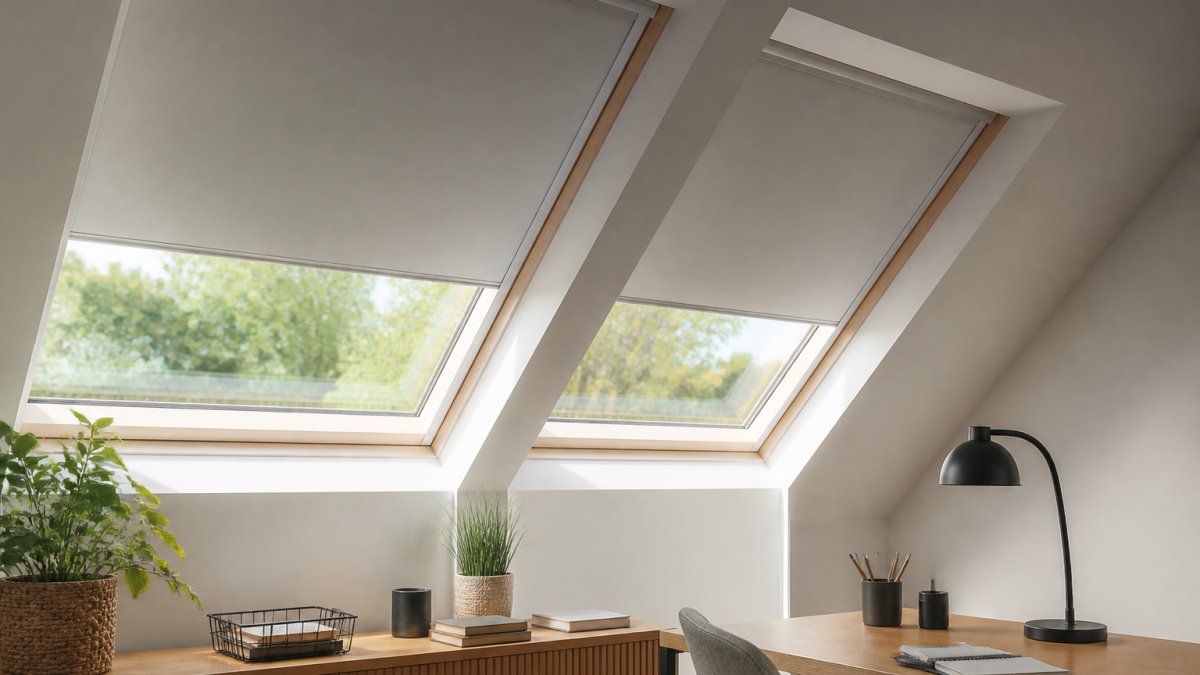
Roller blinds for skylights solve the problem that makes roof windows tricky: they sit close to the glass, run on side channels, and stop light exactly where you want it. At Just Blinds, we make made-to-measure roller blinds for roof windows, and this guide covers measuring, fitting and buying.
Angled windows let in far more daylight than vertical ones, wonderful in a kitchen, less so at 5am in a bedroom. That light arrives with heat: in summer an unshaded roof window can make a loft conversion the warmest room in the house, and in winter the same glass loses heat faster than an insulated wall.
Roller blinds address both problems because they sit in a frame that hugs the window. Side channels hold the fabric flat against the glass, leaving little gap for light to leak around or warm air to escape. Pleated and Venetian styles work, but roller blinds give the cleanest line and simplest operation.
Light Control, Heat and Glare in Angled Windows
The angle is the whole story. A roof window faces the sky, so it catches direct sun for more of the day than a vertical window, more glare on screens, more fading on furniture, more heat gain in the afternoon.
A roller blind dials that down in seconds: pull it partway to keep the view while cutting glare, or fully for near-total darkness. For anyone working under a roof window, that control matters more than the fabric pattern.
Types of Skylight Blinds: Roller, Pleated and Venetian
Roller blinds are the best all-round choice for roof windows: widest range of fabrics, tightest fit against the glass, simplest mechanism. Pleated and Venetian options suit narrower use cases.
Here is how the three compare:
| Type | Best For | Light Control | Maintenance |
|---|---|---|---|
| Roller | Most rooms, blackout needs | Excellent | Wipe clean |
| Pleated | Decorative finish, soft look | Good | Dusting needed |
| Venetian | Fine adjustment, day-to-day | Good | Regular dusting |
Roller Blind Options for Roof Windows
Within roller blinds, the main choice is fabric. Blackout fabric blocks light completely, suiting bedrooms and nurseries. Light-filtering fabric softens daylight while keeping the room bright, suiting kitchens, landings and offices.
You also choose hardware colour: our roof blinds come with anodised silver or white profiles to match existing window furniture. Both use an assisted cord tension system that keeps the fabric taut and stops it flapping when the window is open.

How to Measure Skylight Blinds Without Getting It Wrong
Measuring is where most orders go wrong, and it is the step you cannot undo. Check your window's code plate before ordering.
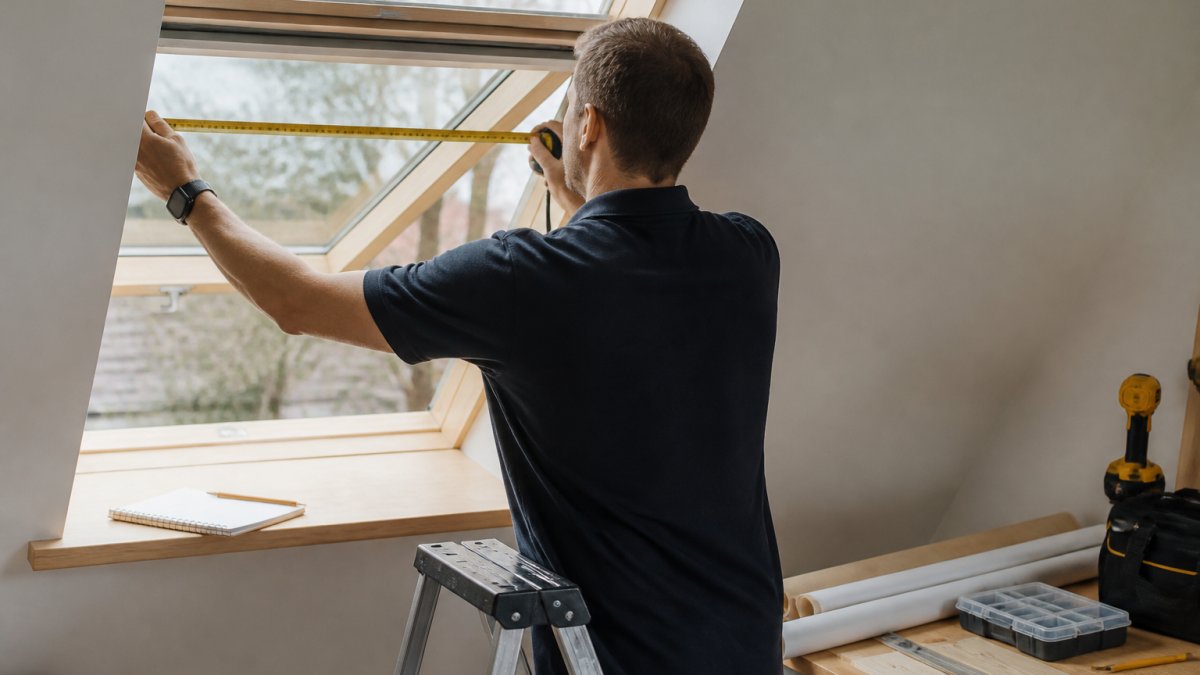
Work through it in this order:
- Open the window fully so you can reach the frame
- Measure the width of the glass at the top, middle and bottom
- Measure the height of the glass on both sides
- Note the smallest width and smallest height
- Photograph the code plate for reference
- Write down your window model before ordering
If the three width readings differ, use the smallest. A slightly narrow blind still fits; one that is too wide will not seat in the side channels.
Finding Your Window Code and Model
Every roof window carries a code plate, usually at the top or side of the frame, though it varies by model and age. Example codes include GGL M08 or CK01.
That code tells you the size and model, which is how you match a compatible blind. If you cannot find the plate, contact the supplier. Getting this right first time is far cheaper than returning a made-to-measure blind.
How to Identify Your Roof-Window Model and Choose a Compatible Blind
Compatibility is the biggest source of returns on roof-window blinds. Here is a walkthrough that works for current and older windows.
Step 1: Find the code plate. Usually on the top or side of the frame, sometimes behind the open sash. On older windows it may be a metal plate, sticker, or stamped into the frame.
Step 2: Read the code. Codes combine a model prefix and a size code: GGL or GGU indicates a model family, and the following characters (M08, CK01, 78) indicate size. Meaning varies by manufacturer, so check the supplier's compatibility list rather than guessing from the prefix.
Step 3: Match the code to a blind. Most suppliers publish a compatibility table mapping prefixes and size codes to the correct blind.
Step 4: Handle older or discontinued windows. If your window predates the current range, the code plate may be missing, faded, or in a format the supplier no longer lists. Then:
- Measure the frame opening width and height at the points where the side channels will sit
- Note the frame profile, whether it is flat, chamfered, or has an existing accessory groove
- Photograph the frame from the inside and outside
- Send these details to the supplier before ordering
Measuring for a Made-to-Measure Blind
Made-to-measure means your measurements, so double-check them. Use a metal tape measure, not fabric, and measure in millimetres. If unsure, order a fabric sample first to check colour and light control in your own room.
For a made-to-measure blind, the supplier will usually ask for:
- Frame opening width (the smallest of your three width readings)
- Frame opening height (the smallest of your two height readings)
- Window model code, if you have it
- Hardware colour preference (silver or white)
If you cannot find the plate, contact the supplier with your measurements. Getting this right the first time is far cheaper than returning a made-to-measure blind.

How to Fit Skylight Blinds: Step-by-Step
Fitting a roof blind is a short job: on our Velux-compatible range it is drill-free apart from four screws, needing a screwdriver, a step ladder and about twenty minutes.
Blackout Roof Blind for Velux Windows – View Chabon, Silver Hardware →
- Open the window and locate the two bracket points on each side of the frame
- Position the side channels and check they sit flush against the glass
- Fix the four screws, two per side
- Clip the roller and fabric into the channels
- Attach the control cord and test the full travel
- Close the window and check the blind clears the frame
Expected result: the fabric runs smoothly top to bottom and stops at any point. If it snags, the channels are not seated evenly, loosen the screws, realign, and tighten again.
Blackout Skylight Blinds for Bedrooms and Nurseries
Blackout skylight blinds are the most effective fix for a bright bedroom, because side channels stop the light creep of a loose-hanging blind. A standard roller leaves a gap at each edge; a channel-fitted roof blind closes it.
Our blackout roof blinds use 100% polyester, 100% blackout fabric and are completely child safe, which matters in a nursery. They also reduce heat loss and heat gain, keeping the room more even year-round.

Manual, Electric and Battery-Powered Operation Compared
Manual operation suits most roof windows. A cord or rod control is simple, reliable and costs nothing to run. Where a window sits out of easy reach, electric and battery-powered options take over.
| Operation | Best For | Power Source | Running Cost |
|---|---|---|---|
| Manual cord | Reachable windows | None | None |
| Battery-powered | Retrofit, awkward spots | Rechargeable cells | Charging only |
| Electric | Vaulted ceilings, multiple windows | Mains | Minimal |
Battery Life, Charging and Remote Control
Battery-powered roof blinds typically run on rechargeable lithium cells or standard AA batteries. A full charge commonly lasts several months with normal daily use, once or twice a day, and longer with occasional adjustment. Heavy use, such as a south-facing window adjusted multiple times daily, drains it faster.
Most battery models charge via USB or a small solar panel on the window, taking a few hours, often with the blind left in place. If the window is high, check whether the charging port is reachable from a step ladder or whether the model has a detachable battery pack.
Remote control is standard on most electric and battery models, and one remote can usually operate several blinds, useful in a vaulted room with multiple roof windows. Some support wall switches or app control; check compatibility before buying if you want smart-home integration.
Accessibility and Child-Safe Operation
High or hard-to-reach roof windows are the main reason people choose electric or battery operation. If you cannot comfortably reach the cord from the floor, a manual blind becomes a daily chore, or a reason to leave it in one position all year.
For windows above a staircase, over a bed, or in a vaulted ceiling, a remote or wall switch is safer than climbing. Telescopic rods extend a manual blind's reach but still require standing directly under the window and applying pressure.
Child safety is separate. Cords on manual blinds should be kept out of reach, and many suppliers offer cordless or tensioned systems that remove the loop entirely. Electric and battery blinds have no hanging cord, making them common in nurseries and playrooms. In a child's room, check the model meets current safety standards and any cord is tensioned or secured.
Choosing Between Manual, Battery and Electric
Quick decision guide:
- Manual cord or rod: the window is within easy reach, you adjust it occasionally, and you want the lowest cost and simplest maintenance.
Whichever you choose, confirm the control method suits your window model before ordering. A blind that fits but cannot be operated comfortably will not get used.
Costs, Compatibility and What to Check Before You Buy
Our blackout roof blinds for Velux windows are £55.63, a fraction of original manufacturer blinds. Every order is made to measure, with free delivery on orders over £175.
Before you buy, confirm three things:
- Window model: check the code plate and match it to the blind's compatibility list
- Size: made-to-measure means your measurements, so double-check them
- Hardware colour: silver or white profiles, to match your window furniture
We also supply replacement blind slats compatible with most rails, including Hilarys, Argos and Dunelm, so you can refresh an existing blind without replacing the fitting.
Conclusion
Getting roller blinds for skylights right comes down to three things: an accurate measurement, the correct window code, and a fabric that matches the room. Skip one and you will live with the compromise for years.
At Just Blinds, we make made-to-measure roof blinds with blackout fabric, anodised silver or white hardware, and drill-free fitting that takes four screws. Delivery is free on orders over £175, and our blackout roof blinds for Velux windows start at £55.63.
Shop now with Just Blinds and get a roof window blind that fits the first time.
Frequently Asked Questions
Can you get roller blinds for skylights?
Yes. Roller blinds made specifically for roof windows are widely available, including blackout skylight blinds designed to fit Velux windows. They run on side channels so the fabric stays taut on an angled surface, and many models let you stop the blind at any point for precise light control. Standard upright roller blinds will not work because they rely on gravity and cannot hold position on a slope.
How do you measure a skylight for a roller blind?
For Velux windows, open the window and find the code plate at the top or side; example codes include GGL M08 or CK01. That code tells you the exact model and size, which is more reliable than measuring alone. Made-to-measure skylight blinds remove the guesswork entirely.
Are blackout roller blinds suitable for skylights?
They are the best choice for bedrooms, nurseries and any room where you need total darkness. Blackout skylight blinds use a 100% polyester, 100% blackout fabric that blocks light, reduces heat loss and heat gain, and provides privacy. Because roof windows sit directly above the bed, a blackout roller blind with side channels keeps light from creeping around the edges, which a standard fabric blind cannot do.
Do skylight blinds need to be made to measure?
In most cases, yes. Roof windows come in many sizes and models, and a blind that is even a few millimetres out will leave gaps or fail to clip into the side channels. Made-to-measure skylight blinds are cut to your exact window code and model, so the fabric runs edge to edge. Off-the-shelf sizes rarely match non-standard or older windows, and returns on wrongly sized blinds are usually at your own cost.
