

Quick Summary
Motorised vertical blinds work with a smart home when a motor, control hub or wireless link lets your existing system open, close and adjust the slats on a schedule or by voice. Choose a connection type that matches your smart-home platform before you buy, because the hub you already own may not support the motor's protocol.
- Wi-Fi motors join your router directly, so no separate hub is needed.
- Bluetooth range is typically around 10 m in open air, less through walls.
- Zigbee suits multi-window installations because it meshes well across a house.
- Confirm your existing track and headrail width before ordering a replacement.
- Buy the motor and hub from the same ecosystem to avoid a stalled install.
Table of Contents
- What Makes Motorised Vertical Blinds Work With a Smart Home
- Smart Blind Hub Compatibility: What You Need Before You Buy
- Smart Blinds Compatible with Alexa and Google Home
- Home Assistant Blinds Integration for Advanced Setups
- Automated Vertical Blinds: Control Options Compared
- Fitting, Track Compatibility and Running Costs
- Choosing Your Motorised Setup and Next Steps With Just Blinds
- Frequently Asked Questions
What Makes Motorised Vertical Blinds Work With a Smart Home
Last Updated: November 1, 2026
Motorised vertical blinds work with a smart home when a motor, a control hub or a wireless link lets your existing system open, close and adjust the slats on a schedule or by voice. Just Blinds supplies made-to-measure vertical blinds and replacement headrails, so you can choose the control method before you think about the smart-home side.
Here is the short version of how these systems connect:
- Wand control headrails use a rotating wand. Our replacement wand-control headrail is listed in our range.
- Cord and chain headrails use a pull system, which suits manual operation and simple replacements.
- **
Vertical blinds suit wide patio doors, large windows and rooms where light and privacy need to change throughout the day.
Smart Blind Hub Compatibility: What You Need Before You Buy
Most motorised blinds need a hub or bridge before they talk to your smart home app, and the hub you already own may not match the protocol the motor uses. Check the blind's connectivity specification against your current smart-home platform before ordering.
Our replacement headrails are available with a wand or cord and chain control system, so start by confirming which control type your fitted track uses. For a wand-controlled setup, the replacement headrail with wand control is available.

The four connection types you will meet
Motorised vertical blinds reach a smart home in one of four ways, and each has a different hub requirement:
- Wi-Fi (2.4 GHz), the motor joins your router directly, so no separate hub is needed. This is the simplest route for a single room, but each motor occupies an IP address and Wi-Fi motors are usually the most expensive per unit.
- Bluetooth, the motor pairs with a phone or a Bluetooth-to-Wi-Fi bridge. Range is short (typically around 10 m in open air, less through walls), so it suits one window controlled from one room rather than a whole house.
- Zigbee, the motor joins a mesh network and needs a Zigbee coordinator, such as a dedicated hub or a compatible smart-home controller. Zigbee is low-power and meshes well across a house, which makes it the common choice for multi-window installations.
- Proprietary radio (often 433 MHz or 868 MHz), the motor talks only to its manufacturer's own remote or bridge. It works reliably but locks you into that brand's app and hub.
Match the protocol to the platform you already run
Before buying, write down what your smart-home platform can already speak:
- Amazon Alexa and Google Home are voice front-ends, not radios. They control a blind only after the blind's own app or hub has exposed it, so the underlying protocol still has to be supported.
What to confirm before you order
- Measure your track carefully, because a replacement headrail must match the size of your existing track.
A short compatibility matrix is the fastest way to see where a motor will and will not fit:
| Motor connection | Hub or bridge needed | Works with Alexa/Google | Works with Home Assistant | Local control possible |
|---|---|---|---|---|
| Wi-Fi | None (router only) | Yes, via the brand app | Yes, via integration | Usually yes |
| Bluetooth | Phone, or Bluetooth-to-Wi-Fi bridge | Yes, via the bridge | Yes, with a Bluetooth adapter | Yes, within range |
| Zigbee | Zigbee coordinator or hub | Yes, via the hub | Yes, natively | Yes |
| Proprietary radio | Manufacturer's own bridge | Yes, via the bridge | Sometimes, via a community integration | Depends on the bridge |
| Matter | None beyond a Matter controller | Yes | Yes | Yes |
Use the matrix as a filter: if a motor's row does not tick the platform you actually run, the blind is not the right buy regardless of how well it suits the window.
Smart Blinds Compatible with Alexa and Google Home
Voice control is the feature most people ask about, so it is worth testing the pairing with your assistant before you commit to a full installation. Expect a short delay between a spoken command and the blind moving, since most systems send the instruction through a cloud connection first.
Home Assistant Blinds Integration for Advanced Setups
For a more hands-on smart home, Home Assistant lets you build automations that combine blinds with sunlight sensing, schedules and presence detection. Integration usually depends on the motor's supported protocol, so confirm that Home Assistant can read it before buying. Maintaining a consistent connection requires stable smart home hubs to ensure that your automated blinds respond reliably to every command.
This route suits people who want custom rules, such as closing vertical blinds when the afternoon sun hits a west-facing window. It also suits a mixed setup where blinds, lights and heating share one control dashboard.
Automated Vertical Blinds: Control Options Compared
Choosing between wand, cord and motorised control affects cost, safety and how easily you can add automation later. Wand control is the most practical option for households with children, while cord control is the simplest to replace.
Replacement Vertical Blind Headrail (Wand Control) →
| Control type | Best for | Smart-home readiness |
|---|---|---|
| Wand control | Homes with children, daily use | Good, with a compatible motor |
| Cord and chain | Simple replacements, manual use | Limited without a retrofit motor |
| Motorised drive | Full automation, voice and app control | Strongest, needs a hub or bridge |
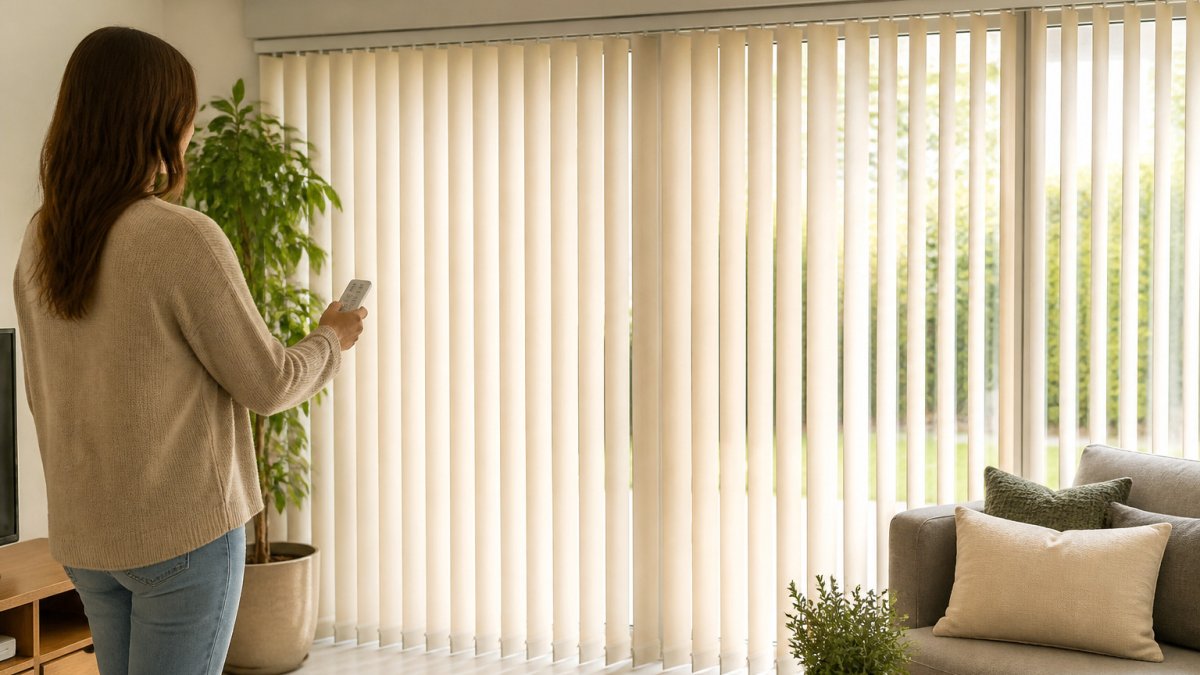
A person in a bright living room using a smartphone to adjust a set of cream vertical blinds, with sunlight coming through the window.
Fitting, Track Compatibility and Running Costs
Track and headrail compatibility matters, so measure the existing track before you buy a new headrail.
Which vertical-blind tracks can be automated
Vertical blinds hang from a headrail that carries a track, a set of carriers (the small trolleys that hold each slat), and a control mechanism.
- Wand-control headrails, the wand rotates a gear that turns the slats and a separate cord or chain draws them across.
- Cord-and-chain headrails, the cord tilts the slats and the chain draws them.
If you are replacing an old headrail, a cord and chain headrail suits a like-for-like swap on a manual setup. Keep the child-safety question in mind too, and consider our child safe blind device.

The measurements that decide fit
Before ordering a motor or a new headrail, record:
- Headrail width, the full width of the track, measured at the top, not the width of the fabric.
- Number and spacing of carriers, carriers are spaced to suit slat width.
- Slat width and drop, the size of your slats and window.
- Control side, which end of the headrail the wand or cord sits on.
When a full replacement beats a retrofit
A retrofit motor is usually the cheaper route when the existing headrail is in good condition, the profile is on the motor maker's compatibility list, and the carriers run freely. A full replacement is the better call when the headrail is old or bent, the carriers stick, the profile is unknown, or you want a guaranteed match between motor, track and carriers. For a wide patio door with heavy slats, a factory motorised headrail is often the more reliable long-term choice.
Running costs to budget for
Running costs come mainly from the motor's power source and the hub's energy use:
- Battery-powered motors need periodic charging or replacement. Rechargeable lithium packs are the common choice; budget for a spare pack or a charging routine, and note that a motor working heavy slats will drain faster.
- Mains-powered motors draw a small constant amount of electricity and avoid battery changes, but need a power point near the headrail, which may mean an electrician if none exists.
- Solar-assisted motors top up the battery from a small panel on the window, which suits bright windows but not shaded or north-facing ones.
- The hub draws a small continuous amount, and a mesh network of several motors adds to that total.
Add installation to the budget as well. DIY fitting is realistic for a like-for-like headrail swap; professional fitting is worth budgeting for when the headrail is being replaced, the window is wide, or mains power needs running to the blind.
Choosing Your Motorised Setup and Next Steps With Just Blinds
Start by deciding which control method suits your home, then check the track and hub requirements before you order. Wand and cord systems remain practical for manual use.
Our made-to-measure range includes options such as the Cameo Cream vertical blind, which you can order to your exact window size. Measure carefully and order a set that fits your track. Just Blinds can help you choose the right headrail and vertical blind for your window.

Frequently Asked Questions
Can motorised vertical blinds connect to a smart home system?
Yes, many motorised vertical blinds are designed to connect to smart home systems. Some products list compatibility with Apple Home, Amazon Alexa, Google Home and Samsung SmartThings, while others advertise support for IFTTT and Tuya-based apps. Before buying, check the exact platforms the motor supports, because compatibility varies between products. Confirm whether a hub or bridge is required for your chosen system.
Do motorised vertical blinds need a hub?
It depends on the motor and the platform you plan to use. Some motorised vertical blinds connect directly to Wi-Fi, while others use a radio-frequency or Bluetooth connection that needs a separate hub or bridge to link with your smart home app. Check the product listing for hub requirements before purchase, and confirm that the hub supports the ecosystem you already use.
Can existing vertical blinds be automated?
Replacement headrails are available in wand control and cord and chain control versions. Measure your current track carefully before buying. Just Blinds replacement headrails start from £11.00 for cord and chain and £21.84 for wand control.
What should I check before buying smart motorised vertical blinds?
Made-to-measure vertical blinds from Just Blinds start from £4.92 per blind. Confirm the fitting requirements for your windows, and choose a cord and chain or child safe wand control system with safety in mind for households with children.

