
Last Updated: October 31, 2026
Quick Summary
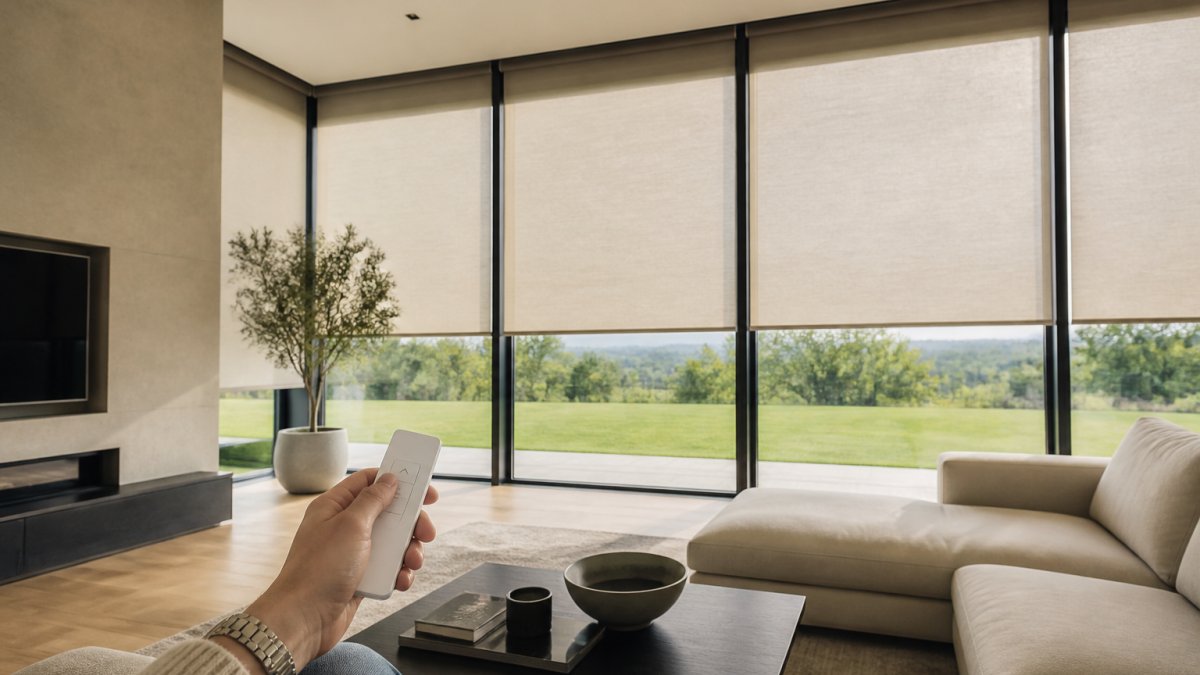
Motorized blinds for large windows do the lifting a cord or wand cannot manage comfortably, handling the real weight and span of oversized glazing. Synchronised operation keeps a long run of blinds aligned, while remote, app and voice control manage light, glare and privacy across the whole span at once. On large windows, motorisation is less a luxury than a structural requirement.
- A three-metre-wide, three-metre-drop roller can carry several times the fabric load of a one-metre window.
- Specify synchronisation and batch compatibility at the point of order to stop blinds drifting out of line.
- Battery blinds keep working in a power cut because they carry their own supply.
- Anything above roughly three metres wide is worth professional installation.
- Just Blinds offers free UK delivery on orders over £175.
Table of Contents
- Why Large Windows Need a Different Approach to Window Coverings
- How Do Motorised Blinds Work on Wide or Oversized Windows?
- The Practical Benefits: Light, Glare, Privacy and Comfort
- Motorised Blinds Pros and Cons for Large Glazing
- What Motorised Blinds Cost and What Drives the Price
- Vertical Blinds for Large Windows: Still the Best Fit for Some Rooms
- Installation Constraints, Power Sources and Maintenance
- Choosing Made-to-Measure Motorised Blinds from Just Blinds
- Frequently Asked Questions
Why Large Windows Need a Different Approach to Window Coverings
Large glazing changes the physics of a room: wide windows let in more light, heat and view, and demand coverings that handle real weight and span.
Oversized glazing is where the wrong choice shows up fastest.
On large windows, motorisation is less a luxury than a structural requirement. Below, we break down how these systems work, what they deliver, what they cost, and where a simpler option still wins.
How Do Motorised Blinds Work on Wide or Oversized Windows?
Motorised blinds are window coverings fitted with an electric motor that raises, lowers or tilts the slats via a remote control, wall switch, app or voice command.
A tubular motor sits inside the roller, or a headrail motor drives vertical or Venetian slats. Power comes from mains wiring or a rechargeable battery pack, and a receiver accepts signals from a handset, wall switch or smart-home hub.
Motors, Tracks and Synchronised Operation
Width is the deciding factor. A single motor has a maximum load rating, and a wide window may need a more powerful motor or two blinds working together.
Pairing motors from different batches without checking compatibility can leave blinds drifting out of alignment. Specify synchronisation at the point of order.
If you are weighing power options on large glazing, our guide to alternatives to hardwired smart blinds covers the wireless routes in detail.
What Actually Determines Motor Capacity on a Large Window
On a standard window, motor choice is rarely a talking point. On oversized glazing it is the first decision, because the motor moves the full weight of the blind every time.
Four variables drive the requirement:
- Width and drop: a wider roller needs more torque to turn the tube, and a longer drop adds fabric weight. A three-metre-wide, three-metre-drop roller can carry several times the fabric load of a one-metre window, so motor rating must rise with both dimensions.
- Fabric weight: blackout, thermal and lined fabrics are substantially heavier per square metre than sheers. A motor rated for lightweight fabric may be near its limit with heavy blackout cloth on the same opening.
- Blind type: roller and Roman blinds load the motor mainly through fabric weight and tube friction. Venetian and vertical blinds add slat weight and tilt mechanisms, so the headrail motor drives both lift and tilt. Wide vertical blinds also stack many slats to one side, concentrating load at the end of the run.
Why Synchronisation Matters More Than the Motor Itself
On a single wide window, one correctly rated motor is usually enough. The harder problem is a run of windows, a wall of glazing, a bay, or a set of patio doors, where several blinds need to look like one.
Synchronisation works in one of two ways. Some systems use a single control unit that sends the same command to each motor and relies on internal position tracking to keep them aligned. Others use a group controller that actively coordinates start and stop positions.
If you are weighing power options on large glazing, our guide to alternatives to hardwired smart blinds covers the wireless routes in detail.
Four variables drive how much motor capacity a large window actually needs.
| Variable | What it covers | Effect on motor choice |
|---|---|---|
| Width and drop | Wider roller needs more torque; longer drop adds fabric weight | Motor rating must rise with both dimensions |
| Fabric weight | Blackout, thermal and lined fabrics are heavier than sheers | A motor rated for lightweight fabric may be near its limit |
| Blind type | Roller and Roman load via fabric weight and tube friction | Venetian and vertical add slat weight and tilt mechanisms |
| Fixing and friction | Unlevel headrail or debris-filled track increases effort | Specifying slightly above the minimum is common practice |
The Practical Benefits: Light, Glare, Privacy and Comfort
The everyday payoff is control.
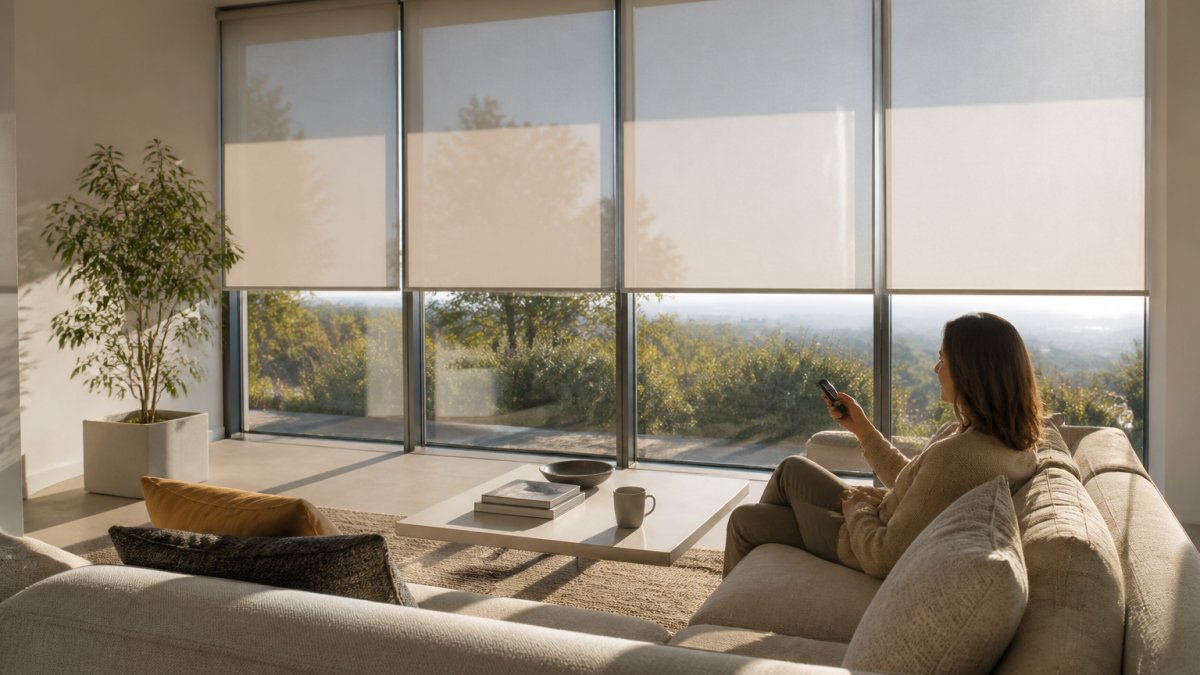
On a wide window, a single remote can lower every blind at once, most useful where glare hits a screen or seating area at a predictable time each day.
Privacy follows the same logic. One command closes the whole run, far quicker than adjusting several separate coverings by hand.
Energy Efficiency, Heat Gain and Insulation
Blinds help manage heat gain and loss at the window, but be realistic. A closed blind reduces direct solar gain and adds a layer of insulation at the glass, but it is not a substitute for double glazing and will not fix a poorly insulated building on its own.
For a fair comparison of where blinds sit against glazing upgrades, see our piece on thermal blinds versus double glazing. If solar heat is your main concern, we also explain whether blackout fabric helps reduce heat.
Motorised Blinds Pros and Cons for Large Glazing
Here is the honest trade-off list. Motorised blinds pros and cons come down to upfront cost and power logistics against daily convenience and safety.
Pros:
- Effortless operation across wide spans, including hard-to-reach windows
- Cordless operation removes a child safety hazard
- Synchronised movement keeps a long run of blinds aligned
Cons:
- Higher upfront cost than manual coverings
- Battery models need periodic recharging; hardwired models need an electrician
- Motor and receiver add a failure point that manual blinds do not have
What Motorised Blinds Cost and What Drives the Price
Motorised blinds cost more than manual equivalents, and the gap widens with size. Pricing depends on width and drop, motor rating, fabric or slat type, power source and whether synchronisation is needed. We do not publish fixed figures because every large window is quoted on its own measurements.
The main cost drivers are worth knowing before you enquire:
- Motor capacity: a heavier, wider blind needs a stronger motor
- Power source: hardwired needs an electrician; battery avoids wiring but adds recharging
- Control type: a basic handset costs less than full smart-home integration
Ask for a full quote that separates hardware, motor and controls so you can see where the money goes.
Vertical Blinds for Large Windows: Still the Best Fit for Some Rooms
Vertical blinds for large windows remain the practical choice for wide patio doors and full-height glazing.
They suit sliding doors, conservatory openings and wide office glazing where you want light control without blocking access. For a direct comparison on patio openings, read our guide to Venetian versus vertical blinds for patio doors.
Where vertical blinds fall short is on very tall windows with a strong view, where a roller or a Roman gives a cleaner line. Match the covering to the opening, not to a trend.
Installation Constraints, Power Sources and Maintenance
Installation is where oversized glazing gets awkward. A wide blind is heavy, the headrail must be fixed into sound material, and the drop must be measured precisely. On very large windows, two people are needed just to lift the unit into place.
Power is the second constraint. Battery-powered blinds avoid wiring entirely and suit retrofits. Hardwired blinds give permanent power but need an electrician and a route to the window.
Mounting and Installation Constraints on Oversized Glazing
The practical problems on a large window are weight, fixing depth and access:
- Fixing substrate: a wide blind pulls on its brackets every time it runs. Plasterboard alone will not hold a heavy headrail reliably, so fixings need to reach timber studs, masonry or a structural lintel. Where the window head has no suitable substrate, a timber batten or purpose-made headrail box is often added first.
- Mounting depth: recessed blinds need enough headroom inside the reveal for the roller or headrail plus motor housing. On shallow reveals, a face-fix outside the recess is usual, but that changes sight lines and should be decided before measuring.
- Wiring access: hardwired blinds need a permanent live feed at the window head, ideally on a fused spur or dedicated circuit. Retrofitting a feed often means lifting flooring or chasing walls, which is why battery options are popular on upper floors and in finished rooms.
Power-Source Trade-Offs: Battery, Mains and Solar
Each power route suits a different situation on large glazing:
- Rechargeable battery packs: the most common retrofit choice. They avoid wiring entirely, but charging frequency depends on blind size and use, a large blind used twice a day needs charging more often than a small one used occasionally. Expect to recharge every few months to roughly twice a year, and check the pack is reachable without removing the blind.
- Replaceable batteries: simpler to swap but usually lower capacity, so they suit smaller or infrequently used blinds better than a wide, heavy roller.
- Hardwired mains: permanent power with no charging routine, and the best choice for a heavily automated run of blinds. The trade-off is the electrician and cable route.
Maintenance and What Happens in a Power Cut
Maintenance on motorised blinds is modest but not zero. Tracks and headrails collect dust, which increases friction and makes motors work harder; a periodic clean with a soft brush is usually enough.
It is also worth knowing what happens when power or connectivity fails. Mains-powered blinds stop where they are during a power cut and resume when power returns. Battery blinds keep working because they carry their own supply.
Accessibility and Control Alternatives
For anyone with limited mobility, or for windows above stairwells and behind furniture, control choice matters as much as the motor. A wall switch at reachable height is often the most reliable option, with a handset as backup and voice control through a smart-home hub for hands-free operation. App control adds scheduling and away-from-home routines, but should sit alongside a physical control rather than replace it, so the blinds still work if the network is down.
Choosing Made-to-Measure Motorised Blinds from Just Blinds
The right system starts with accurate measurements. Just Blinds supplies made-to-measure blinds built to your window's actual dimensions, with free UK delivery on orders over £175.
Our range includes blackout blinds for total darkness in bedrooms and nurseries, moisture-resistant faux wood, and vertical and Venetian blinds. For help ordering the right motorised blinds, read our made to measure blinds buying guide.
Frequently Asked Questions
Do motorised blinds need power?
Yes. Every motorised blind needs a power source, and you have two main choices. Battery-powered blinds run on rechargeable lithium packs and need no wiring, which suits retrofit projects and period homes. Mains-powered blinds are wired into the property's electrical supply and suit new builds or rooms being rewired. For very wide windows, mains power is usually the more dependable option because a single motor can draw more current over long operating cycles. Ask your supplier which setup suits your glazing before ordering.
Are motorised blinds worth it for large windows?
For large windows, the case is stronger than for small ones. Wide or tall glazing is awkward to reach, and manual cords on heavy blinds wear out faster. A motor removes the daily physical effort, keeps slats or fabric aligned across a wide span, and lets you schedule closing for glare or heat. The trade-off is a higher upfront cost than manual blinds. If a window is hard to reach or you open and close it daily, motorised blinds usually earn their place.
Can motorised blinds cover wide or hard-to-reach windows?
They can, provided the system is specified for the span. Wide windows need a motor rated for the weight of the fabric or slats, and very wide openings often need two motors working in sync rather than one oversized unit. Height matters too: a tall window means more fabric to lift, so check the motor's rated load rather than assuming any motor will cope. Made-to-measure suppliers build the blind to your exact opening, which avoids the gaps and sagging that off-the-shelf sizes cause.
Are battery-powered or mains-powered motorised blinds better for large windows?
Mains-powered is generally better for large windows. A wide blind is heavier, so the motor works harder and drains batteries faster, meaning more frequent recharging on a window you may not be able to reach easily. Mains power removes that chore entirely. Battery options still make sense where wiring is impractical, such as a bay window in an older property. Weigh the cost of an electrician against the convenience of never charging a pack again.
Large windows are unforgiving of the wrong covering. If you are ready to specify motorised blinds sized for your glazing, Just Blinds can help you get the measurements and the motor rating right the first time. Get started with Just Blinds and order made-to-measure blinds built for your windows.

