

Table of Contents
- Venetian Blinds vs Vertical Blinds for Patio Doors: Quick Comparison
- What Are Venetian Blinds?
- What Are Vertical Blinds?
- Light Control and Privacy Comparison
- How to Measure Patio Doors for Blinds
- Child Safety Regulations for Window Blinds
- Best Blinds for Sliding Patio Doors: Durability, Maintenance and Costs
- Frequently Asked Questions
Last Updated: September 20, 2026
Venetian Blinds vs Vertical Blinds for Patio Doors: Quick Comparison
Choosing between venetian vs vertical blinds is one of the most common decisions homeowners face when renovating their interiors, especially for patio doors. Both styles offer distinct advantages, and which one suits your needs depends on your priorities for light control, durability, and aesthetic appeal.
This guide breaks down the key differences and helps you decide which option works best for your space.
| Feature | Venetian Blinds | Vertical Blinds |
|---|---|---|
| Light Control | Adjustable tilt for precise diffusion | Full closure or complete openness |
| Privacy | Excellent with angled slats | Excellent when fully closed |
| Best For | Traditional interiors, precise control | Modern spaces, large windows |
| Maintenance | Dust accumulation on slats | Easier to clean, fewer crevices |
| Durability | Depends on material (aluminium lasts longer) | Fabric wears faster in high-traffic areas |
| Starting Price | From £41.95 | From £4.92 |
| Installation | Requires headrail mounting | Track system installation |
What Are Venetian Blinds?
Venetian blinds consist of horizontal slats suspended by ladder strings, controlled by a tilt mechanism that lets you adjust the angle of each slat. When you pull the cord or use the wand, the slats rotate together, allowing you to fine-tune how much light enters and how visible the interior is from outside.
You can tilt them fully open for an unobstructed view, partially closed for filtered light and privacy, or completely shut for total darkness. Aluminium slats are the most durable choice for patio doors because they resist warping, moisture, and dust accumulation better than fabric or wood. Just Blinds offers made-to-measure aluminium Venetian blinds like the Matt Textured White Aluminium Venetian Blind (£41.95) and the Cedar Wood Look Aluminium Venetian Blind (£41.95), both with 25mm slats.


What Are Vertical Blinds?
Vertical blinds hang from a track system at the top of your window, with individual louvres running floor-to-ceiling. Each louvre pivots independently, and the entire set slides left or right along the track. This design makes them ideal for sliding patio doors because the louvres can be drawn completely to one side, opening the full width of the door.
They handle the weight of tall, wide patio doors without sagging. Just Blinds' Cameo Cream Vertical Blinds (89mm) (£4.92) are made from spongeable flatweave fabric and come with either cord control or a child-safe wand system, made to measure for your exact window size.

The louvres are sewn rather than glued, which improves longevity and prevents delamination over time.
Light Control and Privacy Comparison
Venetian blinds offer superior light diffusion because their horizontal slats let you adjust the angle infinitely, from fully open to completely closed. You can filter harsh sunlight while maintaining a clear view outside, or angle the slats upward to bounce natural light toward the ceiling. When closed, very little light or detail is visible from outside, even in bright daylight.
Vertical blinds provide light control through complete closure or full opening. When fully closed, they block most light and offer strong privacy.
Energy efficiency and thermal insulation: Aluminium Venetian blinds conduct heat readily and offer minimal insulation value. Wood Venetian blinds retain heat better but are less durable in moisture-prone patio door environments. Vertical blinds made from dense fabric provide better thermal insulation than aluminium because the fabric traps air pockets. Thermal-lined vertical blind fabrics can reduce heat loss by 10-15% compared to standard fabric, with a payback period of 3-5 years through reduced heating costs. Ask your supplier whether thermal-backed options are available.
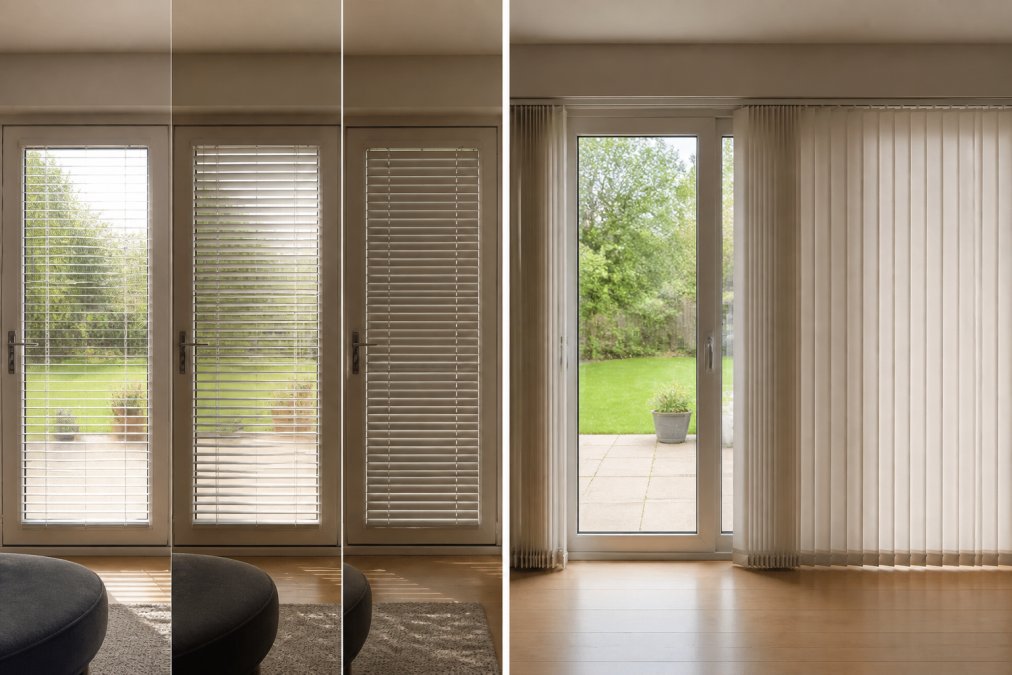
For west-facing patios with intense afternoon sun, Venetian blinds let you angle the slats to block direct heat while maintaining visibility. Vertical blinds require you to either close them completely (losing your view) or leave them fully open. Homeowners in high-traffic areas often prefer vertical blinds because they're simpler to operate, just slide them left or right.
How to Measure Patio Doors for Blinds
Measure the width inside the window recess and the drop (distance from the top of the recess to the sill or floor). Use a metal tape measure and take measurements in three places, top, middle, and bottom, to account for any slight variations in your frame.
Cameo Cream Vertical Blinds | 89mm →
For patio doors, you have two installation options: inside the recess (narrower measurement, neater appearance) or outside the recess (covers the frame and wall, blocking more light leakage). Inside recess fitting works best for Venetian blinds because the headrail sits neatly within the frame. Outside recess installation suits vertical blinds better because the track can extend fully across the door width without obstruction.
Record your measurements in millimetres and double-check them before ordering. Most made-to-measure suppliers, including Just Blinds, allow you to input your exact sizes online, and the price calculates automatically based on your dimensions. If you're uncertain about measuring, it's worth using a professional service if you've had fitting issues before.
Child Safety Regulations for Window Blinds
In the UK, window blind safety is governed by BS EN 13120 safety standard for blinds, which sets requirements for cordless operation and looped cord safety devices. The standard requires that any blind with a cord or chain must have a safety device that prevents children from becoming entangled.
Most modern blinds sold in the UK meet this standard, but older blinds, especially those installed more than five years ago, may not. If you have young children or toddlers in your home, prioritise cordless or wand-operated blinds. Both Venetian and vertical blinds are available with child-safe wand systems, where a rigid rod replaces the cord, eliminating strangulation risk entirely.
Just Blinds' Cameo Cream Vertical Blinds offer a choice of cord control or child-safe wand operation. If you're replacing existing blinds in a home with children, the wand system is the safer option and costs the same. Check the product specification before ordering to confirm the safety features included.
Best Blinds for Sliding Patio Doors: Durability, Maintenance and Costs
Sliding patio doors experience more wear than fixed windows because they're opened and closed frequently, exposing blinds to dust, moisture, and temperature fluctuations. Understanding the specific failure points and repair costs is essential for calculating true long-term value.
Venetian blinds for patio doors: Aluminium slats are the most durable material because they don't warp, fade, or absorb moisture. The 25mm thickness used in made-to-measure options provides rigidity and longevity. However, the tilt mechanism, the rod, cords, and ladder strings, is where failures occur in high-traffic patio door installations. The cord can fray or snap after 5-8 years of repeated daily use, and replacement cords typically cost £15-£35 depending on the blind width. The tilt rod itself rarely breaks, but if it does, replacement costs £20-£50 plus labour. Ladder strings (the vertical supports holding the slats) can wear through at stress points where they pass through the slats; replacement of a single ladder string costs £10-£20, but replacing both sides of a large patio door blind can run £40-£60. Maintenance involves occasional dusting with a microfibre cloth or vacuuming with a soft brush attachment. Replacement slats are available for most standard rails, costing £0.50-£2.00 per slat, so you can refresh individual damaged slats without replacing the entire headrail. Over a 10-year period, expect to budget £60-£150 for cord and mechanism replacements, but the aluminium structure itself will remain intact.
Vertical blinds for patio doors: Fabric louvres wear faster because they accumulate dust, absorb moisture from patio humidity, and can discolour with sunlight exposure.
Frequently Asked Questions
Which blinds are better for large patio doors: venetian or vertical?
Vertical blinds work better for large patio door openings because they cover wider spans without stacking width issues. Their louvres stack to the side, leaving the full glass exposed when open. Venetian blinds with horizontal slats work well too, but require more headroom and can accumulate dust in the slat grooves over time. For patio doors, vertical blinds offer easier operation across wide glass areas.
Are vertical blinds easier to clean than venetian blinds?
Vertical blinds are generally easier to maintain. You can wipe individual louvres with a cloth or use a vacuum brush. Venetian blinds trap dust between horizontal slats, requiring more frequent attention. Both types benefit from regular light dusting, but vertical blinds' fabric louvres and simple design make them faster to clean. For patio doors with high traffic, vertical blinds reduce maintenance burden.
What safety features do window blinds need for homes with children?
All window blinds in homes with children must comply with British Standard BS EN 13120, which requires cordless or cord-free operation for blinds within reach of children. Avoid traditional corded systems; instead, choose wand-operated or motorised options. Vertical blinds with child-safe wand systems and venetian blinds with cordless tilt mechanisms both meet these regulations.
How do I know my made-to-measure blinds will fit my patio door properly?
Measure your window recess width and drop in millimetres at three points (top, middle, bottom for width; left, right, centre for drop). Use the smallest width and largest drop measurements to ensure proper fit without gaps. Made-to-measure blinds are manufactured to your exact specifications, so accuracy during measuring is critical. Precise measurements prevent light leakage around edges that can occur with off-the-shelf options.
