
Table of Contents
- Why Blackout Blinds Matter for Babies and Toddlers
- How Sleep Needs Differ: Babies vs Toddlers
- Child Safety Blind Regulations and Standards
- Made-to-Measure Blackout Blinds: The Right Fit for Growing Children
- Benefits of Total Blackout for Children's Sleep Development
- Blackout Blinds vs Blackout Curtains for Nurseries
- Choosing Between Vertical Blinds Options for Your Nursery
- Installation and Rental-Friendly Solutions
- Frequently Asked Questions
Last Updated: September 19, 2026
Why Blackout Blinds Matter for Babies and Toddlers
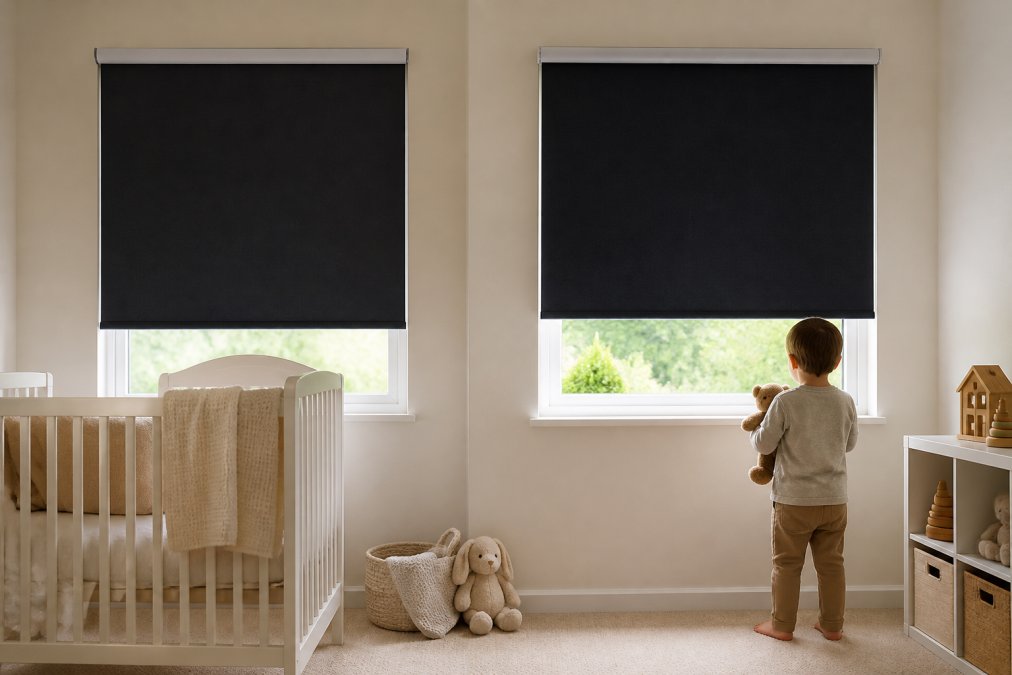
Blackout blinds for babies vs toddlers serve fundamentally different purposes in a child's sleep environment. Newborns need darkness to support melatonin production and regulate their developing circadian rhythm. Toddlers, on the other hand, often resist naps and wake early, and a truly dark room becomes your most reliable tool for managing sleep regression and preventing early morning wake-ups that derail the entire day.
What works for a six-month-old may seem excessive for a three-year-old resisting sleep, but total blackout actually reduces the battle by preventing external stimuli like dawn light from triggering wakefulness.
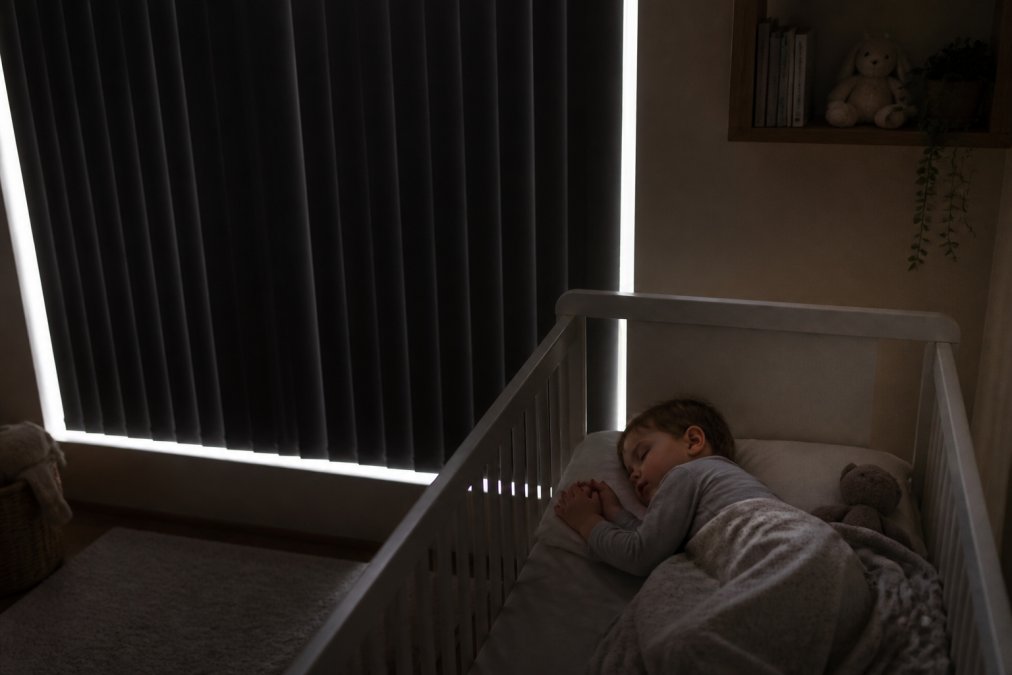
Made-to-measure blackout blinds eliminate light leakage at the edges, the difference between a child sleeping through and one waking at 5 a.m. from a sliver of dawn light.
How Sleep Needs Differ: Babies vs Toddlers
Babies and toddlers have different sleep architectures, circadian maturity, and environmental sensitivities that determine what blackout solution works best.
Babies and Melatonin Production
Newborns don't naturally produce melatonin reliably. For the first three months, sleep is driven by hunger and discomfort rather than circadian rhythm. By month four to six, melatonin production synchronises with day-night cycles, but remains fragile and easily disrupted.
Consistent darkness during sleep windows strengthens melatonin production in a baby's developing nervous system. Light pollution during naps or early morning leads to shorter sleep and more frequent wakings. Establishing this environment remains the most effective way to support natural circadian rhythms, though integrating other baby sleep aids can provide additional stability for infants struggling to settle.
Total blackout is developmental support, not luxury, a room blocking 95% of light still allows enough illumination to trigger wakefulness in sensitive infants.
Toddlers and Circadian Rhythm Development
By 18 months, a toddler's circadian rhythm is established but resistant. Sleep regression around 18-24 months means external stimuli like early morning light can trigger premature wakefulness.
Toddlers can see and understand their environment. A toddler waking to daylight at 5:30 a.m. may decide the day has started and resist returning to sleep, whereas total darkness keeps them in sleep mode.
Child Safety Blind Regulations and Standards
Any blind installed in a child's room must meet specific safety standards. This isn't optional, it's a legal requirement in the UK and reflects genuine hazard prevention.
Cord Safety and Strangulation Hazards
Cords and chains present a strangulation risk for children under five (Blind cord safety). Standard blinds with accessible cords should never be installed in a nursery.
Child-safe blackout blinds eliminate this hazard through cordless operation, wand controls, or motorised mechanisms. Our Bella Plain Cream Blackout Vertical Blinds offer a chain and cord or wand control system. Other vertical blinds, such as the Unilux Cream PVC Blackout Vertical Blinds, Bella Snow White Blackout Vertical Blinds, and Metz Black PVC Blackout Vertical Blinds, feature a chain and cord control system. The key is ensuring any control mechanism is mounted high on the window frame, beyond a child's reach even if they stand on furniture.

The key is ensuring any control mechanism is mounted high on the window frame, beyond a child's reach even if they stand on furniture.
Material Safety: PVC-Free and Non-Toxic Options
Blackout blind material matters for child health. Some older PVC fabrics release volatile organic compounds or plasticisers, particularly when new. Young children's developing respiratory systems are more sensitive to these emissions.
We offer two material approaches: PVC Blackout Fabrics (Unilux Cream, Metz Black, Sahara White) are wipe-clean and moisture-resistant, ideal for spills and humidity. Flatweave Blackout Fabrics (Bella Snow White, Bella Cream) feel softer and warmer. Choose PVC for easy cleaning, flatweave for softer aesthetics.
Made-to-Measure Blackout Blinds: The Right Fit for Growing Children
Off-the-shelf blinds rarely fit perfectly, leaving gaps that allow light leakage. Made-to-measure blinds fit exact window dimensions and eliminate this problem.
Why Made-to-Measure Eliminates Light Leakage
Small gaps, 2cm too narrow or 5cm too short, render blackout blinds ineffective by allowing light leakage.
Made-to-measure blinds span the full window width and extend from frame top to sill, transforming a "mostly dark" nursery into a genuinely dark sleep environment.
Unilux Cream PVC Blackout Vertical →
Seasonally, summer dawn at 4:30 a.m. means even small gaps trigger early waking. Properly fitted made-to-measure blinds block this entirely.
Durability Through Growth Stages
Made-to-measure blinds last through growth transitions from cot to toddler bed to full-size bed because they're manufactured with quality materials and precision engineering.
Our Bella and Unilux ranges use high quality powder coated aluminium headrails and sewn louvres, not glued construction, keeping blinds light-tight and functional year after year.
Benefits of Total Blackout for Children's Sleep Development
Total darkness in a child's sleep environment produces measurable benefits beyond simply making bedtime easier. The neurological and developmental effects are real.
Improved Daytime Naps and Sleep Regression Prevention
Daytime naps become dramatically easier in a truly dark room. A toddler who resists naps in a bright room will often settle quickly in darkness because the environmental cue removes the cognitive resistance to sleep.
Sleep regression, the temporary disruption of sleep patterns during developmental leaps, is less severe in a dark room.
Protection from Seasonal Light Changes
The UK experiences dramatic seasonal light variation. In winter, dawn may not arrive until 8 a.m., but in summer, the sun rises before 5 a.m. This seasonal shift disrupts children's sleep patterns unless you actively manage it with blackout blinds.
| Sleep Benefit | Babies | Toddlers | Why It Matters |
|---|---|---|---|
| Melatonin regulation | Critical | Established | Supports natural sleep onset |
| Nap consolidation | Important | Essential | Prevents overtiredness and regression |
| Early morning waking | Moderate | Severe | Blackout prevents 5 a.m. wake-ups |
| Seasonal adjustment | Moderate | Important | Maintains sleep schedule year-round |
| Sleep regression support | Important | Critical | Reduces disruption during development |
Blackout Blinds vs Blackout Curtains for Nurseries
Both blackout blinds and blackout curtains can darken a nursery, but they perform differently in practice. The choice depends on your window type, aesthetic preference, and maintenance tolerance.
Choosing Between Vertical Blinds Options for Your Nursery
Vertical blinds are the most popular choice for blackout in children's rooms because they're durable, easy to control, and available in materials suited to a nursery environment.
PVC Blackout Blinds for Easy Cleaning
PVC blackout vertical blinds like the Unilux Cream and Metz Black options are wipe-clean and moisture-resistant. A nursery is inherently messy, spills happen, humidity builds, and sticky fingers touch surfaces. PVC louvres wipe clean in seconds with a damp cloth.
Flatweave Blackout Fabrics for Softer Aesthetics
The Bella Plain Cream Blackout Vertical Blinds from Just Blinds offer an excellent middle ground: they're flatweave (soft, warm aesthetic) but spongeable (practical cleaning), and they start at £21.17 for made-to-measure, making them accessible without sacrificing quality.

Installation and Rental-Friendly Solutions
Tension rods with blackout fabric: These mount inside the window frame without drilling, using tension to hold the fabric in place. They work for small windows but can be unreliable for larger nursery windows.
Frequently Asked Questions
Are blackout blinds safe for babies and toddlers?
Yes, when you choose child-safe options. Look for cordless designs or wand-controlled systems to eliminate strangulation hazards. Ensure materials are non-toxic and PVC-free where possible. Made-to-measure blackout blinds fit precisely, leaving no gaps where small fingers can get trapped. Always verify that your chosen blinds comply with child safety standards and are securely anchored to prevent tipping.
Do babies and toddlers need different blackout blinds?
Babies and toddlers have different developmental needs. Babies benefit from complete darkness to support melatonin production and longer sleep cycles. Toddlers need blackout blinds to manage circadian rhythm development and prevent early rising caused by external light stimuli. Both age groups need total blackout capability, but toddlers may benefit from blinds they cannot easily tamper with, making cordless or wand-controlled systems ideal for both ages.
What are the benefits of total blackout for children's sleep?
Total blackout improves sleep quality by supporting natural melatonin production and protecting sleep cycles from light pollution and seasonal changes. Babies sleep longer and more deeply in darkness, reducing sleep regression. Toddlers experience fewer early morning wake-ups and more consistent daytime naps. Blackout also helps children maintain healthy sleep patterns during daylight savings transitions and summer months when dawn arrives earlier.
Can made-to-measure blackout blinds prevent light leakage in bay windows?
Yes. Made-to-measure blackout blinds are cut to your exact window dimensions, eliminating gaps at the edges and sides where light typically creeps in. This precision fit is especially important in bay windows, which have angled frames. Standard off-the-shelf blinds often leave visible light leakage, but custom-made options ensure complete darkness for optimal sleep conditions.
What's the difference between PVC and flatweave blackout blinds for nurseries?
PVC blackout blinds are wipe-clean and moisture-resistant, making them ideal for nurseries where spills and humidity are common. Flatweave blackout fabrics offer a softer, more aesthetic appearance and are spongeable for gentle cleaning. PVC delivers complete light block. Flatweave fabrics, such as our Bella Plain Cream Blackout Vertical Blinds, have a 100% blackout coating to the reverse. PVC suits practical, easy-maintenance priorities, while flatweave suits parents preferring a warmer, fabric-like look in the nursery environment.
