
Table of Contents
- Why Privacy and Sunlight Adjustment Matter in Renovation
- Day and Night Blinds vs Roller Blinds: Which Suits Your Needs
- Day and Night Blinds for Bedrooms: Light Control and Sleep Quality
- Can You See Through Day and Night Blinds at Night: Privacy Assurance
- How to Measure for Blinds: Getting the Perfect Fit
- Venetian and Faux Wood Options for Effortless Control
- Frequently Asked Questions
Last Updated: October 8, 2026
Why Privacy and Sunlight Adjustment Matter in Renovation
When you're planning a home renovation, privacy and sunlight adjustment often feel like afterthoughts. They're not. Getting window treatments right transforms how a room functions and how comfortable your home feels. Poor light control means fighting glare at 6am or feeling exposed; effortless privacy and sunlight adjustment means you control exactly who sees in.
At Just Blinds, we've helped thousands of homeowners solve this during renovations. Most discover too late that their original choice doesn't match their needs: a south-facing bedroom needs blackout capability, a home office needs glare reduction without total darkness, a kitchen needs moisture resistance. The right choice depends on orientation, use, and how much you'll adjust regularly.
The stakes are real: poor window treatments mean glare, lost privacy at night, or summer overheating. Good ones mean your renovation delivers the comfort you paid for.
Day and Night Blinds vs Roller Blinds: Which Suits Your Needs
Roller blinds are single-layer fabric that rolls up and down, open or closed, with limited in-between options.
Roller blinds give you two states: open (full light, no privacy) or closed (blocked light, full privacy), a binary choice most renovations find limiting.
A structured comparison by what actually matters
| Feature | Day and Night Blinds | Roller Blinds |
|---|---|---|
| Light control | Gradual adjustment via sheer/solid stripes | Full open or closed only |
| Privacy options | Multiple levels throughout the day | Complete or none |
| Operation | Cord, chain, or motorised | Cord, chain, or motorised |
| Child safety | Cordless and spring-loaded options available | Cordless and spring-loaded options available |
| Cleaning | Dust weekly, spot clean | Dust weekly, spot clean |
| Typical lifespan | 5-10 years with regular use | 5-10 years with regular use |
| Best for | Bedrooms, living rooms, offices | Kitchens, bathrooms, utility spaces |
Control types and what they mean day to day
Both types operate by cord, chain, or motorised wand. Cordless and spring-loaded versions are the sensible default in homes with young children, since they remove the looped cord that presents a strangulation risk. If renovating a family home, specify cordless operation at the ordering stage rather than retrofitting later.
Motorised options add cost but remove the daily friction of reaching behind furniture or over a bath. For hard-to-reach windows, above a kitchen worktop, a stairwell, or a tall gable, motorisation is often the difference between a blind you use and one you leave permanently down.
Cleaning, maintenance and lifespan
Both are low-maintenance: dust with a microfibre cloth or vacuum brush attachment every week or two, spot clean with a damp cloth and mild detergent, and avoid soaking the headrail.
Neither type tolerates being left damp. In bathrooms and kitchens, choose moisture-resistant fabrics and leave the blind partially open after showering or cooking to let air circulate.
How to choose for a whole-home renovation
A common pattern is to mix different blind types rather than commit to one across the house. Ordering from the same made-to-measure supplier means consistent headrail colours and a single fitting visit.
Cost-wise, made-to-measure options offer excellent value. If you're investing in a renovation, the right window treatments often pay dividends in daily comfort.
Day and Night Blinds for Bedrooms: Light Control and Sleep Quality
Bedrooms need darkness for sleep and filtered light for waking naturally.
Sleep quality depends partly on light control: your circadian rhythm responds to light cues. A room too bright at night disrupts sleep; one too dark in the morning throws off your wake cycle.
The adjustment is effortless: a simple pull of the cord shifts the stripes, with no rolling or fiddling with multiple layers. For a bedroom where you adjust blinds multiple times daily, that ease matters. Children's bedrooms and nurseries benefit especially, a calm, dark sleep environment at night, gradual light in the morning.
For maximum darkness when needed, consider blackout options, giving you soft filtered light for relaxation, complete darkness for sleep, and everything in between.
Can You See Through Day and Night Blinds at Night: Privacy Assurance
This is the question every homeowner asks: when the sun sets and your lights are on inside, can someone standing outside see in?
The answer depends on contrast and positioning. When your interior lights are on and it's dark outside, some visibility may occur. That's the trade-off for daytime light filtering.
For genuine privacy at night, position the blinds for total darkness and complete privacy. The flexibility means you choose: soft filtered light during the day with some visibility, or solid coverage at night with zero visibility.
For bedrooms and bathrooms where privacy is non-negotiable, this matters: solid coverage in the evening gives both darkness and privacy, while daytime light filtering gives natural light without anyone seeing in clearly. Extending this need for seclusion beyond the interior walls often requires the installation of privacy fence panels to maintain a consistent sense of sanctuary throughout the entire property.
Gold Shimmer Aluminium Venetian Blind | Glam | Made to Measure →
In a full renovation, combining window treatments gives you flexible daytime light control plus reliable night-time privacy.
How to Measure for Blinds: Getting the Perfect Fit
Measuring for made-to-measure blinds is straightforward if you follow the right process. Poor measurements are the most common reason for gaps, misalignment, or blinds that don't operate smoothly.
Measure the width of your window at three points: top, middle, and bottom. Take the smallest measurement, this is your blind width. Measure the height from the top of the window frame to the sill at three points: left, centre, and right. Again, use the smallest measurement to avoid gaps.
For inside-mount blinds (fitted inside the window frame), subtract 3mm from your width measurement to allow for smooth operation. For outside-mount blinds (fitted to the wall above the window), add 50-100mm to the width to cover the wall space on either side and prevent light gaps.
Measure twice. A 5mm error seems small until your blinds arrive and don't fit. Just Blinds provides detailed measuring guides with every order, and our made-to-measure service cuts your blinds to your exact specifications.
Common mistakes: measuring the glass instead of the frame, ignoring window depth for inside-mount, and forgetting multiple measuring points (windows aren't always square). Use a metal tape measure and measure three times if uncertain.
Venetian and Faux Wood Options for Effortless Control
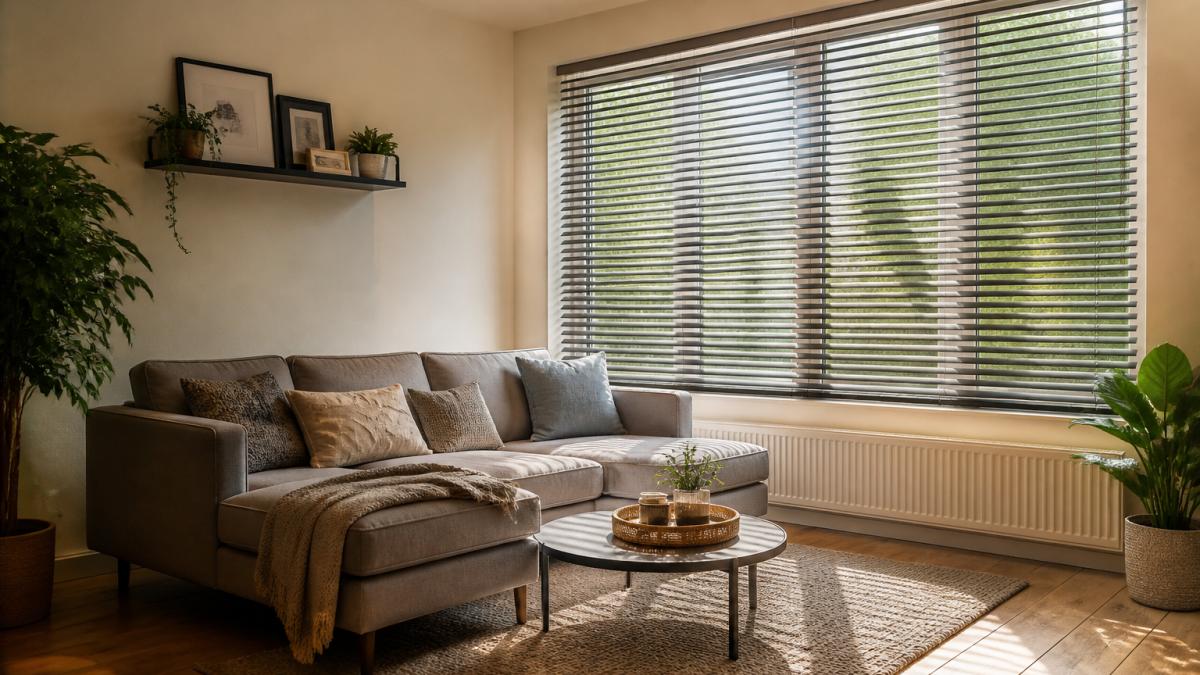
Venetian blinds offer precise light control through tilting slats. Aluminium Venetian blinds are durable, lightweight, and easy to clean, ideal for kitchens and bathrooms. Faux wood Venetian blinds deliver the warmth and elegance of natural wood without the warping, moisture sensitivity, or high maintenance.

Aluminium versus faux wood: the practical trade-offs
Aluminium Venetians give precise tilt control: rotate the slats to adjust light intensity without changing privacy levels. They're moisture-resistant, perfect for bathrooms and kitchens. The downside: they can feel cold or clinical in living spaces, and they conduct heat, so a south-facing window in summer turns them into a radiator.
Faux wood options are composite PVC that resists warping, moisture, and fading, far more durable than real wood in wet rooms, and wipe clean with a damp cloth, no special treatments needed. The trade-off: heavier than aluminium, so they need sturdy brackets and proper installation.
| Feature | Aluminium Venetian | Faux Wood Venetian |
|---|---|---|
| Moisture resistance | Excellent | Excellent |
| Weight | Light | Heavier, needs sturdy brackets |
| Heat conduction | High, can feel warm in direct sun | Lower |
| Aesthetic | Cool, modern, clinical | Warm, wood-look |
| Cleaning | Wipe clean | Wipe clean |
| Best rooms | Kitchens, bathrooms, utility | Living rooms, bedrooms, dining |
Controls, child safety and operation
Venetian blinds operate by a cord or chain for raising and lowering, plus a wand or cord for tilting the slats.
Motorised Venetian blinds exist but are less common, since the tilt function adds complexity.
Installation requirements
Venetian blinds are heavier than rollers and need secure fixing points. Inside-mount (recess) fitting looks neater but requires enough window depth for the headrail and slats to clear the glass. Outside-mount (face) fitting is more forgiving and reduces light gaps at the edges. For bay windows and angled frames, measure each section separately, sections are rarely identical, and made-to-measure blinds can be cut to fit each one precisely.
Maintenance and lifespan
Dust slats weekly with a microfibre cloth or vacuum brush attachment. For a deeper clean, wipe each slat with a damp cloth and mild detergent, top to bottom, avoiding the headrail and cords. Aluminium slats can dent if knocked; faux wood slats are more rigid but heavier. With reasonable care, both last many years, and replacement slats are often available.
Coordinating Venetians across a renovation
The choice between aluminium and faux wood often comes down to room type: kitchens and bathrooms benefit from aluminium's moisture resistance, living rooms and bedrooms from faux wood's warmth. For a whole-home renovation, using both in the right spaces gives the best functionality and appearance, and ordering together from the same made-to-measure supplier keeps headrail colours and slat widths consistent.
For most home renovations, faux wood Venetians strike the best balance: the aesthetic warmth you want, the durability you need, and effortless light and privacy control. Pair them with made-to-measure fitting to eliminate gaps and ensure smooth operation.
Frequently Asked Questions
Can you see through day and night blinds at night?
For maximum night-time privacy, ensure your blinds are fully lowered.
Are day and night blinds suitable for bedrooms?
Yes, blinds can work well in bedrooms because they offer flexible light and privacy control. When fully closed, blackout options provide near-total darkness for sleep. This makes them ideal for bedrooms where you need both daytime privacy and complete darkness at night. Many parents also choose blackout blinds for children's rooms to manage nap times and bedtime routines.
How do I measure my windows correctly for made-to-measure blinds?
Measure the width at three points: top, middle, and bottom of the window frame. Use the smallest measurement to ensure the blinds fit properly. For drop (height), measure from the top of the frame to the sill at three points: left, centre, and right. Use the smallest measurement. Measure in millimetres for accuracy. If you're uncertain, Just Blinds provides detailed measuring guides. Accurate measurements prevent gaps and ensure your blinds operate smoothly once installed.
What's the difference between day and night blinds and roller blinds for privacy and light control?
Roller blinds are typically single-fabric and either block light completely or let it through, offering less nuanced control. For rooms needing varied light control without changing treatments, other blind types may provide more versatility.
