
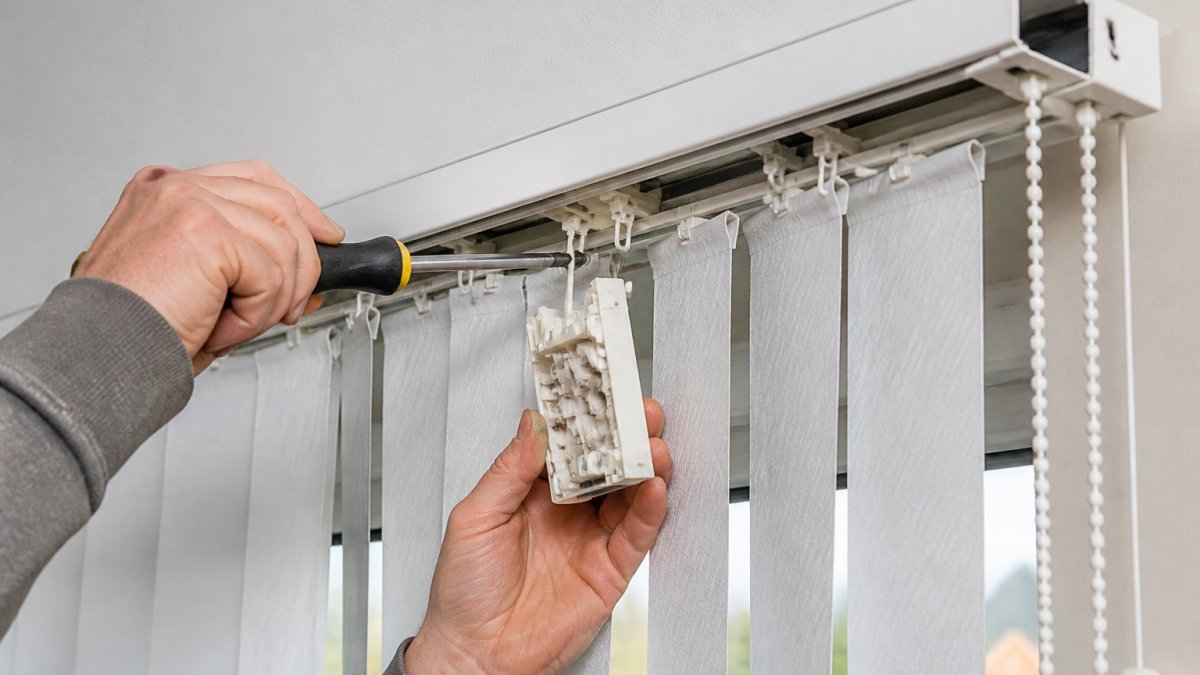
Last Updated: October 29, 2026
Quick Summary
To replace a vertical blind headrail, unclip the slats, prise off an end cap, release the rail from its brackets and lower it, then fit a compatible made-to-measure rail. Match the rail profile, carrier pitch and control type to your existing brackets and slats before ordering. Replacement headrails start at £11.00 for cord and chain control and £21.84 for wand control.
- Removing a vertical blind headrail takes about ten minutes with a step ladder and flathead screwdriver.
- Broken carrier hooks are the most common vertical blind fault, snapping as UV makes plastic brittle.
- Test tilt and traverse separately to isolate the fault before removing any slats.
- Do not order a headrail by width alone; bracket profile and carrier pitch must also match.
- Fit the rail, hang two slats and test tilt and traverse before hanging the rest.
Table of Contents
- Diagnosing a Faulty Vertical Blind Headrail
- How to Remove a Vertical Blind Headrail
- Vertical Blind Carrier Replacement
- Vertical Blind Carrier Hook Replacement
- Vertical Blind Gear Replacement
- Choosing a Compatible Replacement Headrail
- Ordering Your Replacement Headrail from Just Blinds
- Frequently Asked Questions
Diagnosing a Faulty Vertical Blind Headrail
Most vertical blinds fail at the headrail, not the fabric. The vertical blind headrail is the track that carries every slat, and it holds three separate mechanisms: the tilt gear that rotates the slats, the traverse system that slides them open and closed, and the carriers that grip each slat.
Diagnosis starts with one question: what exactly is failing? Watch the blind through a full open and close cycle before you touch anything. The symptom tells you which component has gone, and the component tells you which part to order.
| Symptom | Most likely fault | Part to check first |
|---|---|---|
| Slats will not rotate at all | Tilt gear stripped, or tilt rod disengaged | Tilt gear and gear housing |
| Slats rotate by hand but not with the wand or chain | Wand disconnected from gear housing, or chain off the sprocket | Wand socket, drive sprocket |
| Slats bunch up or refuse to slide | Broken carrier or detached connector | Carrier and connector links |
| One slat hangs loose or drops | Broken carrier hook or split stem | Carrier hook and stem |
| Movement jams at one point on the track | Single carrier misaligned in the rail | That carrier only |
| Slats turn but drag heavily | Worn gear teeth or stiff tilt rod | Tilt gear |
Blinds That Won't Turn or Slide
A blind that won't tilt and a blind that won't slide are two different faults, and mixing them up wastes money on the wrong part.
- Won't turn: slats stay flat when you twist the wand or pull the chain. The tilt gear or the tilt rod inside the headrail has stripped. If the wand spins freely with no resistance, the wand has usually come out of its socket rather than the gear failing.
- Won't slide: slats bunch up or refuse to move along the track. A carrier has snapped, or a connector has detached between two carriers.
- Turns but drags: the gear is worn but not broken. It will fail soon, so order the gear before it strips completely.
If the slats rotate freely by hand but not with the control, the mechanism is at fault, not the fabric. That test alone rules out the slats and saves you buying parts you do not need.
Checking the Wand, Chain and Connectors
Before you order anything, rule out the cheap fixes. A wand that spins without resistance usually means the wand has disconnected from the gear housing, not that the gear has failed.
For cord and chain systems, check three things:
- The chain sits properly on the drive sprocket
- The cord runs free of the track end
- No connector clips have popped apart between carriers
Look along the underside of the track with a torch. Detached connectors and cracked carrier hooks are visible as small white or grey clips hanging loose. That inspection takes two minutes and saves a wasted order.
Mechanism-Specific Failure Causes
Knowing why a part failed helps you decide whether to replace the part or the whole headrail.
- Tilt gear: usually stripped by forcing a stiff wand or chain. Once the teeth round off, the slats stop rotating and no amount of adjustment will bring them back.
- Traverse system: the cord or chain jumps the sprocket when it is slack, and the carriers stop travelling evenly.
- Carriers: the plastic trolley cracks at the stem or the connector lug, usually after years of sun exposure making the plastic brittle.
If two or more of these mechanisms are worn at once, replacing the headrail is usually cheaper than buying the parts separately. If only one has failed, replace that part and keep the rest.
How to Remove a Vertical Blind Headrail
Removing a vertical blind headrail takes about ten minutes and needs only a step ladder and a flathead screwdriver. Work with the blind fully closed so the slats hang clear of the window.
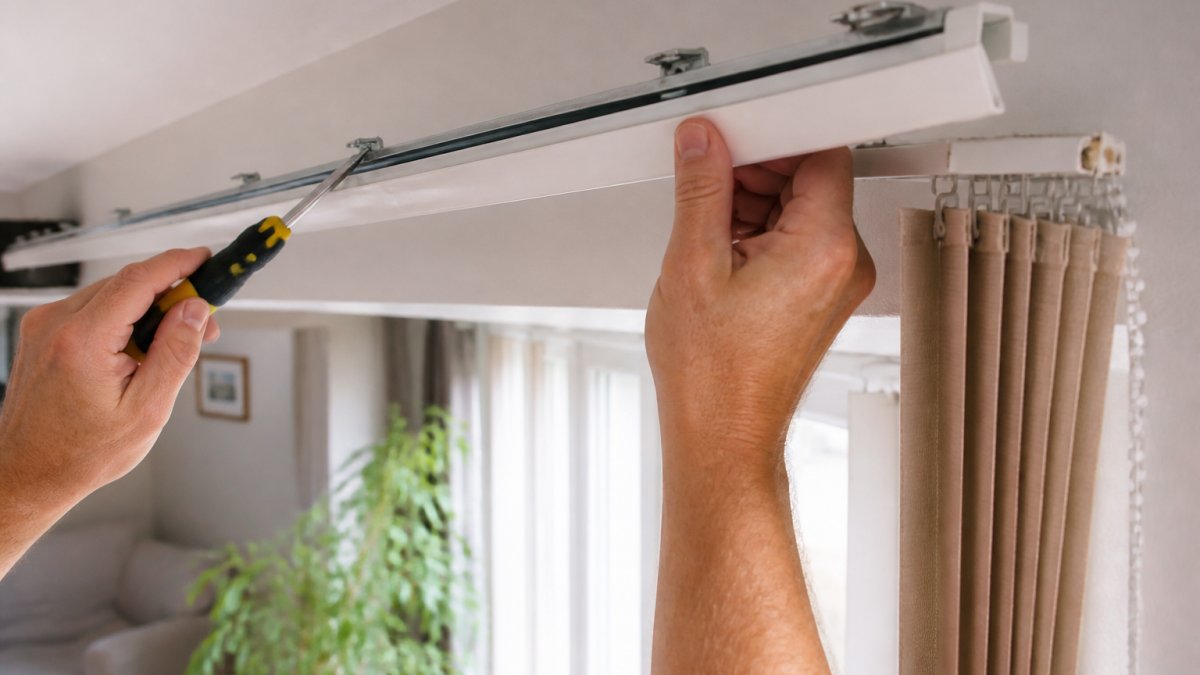
- Unclip the slats. Each carrier has a hook or stem. Twist the slat a quarter turn and lift it free. Stack the slats flat.
- Open the end caps. Most headrails have a cap at each end. Prise one off with the screwdriver.
- Release the brackets. Headrails sit in wall or ceiling brackets. Push the rail up and tilt it towards you, or press the bracket tab, depending on the fitting.
- Lower the rail. Take the weight with both hands and lift it clear.
Watch out: never lever a headrail out with force. Bent brackets will not hold a new rail straight, and a twisted track causes the exact jamming you are trying to fix.
Vertical Blind Carrier Replacement
A vertical blind carrier replacement is the fix when slats droop, fall out, or refuse to travel along the track. Each carrier is a small plastic trolley that runs inside the rail and holds one slat.
To swap a carrier:
- Slide the remaining carriers to one end to free up space
- Squeeze or unclip the damaged carrier from the connector link
- Snap the new carrier onto the connector
Carriers come in different stem lengths and clip styles. Measure the old one before ordering, or the new part will not grip your slat stems.
Vertical Blind Carrier Hook Replacement
A vertical blind carrier hook replacement solves a different problem: slats that hang loose or drop to the floor.
Broken hooks are the most common vertical blind fault we hear about. The plastic goes brittle with sun exposure and snaps under the weight of a heavy slat.
Replacement Vertical Blind Headrail (Wand Control) →
- Twist the slat off the broken hook
- Pull the old hook from the stem
- Push the new hook onto the stem until it clicks
If hooks keep snapping on the same blind, the slats may be too heavy for that carrier type.
Vertical Blind Gear Replacement
A vertical blind gear replacement restores the tilt function when slats stop rotating. The gear sits inside the headrail housing at the control end, meshed with the tilt rod.
Access it by removing the end cap and sliding the gear housing out.
- Remove the control wand or chain from its socket
- Slide out the gear housing
- Prise out the old gear
Gear wear is usually caused by forcing a stiff control. If the wand feels tight, stop twisting and investigate before the teeth strip.
Choosing a Compatible Replacement Headrail
Compatibility is where most DIY headrail jobs go wrong. Headrails are not universal: rail profiles, bracket types, carrier spacing and control systems all vary between manufacturers and between older and newer ranges. A rail that looks identical from the front can have a different carrier pitch or a different bracket tab, and the new rail will not clip in.
Measure before you buy:
- Rail width in millimetres, end cap to end cap
- Control type: wand, cord and chain, or both
- Bracket style: wall fix, ceiling fix, or face fix
Matching the Part to the Headrail
Each component has its own compatibility rules, and getting one wrong means a second order.
- Carriers: match the stem length and the connector style. A carrier with the wrong stem length will hold the slat at the wrong height, and a carrier with the wrong connector will not link to its neighbours.
- Carrier hooks: match the hook to the stem diameter. Hooks are not interchangeable between stem sizes, and a loose hook will drop the slat.
- Gears: match the gear to the housing and the tilt rod. Note the tooth count and the orientation before removing the old gear, because a gear fitted the wrong way round leaves the slats stuck at an angle.
Our replacement vertical blind headrail with wand control is available to order. We also stock a cord and chain control headrail and a Cruze anthracite headrail. Replacement blind slats are made to work with most rails, including Hilarys, Argos and Dunelm.


Repair or Replace?
Use the damage, part availability, age and relative cost to decide.
- Repair when one carrier, hook or gear has failed and the rest of the mechanism moves freely.
- Replace the headrail when the gear, carriers and connectors are all worn, when the track itself is bent, or when the blind is old enough that the plastic has gone brittle throughout.
- Replace the whole blind only when the slats are also worn or the brackets are damaged beyond reuse.
If the parts cost more than a made-to-measure rail, the rail wins. That is usually the case once two or more mechanisms have failed.
| Fault | Part Needed | Difficulty | When to Replace the Headrail |
|---|---|---|---|
| Slat hangs loose or falls | Carrier hook | Easy | Only if hooks keep snapping |
| Slat won't travel along track | Carrier | Easy | If several carriers are broken |
| Slats won't rotate | Tilt gear | Moderate | If the tilt rod is also worn |
| Bunching at one point | Connector or carrier | Easy | If the track itself is bent |
| Multiple faults at once | Full headrail | Moderate | Replace the headrail |
Troubleshooting After Installation
A new headrail or part can still leave the blind misbehaving, and most guides stop before this point. Check these before assuming the part is faulty.
- Carriers misaligned: slide all carriers to one end and re-space them evenly. A carrier that sits out of line will jam the traverse.
- Slats uneven: check that every carrier hook is pushed fully onto its stem and that the slats are the same length. One short slat makes the whole run look uneven.
- Movement jammed: check that no connector is twisted and that the rail sits straight in its brackets. A rail that is not fully seated will bind.
Ordering Your Replacement Headrail from Just Blinds
Matching the part to the fault is the whole job. Diagnose first, measure second, order third, and the repair is straightforward.
At Just Blinds, replacement headrails start at £11.00 for cord and chain control and £21.84 for the wand control version, with free delivery on orders over £175. Every rail is made to measure, so it arrives ready to clip into your existing brackets.
Frequently Asked Questions
How can you tell if a vertical blind headrail mechanism is broken?
Look for slats that will not turn when you twist the wand, carriers that bunch together instead of sliding evenly, or a visible break in the connectors inside the track. A grinding sound or a wand that spins freely usually points to a stripped gear. If only one or two slats misbehave, the fault is often a single carrier or hook rather than the whole vertical blind headrail, so inspect before ordering a full replacement.
Can you replace a vertical blind carrier without replacing the whole headrail?
Yes, in most cases. If the track itself is straight and the gears still turn, you can slide the old carriers out of the end of the rail and fit new ones. Carrier replacement is typically far cheaper than a new headrail. Check that the new carrier stem matches the width of your existing track, because carriers from a different system will not clip in properly.
How do you find the right replacement mechanism for vertical blinds?
Start by identifying the control type: wand control and cord and chain control use different mechanisms and are not interchangeable. Measure the exact width of the existing headrail and note the colour, such as anthracite, if the track is visible. Just Blinds supplies a wand control headrail at £21.84, a cord and chain headrail at £11.00 and a Cruze anthracite headrail at £19.00. Call free on 0800 783 9510 if you are unsure which system you have.
Can a vertical blind headrail be repaired, or does it need replacing?
It depends on what has failed. A snapped carrier hook or a worn gear can be swapped out as a spare part, keeping the original rail. If the track is bent, cracked or the internal tilt mechanism has seized along its length, a full replacement headrail is the better route. As a rough guide, if the repair needs more than two or three parts, a new headrail is often the simpler and more reliable option.
A jammed or broken blind is usually a small plastic part away from working again, and guessing at the cause is what turns a ten-minute fix into a wasted order. Send us a photo of your headrail and control, or measure your rail width, and we will point you to the right replacement. Get started with Just Blinds and restore smooth tilt and glide to your vertical blinds without replacing the fabric.

