
Table of Contents
- Why Blackout Blinds Matter for Shift Workers in 2026
- Quick Comparison: 5 Best Blackout Blinds for Day Sleeping
- 1. Como Drama Black Blackout Roller Blind: Best Overall for Total Darkness
- 2. Bella Plain Cream Blackout Vertical Blinds: Best Value for Large Windows
- 3. PVC Blackout Plain Black Roller Blind: Best for Damp Rooms and Bathrooms
- 4. Unilux White Blackout Vertical Blinds: Best for Rental-Friendly Installation
- 5. Como Bare White Blackout Roller Blind: Best Budget Option Under £30
- Made to Measure Blackout Blinds: Why Fit Matters More Than Fabric
- Frequently Asked Questions
Last Updated: September 14, 2026
Why Blackout Blinds Matter for Shift Workers in 2026
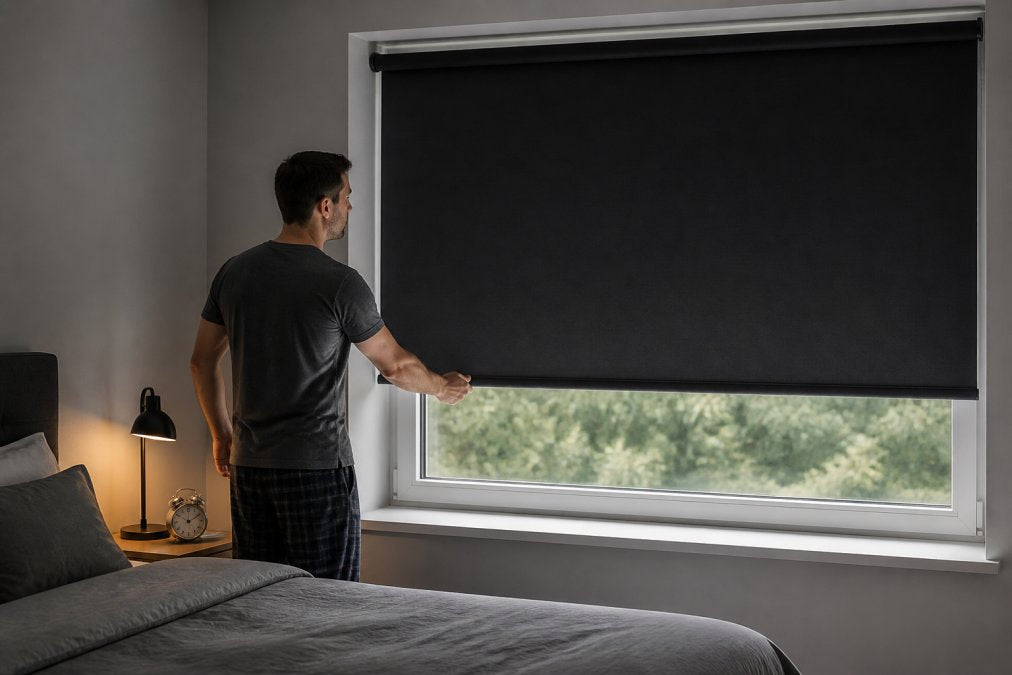
If you work nights, your bedroom is doing two jobs at once: it is a place to sleep and, for eight hours a day, it has to pass as midnight. Blackout blinds are window coverings built with an opaque or coated fabric that blocks incoming light, and for shift workers they are the difference between proper daytime sleep and broken, restless rest. This guide from Just Blinds compares five made to measure options that do the job properly.
The problem is rarely the fabric itself. It is the edges. Light escapes around the sides, over the top, and through the gap between the blind and the window recess. A blind can be rated 100% blackout and still leave a bright halo across your pillow (bbsa.org.uk).
That is why fit matters more than the label. Below, we break down five blackout blinds, what each one suits, and how to close the gaps that ruin daytime sleep.
Quick Comparison: 5 Best Blackout Blinds for Day Sleeping
The table below summarises our five picks by price, type, and best use case, but price and type alone do not tell you whether a blind will actually darken a room at 10am. The column that matters most is how the blind seals at the edges.
| Blind | Type | Price From | Edge Sealing | Best For |
|---|---|---|---|---|
| Como Drama Black Blackout Roller | Roller | £26.53 | Fabric-over-roller; side channels optional | Total darkness in bedrooms |
| Bella Plain Cream Blackout Vertical | Vertical | £21.17 | Overlapping louvres; no side channel | Large windows and patio doors |
| PVC Blackout Plain Black Roller | Roller | £26.53 | Fabric-over-roller; wipe-clean | Bathrooms and damp rooms |
| Unilux White Blackout Vertical | Vertical | £22.12 | Overlapping louvres; recess fit | Rental-friendly installation |
| Como Bare White Blackout Roller | Roller | £26.53 | Fabric-over-roller; side channels optional | Budget setups under £30 |
What the table cannot show you
Light-blocking percentage is not the same as room darkness. A fabric rated 100% blackout still lets light around the edges. The difference between a room that is merely dim and one that is genuinely dark comes down to three things: whether the blind runs in side channels, whether the top is enclosed in a cassette, and whether the bottom sits against the sill or floats above it.

Thermal and acoustic performance vary by construction. Cellular (honeycomb) blinds trap air in their cells and insulate noticeably better than a single-layer roller, useful if your bedroom is over a garage or faces a busy road. Rollers with a coated reverse offer some radiant barrier effect but no air gap. Vertical louvres perform worst on both counts because air passes between the slats. None of the five picks above is a cellular blind, so if insulation or noise is your priority, that is the type to research separately.
Motorisation changes the shift-worker use case. A mains- or battery-powered roller on a timer can be scheduled to close before you get home and open at a set time, which matters more for shift workers than for anyone else. Not all five picks above are motor-compatible, check before ordering if you want to automate.
How to read the prices
All prices are 'from' figures for the smallest made to measure size and exclude delivery. A wide patio door in a vertical will cost considerably more than the entry price, and side channels or a cassette are usually a paid upgrade. Budget for the sealing accessories, not just the blind, if total darkness is the goal.
1. Como Drama Black Blackout Roller Blind: Best Overall for Total Darkness
The Como Drama Black is the pick for anyone who needs a room genuinely dark at 10am. It is a made to measure roller blind in a deep black total blackout fabric, supplied with brackets for recess or face fitting.
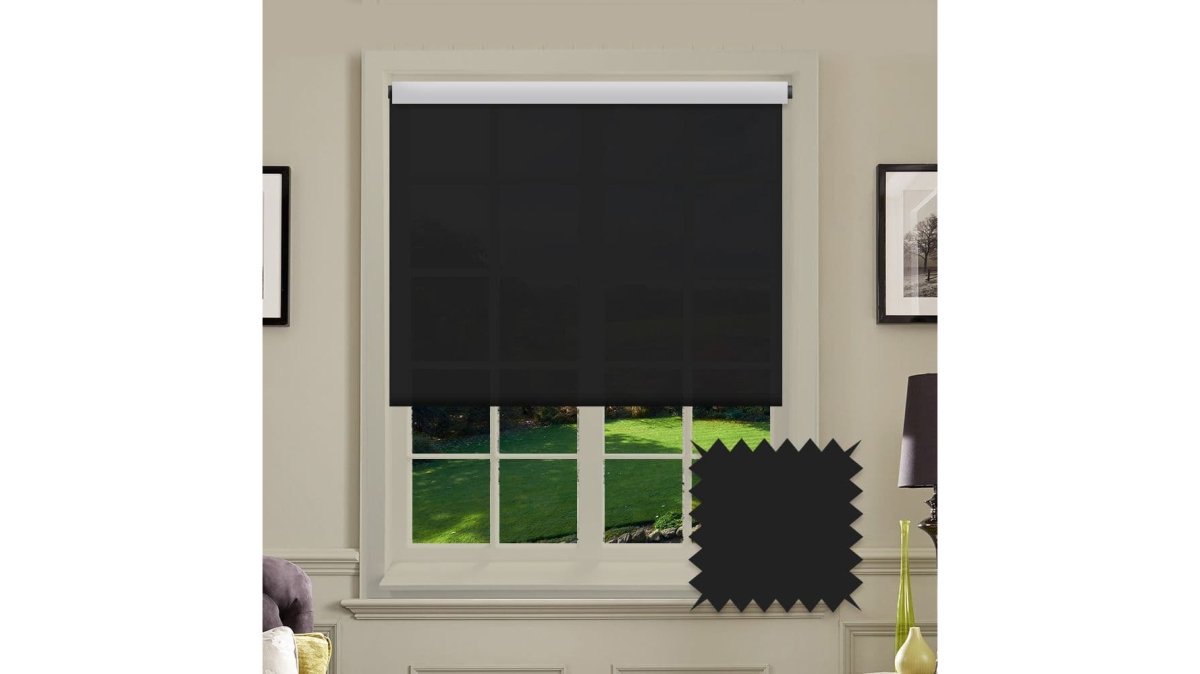
Roller blinds pull flat against the window, which reduces the side gaps that plague vertical systems. The child-safe control cleat keeps the cord tidy, and the fabric handles UV protection as a side benefit.
Pros: Total blackout fabric; recess or face fit; child-safe control. Cons: Rollers suit single windows better than wide sliding doors.
2. Bella Plain Cream Blackout Vertical Blinds: Best Value for Large Windows
Wide windows and patio doors are where vertical blinds earn their keep, and the Bella Plain Cream is the value option at £21.17. Each 89mm louvre carries a 100% blackout coating to the reverse.
The louvres are sewn, not glued. The powder-coated aluminium headrail takes chain and cord or wand control.
Pros: Cheapest pick here; ideal for wide spans; sewn louvres. Cons: Vertical louvres leave more side gaps than a roller.
3. PVC Blackout Plain Black Roller Blind: Best for Damp Rooms and Bathrooms
Bathrooms and kitchens punish fabric blinds. The PVC Blackout Plain Black Roller uses a waterproof, wipe-clean PVC fabric that shrugs off steam and splashes while still blocking light.

It arrives made to measure with fitting brackets and a child-safe cleat, and suits conservatories where condensation is a constant battle.
Pros: Waterproof and wipeable; child-safe; made to measure. Cons: PVC has a firmer hand than woven fabric, so it looks more utilitarian.
4. Unilux White Blackout Vertical Blinds: Best for Rental-Friendly Installation
Renters need light control without drilling into a landlord's window frame. The Unilux White Blackout Vertical is a wipe-clean PVC option at £22.12 that fits neatly inside a recess with minimal fixing.

The 89mm louvres deliver full privacy and light control for bedrooms and bathrooms, and the white finish keeps small rooms feeling bright when open.
Pros: Recess fit suits rentals; moisture-resistant; clean white finish. Cons: Vertical louvres need careful alignment to avoid light leakage.
5. Como Bare White Blackout Roller Blind: Best Budget Option Under £30
At £26.53, the Como Bare White is the budget entry that still delivers total blackout. It is a made to measure white roller blind in the Como Bare fabric, supplied with brackets for recess or face fitting.
For a nursery or media room, the crisp white keeps the room feeling airy by day, while the blackout fabric does its work at night. It includes a child-safe control with cleat.
Pros: Under £30; total blackout; child-safe; delivered nationwide. Cons: White fabric shows marks more readily than darker options.
Made to Measure Blackout Blinds: Why Fit Matters More Than Fabric
Made to measure blackout blinds are cut to your exact window dimensions rather than sold in standard sizes, which is what closes the light leakage gaps that off-the-shelf blinds leave. But on UK windows, the measurement that decides success is not width or drop, it is recess depth and how your window opens.
Why UK uPVC windows are the hard case
Most UK homes have uPVC casement or tilt-and-turn windows, and they behave differently from the timber sash windows that generic guides assume. Three constraints matter:
- Recess depth. A cassette system or side channel needs roughly 60-80mm of clear recess depth to sit flush without fouling the window (bbsa.org.uk). Many uPVC recesses are shallower than that once you account for the frame profile, so a face-fitted roller with a slim bracket is often the only workable option.
- Handle clearance. Tilt-and-turn and espagnolette handles protrude into the recess. A blind fitted too close to the glass will catch the handle when the window opens. Measure the distance from the glass to the tip of the handle and add at least 20mm of clearance before you choose a cassette depth.
- Frame vs recess fitting. Face-fitting to the uPVC frame is more secure and blocks more light at the top, but it means drilling into the frame, which some tenancy agreements prohibit. Recess-fitting avoids frame damage but leaves a gap at the top that needs a pelmet or a top-down/bottom-up system to close.
The three numbers, measured properly
- Width, measure the recess at the top, middle and bottom, and order to the smallest figure. uPVC frames are rarely perfectly square, and a 5mm discrepancy is enough to stop a cassette seating.
- Drop, measure at the left, centre and right, again taking the smallest. If you want the blind to overlap the sill for a darker room, add the overlap to the drop but check it clears the sill when fully lowered.
- Recess depth, measure from the glass to the front edge of the recess at the deepest point. This is the number that rules cassette systems in or out.
Closing the edges: side channels and cassettes
A blackout fabric only delivers its rated darkness if the edges are sealed. Two mechanisms do that:
- Side channels are rigid guides that the blind runs inside, blocking the 10-20mm of light that escapes down each side of a standard roller. They are the single biggest upgrade for a shift worker's bedroom, but they add width to the fitting and need the recess depth to accommodate them.
- Cassette systems enclose the rolled fabric in a box at the top, which kills the light that leaks over the top of an open roller. A cassette plus side channels is the closest a blind gets to a true blackout envelope without going to a full window shutter.
If your recess is too shallow for either, a face-fitted roller with a fabric-over-roller design, where the fabric hangs in front of the tube rather than behind it, reduces the top gap without adding depth.
When to pay for a professional measure
If your windows are tilt-and-turn, have deep reveals, or sit behind a radiator, a professional measuring service can be beneficial. For straightforward casement windows, a steel tape and the three-number method above is enough.
British Blind and Shutter Association guidance on child safety and measuring
Frequently Asked Questions
What are the most effective blackout blinds for daytime sleeping?
For daytime sleeping, the most effective options are made to measure blackout blinds that fit inside the window recess or have a cassette system to minimise light leakage. Roller blinds with total blackout fabric, like the Como Drama Black, work well for standard windows. Vertical blinds suit larger windows or patio doors. Pairing blinds with side channels or a face-fit installation blocks the gaps around edges where light creeps in.
Do blackout blinds really block out all light?
No blind blocks 100% of light unless it is professionally fitted with side channels and a cassette. A good blackout blind blocks 95% to 99% of light, but thin strips can appear around the edges if the blind is recess-fitted or the window frame is uneven. For shift workers, combining a made to measure blackout blind with a face-fit or side channel system gives the closest result to total darkness.
Can I install blackout blinds in a rental property without drilling?
Yes. No-drill options can include tension blinds that wedge into the window recess or stick-on brackets for lightweight roller blinds. Always check your tenancy agreement before installing anything.
How do I measure my windows for made to measure blackout blinds?
For a recess-fit blind, measure the width and drop inside the window recess in three places and use the smallest measurement. For a face-fit blind, measure the exact width and drop you want the blind to cover, adding overlap if you need extra light blockage. Use a metal tape measure and record millimetres. Always double-check before ordering, as made to measure blinds cannot be resized after production.
Are thermal blackout blinds worth the investment for shift workers?
Thermal blackout blinds offer two benefits: light control and temperature regulation. The thermal coating helps keep rooms cooler in summer and warmer in winter, which supports better sleep quality. For shift workers who sleep during the day, the combined effect of darkness and a stable room temperature can make falling asleep faster and staying asleep easier. Prices for made to measure thermal blackout blinds typically start around £22.
Daytime sleep only works when the room is genuinely dark, and the gap around a poorly fitted blind is the most common reason shift workers still wake at midday. Just Blinds manufactures made to measure blackout blinds cut to your exact window sizes, with free delivery on orders over £175, replacement slats compatible with most rails, and moisture-resistant options for bathrooms and kitchens. Get started with Just Blinds and build a bedroom that behaves like midnight, whatever the clock says.
