
Table of Contents
- Why Made to Measure Curtains Beat Ready-Made
- How to Measure for Curtains: A Step-by-Step Guide
- Curtain Heading Types: Pencil Pleat, Eyelet and Pinch Pleat
- Blackout Lining for Curtains: Light Control and Thermal Performance
- Fabric Choices and Sustainable Sourcing
- Customisation Options: Trimmings, Tie-Backs and Finishing Touches
- Ordering, Lead Times and What to Expect
- Troubleshooting Common Installation Issues
- Frequently Asked Questions
Last Updated: September 13, 2026
Why Made to Measure Curtains Beat Ready-Made
A window that never looks finished usually has one culprit: standard-sized curtains. Made to measure curtains solve that at the root, because they are cut to your exact window dimensions. This guide covers measuring, heading styles, linings and fabrics.
The Real Cost of a Poor Fit
Ready-made curtains are sized for the average window, and very few windows are average. The result: floating hems, light-spilling edge gaps, and flat, lifeless folds.
Those failures add up: a curtain that doesn't close properly leaves a bedroom too bright for sleep, and ready-made panels rarely offer true blackout in the exact width you need.
Made to measure removes the guesswork: you specify width, drop, heading and lining, and the curtain arrives ready to hang.
What Made to Measure Actually Means
Made to measure curtains are cut and sewn to your window's exact dimensions rather than bought in fixed sizes. The process starts with two measurements, width and drop, and ends with a curtain built around your track or pole.
That distinction matters: a made-to-measure curtain accounts for fullness ratio, heading style, and whether it hangs inside a recess or across the wall. A ready-made curtain accounts for none of these.
How to Measure for Curtains: A Step-by-Step Guide
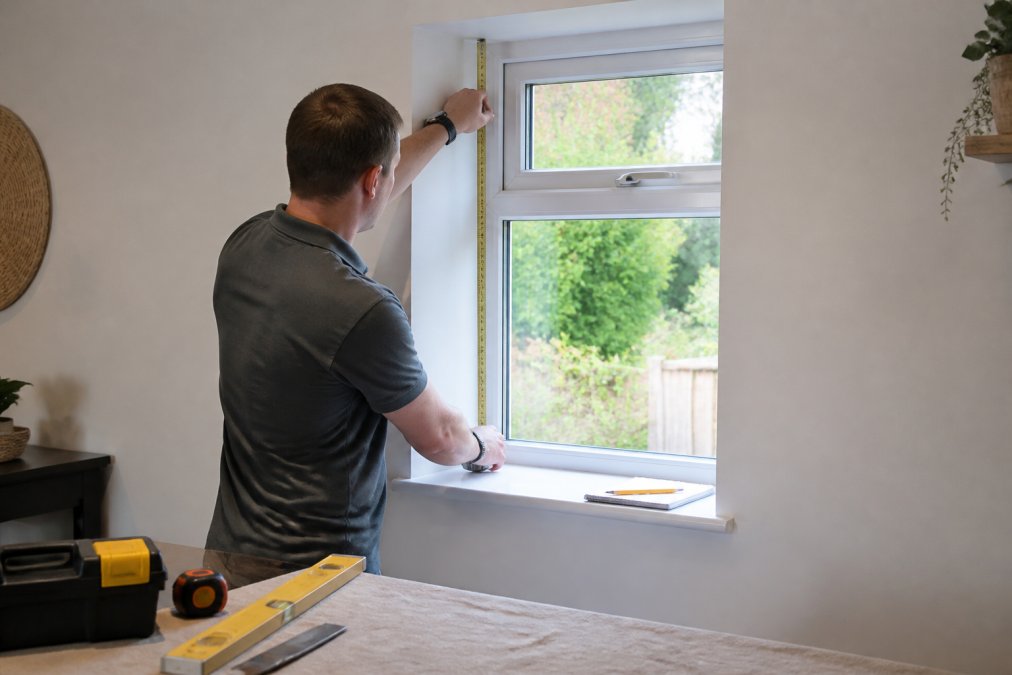
Measuring for curtains takes about ten minutes per window and a metal tape measure. Getting these numbers right is the difference between a curtain that hangs perfectly and one that needs remaking.
Width and Drop Measurements Explained
Width is the distance the curtain must cover when closed, measured across the track or pole, not the glass. Drop is the vertical measurement from the top of the track or pole to your chosen finish point.
Work through it in this order:
- Decide whether the curtain hangs inside the recess or across the wall.
- For a pole, measure between the finials, then add a small overlap at each end so the curtains meet in the middle.
- For a track, measure the full length, including any returns to the wall.
- Measure the drop from the top of the pole or underside of the track to your chosen finish point.
- Note your finish: sill length, below-sill, or floor length.
- Record both figures in the same units and double-check before ordering.
Common Measuring Mistakes to Avoid
A common mistake is measuring the glass rather than the track or pole, producing curtains too narrow to close properly.
Other traps worth avoiding:
- Measuring in feet and inches, then converting incorrectly. Work in centimetres throughout.
- Forgetting to account for a radiator or windowsill when choosing the drop.
- Measuring a bay window as a single flat span instead of treating each section separately.
- Taking the drop from the ceiling rather than from the pole or track.
Curtain Heading Types: Pencil Pleat, Eyelet and Pinch Pleat
The heading is where the curtain attaches to the track or pole, and it decides how the fabric folds. Three styles cover most homes: pencil pleat, eyelet and pinch pleat.
Pencil pleat uses a gathered tape sewn along the top, creating tight, uniform pleats. It suits tracks and poles and almost any fabric weight.
Eyelet curtains have metal rings set into the top and thread directly onto a pole. They produce deep, even folds and are the simplest to hang, though they only work on poles.
Pinch pleat is a tailored, hand-finished heading with fabric pinched into fixed pleats. It is the most formal of the three and suits living and dining rooms.
Which Heading Style Suits Your Track or Pole
Match the heading to your hardware before you order.
| Heading Style | Works With | Best For | Look |
|---|---|---|---|
| Pencil pleat | Track or pole | Bedrooms, versatile rooms | Neat, gathered |
| Eyelet | Pole only | Living rooms, modern interiors | Deep, relaxed folds |
| Pinch pleat | Track or pole | Formal spaces | Structured, tailored |
If you already have a track fitted, pencil pleat or pinch pleat are your options. If you have a pole and want the easiest possible hang, eyelet is the straightforward choice.
Blackout Lining for Curtains: Light Control and Thermal Performance
Blackout lining for curtains is a coated fabric layer sewn behind the main fabric to block incoming light, the difference between a room that dims and one that genuinely goes dark.
For bedrooms and nurseries, that distinction matters. A blackout lining stops light passing through the fabric itself, and when the curtain overlaps at the centre and extends past the window edges, it removes the light spill that wakes early sleepers.
How Blackout Lining Actually Works
A true blackout lining is a tightly woven base fabric, usually polyester, finished with a foam or acrylic coating, or a bonded layer of black yarn, that stops light at the fabric rather than filtering it. That is why a blackout-lined curtain takes a room to near-total darkness, while a heavy unlined curtain only dims it.
Three construction details decide how well it performs:
- Coating versus three-pass construction. Cheaper blackout fabrics use a single coating that can crack or flake over time. Better linings use a three-pass process, base fabric, black yarn layer, then a protective finish, which holds up to repeated drawing and folding.
- Fullness ratio. A blackout curtain only works if there is enough fabric to overlap at the centre. A fullness ratio of around 2 to 2.5 times the track width is the usual starting point; below that, light finds the gaps.
- Return to the wall. Extending the track past the window reveal and returning the curtain to the wall closes the side gaps that no lining can fix on its own.
Thermal Performance: What Lining Does to Heat Loss
A lined curtain adds a still-air layer across the window, and still air is a poor conductor of heat. The curtain slows the movement of warm air from the room to the cold glass rather than generating heat itself.
The effect is most noticeable on single-glazed windows and in rooms with large glazed areas, where glass is the weakest point in the building fabric. On a well-insulated modern window the gain is smaller.
Interlining, an extra layer between the main fabric and the lining, thickens that still-air layer and adds bulk, warmth and a richer drape. It is the biggest upgrade you can make to thermal performance, and it improves acoustics too. This commitment to material density mirrors the importance of durable fabric selection when coordinating your window treatments with the rest of your living room furniture.
For guidance on how window treatments fit into a whole-home approach to energy performance, see Energy Saving Trust advice on windows and draught-proofing.
Acoustic Dampening: What a Heavy Lined Curtain Can and Cannot Do
Sound behaves differently from heat. A heavy, lined curtain absorbs some sound energy that would otherwise reflect around a room, and adds mass at the window opening, reducing external noise.
The gains are real but modest. A lined curtain is most effective against mid- and high-frequency noise, traffic hiss, voices, street hum, and least effective against low-frequency sound such as bass or engine rumble. For a bedroom on a busier road, a lined and interlined curtain will noticeably soften the room; it will not silence it.
If noise is the primary concern, the biggest wins come from fabric weight, interlining, and closing the gaps around the edges. A curtain that overlaps at the centre and returns to the wall performs far better than one that hangs flat across the opening.
Fabric Choices and Sustainable Sourcing
Fabric composition decides how a curtain hangs, how it ages and how much light it blocks. The main choices are natural fibres, synthetics and blends.
How the Main Fibres Compare
Cotton drapes softly, takes dye well and suits living spaces, though it can fade in strong sun and creases more than blends. Linen has a similar natural look with a crisper hand and better longevity, but it wrinkles and is usually the most expensive. Polyester and polyester blends hold their shape, resist creasing and are easy to maintain, practical for busy households and for blackout constructions, where the coating bonds more reliably to a synthetic base. Velvet gives a heavier, warmer drape and pairs well with blackout lining, but it is the least forgiving of poor measuring because the weight exaggerates any unevenness in the heading.
A common pattern is to choose the fibre for the look and the lining for the performance: a linen face with a blackout or interlined backing gives natural texture without sacrificing light control or warmth.
What "Sustainable" Actually Means on a Curtain Label
Sustainability claims on textiles are only as good as the certification behind them. Three schemes are worth knowing:
- OEKO-TEX Standard 100 tests the finished fabric for harmful substances (oeko-tex.com). It is a safety standard, not an environmental one, but it is a useful baseline.
- Global Recycled Standard (GRS) verifies recycled content and traces it through the supply chain. If a fabric is described as recycled, this is the certification that backs it up.
- Global Organic Textile Standard (GOTS) covers organic fibre content plus environmental and social criteria across processing (global-standard.org).
If a fabric is described as "eco" or "responsible" without one of these, treat the claim as marketing until the supplier can name the certification and the mill.
The Sourcing Questions Worth Asking
A curtain that lasts a decade is a lower-waste choice than one replaced every couple of years, so fabric quality and construction matter as much as the label. Before ordering, ask:
- Where is the fabric woven, and is the mill named?
- Does the lining carry the same certification as the face fabric, or is it an uncertified add-on?
- Are offcuts and returns recycled, or sent to landfill?
- Is the curtain repairable, can a hem be let down or a lining replaced, or is it designed to be disposable?
None of these questions have a single right answer, but a supplier who can answer them usually sells fabric that will outlast a cheaper alternative.
Seeing the Fabric Before You Commit
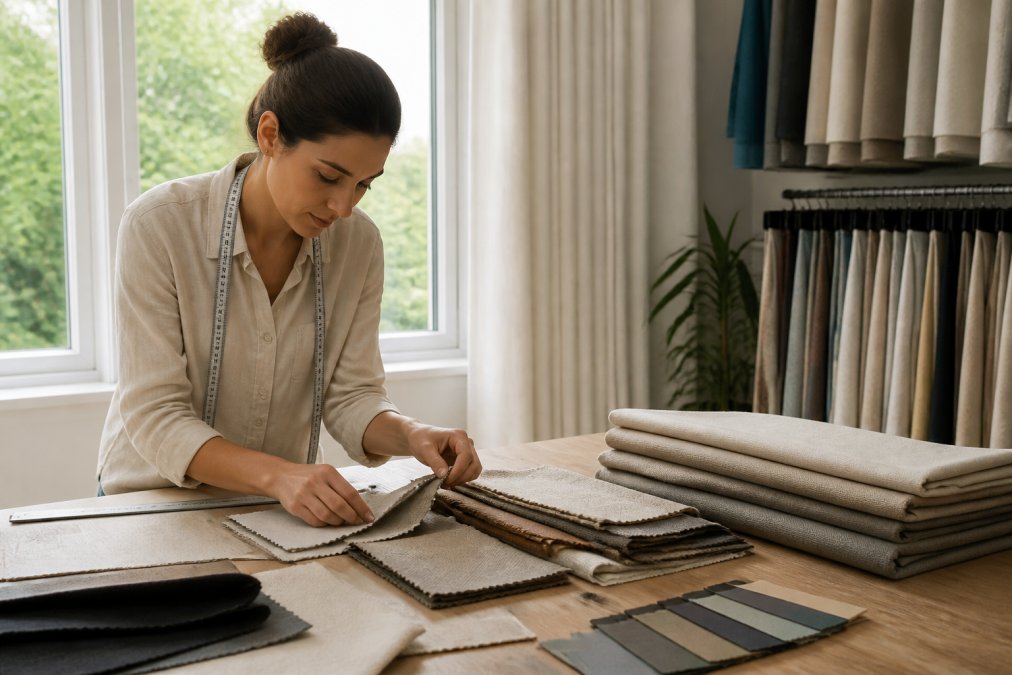
Requesting fabric swatches before ordering is the best way to judge colour, weight and texture in your own light. Screens distort colour, and a fabric that looks warm online can read cold against your walls. Swatches also let you check the hand of the fabric, how it feels and folds, which photographs cannot convey.
Customisation Options: Trimmings, Tie-Backs and Finishing Touches
Trimmings and tie-backs turn a well-fitted curtain into a finished window. They are optional, but they carry a lot of visual weight.
Common options include:
- Tie-backs in matching or contrasting fabric, or in metal and wood finishes.
- Trimming such as braid, piping or a contrast leading edge along the inner edge of the curtain.
- Interlining for extra body and a more luxurious drape.
- Contrast lining, which shows a flash of colour when the curtain is drawn back.
Machine-sewn headings are standard, while hand-finished detailing is available on more tailored styles. If unsure, keep trimmings subtle on patterned fabrics and let them do more work on plain ones.
Ordering, Lead Times and What to Expect
Ordering made-to-measure curtains online is straightforward once your measurements and fabric choice are settled. A typical order runs through a curtain builder: enter width and drop, select the heading, choose the lining, add trimmings, and confirm.
Because every item is cut to your specification, expect a lead time rather than next-day dispatch. Lead times vary by fabric and heading style, so check the estimate at checkout and order well ahead of a room's completion date.
A few practical points before you order:
- Confirm your measurements twice, in centimetres.
- Check the fullness ratio included in the price.
- Ask whether the price covers the track or pole, or the curtain only.
- Keep your order reference for any follow-up.
Just Blinds manufactures made-to-measure window treatments and delivers across the UK, with free delivery on orders over £175.
Troubleshooting Common Installation Issues
Most installation problems trace back to one of three things: the wrong fixings, an uneven track, or a curtain heavier than the hardware was rated for.
If curtains drag or stick when you draw them, the track is usually misaligned or the runners are overloaded. Check that the track is level along its full length and that the brackets are fixed into a solid surface, not plasterboard alone.
If light leaks around the edges, the curtain is too narrow or the track sits too far from the wall. Extending the track past the window edges and fitting a return to the wall closes most of that gap.
If the curtain hangs unevenly, the heading tape may have been gathered inconsistently, or the fabric needs a few days to settle. Give heavier fabrics time before adjusting anything.
Frequently Asked Questions
How much do made to measure curtains cost?
Pricing for made to measure window treatments depends on fabric choice, size, heading style, and lining options. Larger windows and premium fabrics will cost more. Just Blinds offers affordable pricing with free delivery on orders over £175. For an accurate quote based on your specific window dimensions and fabric selection, visit the Just Blinds website or use their online builder.
What is the difference between ready-made and made to measure curtains?
Ready-made curtains come in standard sizes and often leave gaps at the sides or puddle on the floor. Made to measure curtains are cut to your exact window dimensions, ensuring a clean drape and proper coverage. They also let you choose heading styles, linings, and fabric composition to suit your room's light control and insulation needs.
Do made to measure curtains provide better insulation than ready-made?
Yes. Made to measure curtains with thermal or blackout lining create a tighter seal against draughts because they fit your window precisely. Ready-made curtains often have gaps that let heat escape. The interlining and fabric composition also affect thermal performance, so choosing the right lining for your room makes a noticeable difference in energy efficiency.
How long does it take for made to measure curtains to be delivered?
Lead times vary depending on fabric availability, heading style, and whether you choose hand-finished or machine-sewn construction. Most made to measure items are delivered within two to four weeks. Just Blinds provides clear lead time estimates when you place your order, and free delivery applies on orders over £175.
Getting the measurements, heading and lining right is what separates a window that looks finished from one that never quite does. Just Blinds manufactures made-to-measure blinds and curtains with free delivery on orders over £175, replacement slats compatible with most existing rails, and blackout options built for nurseries and bedrooms. Start with your measurements, order your free fabric samples, and get started with Just Blinds to fit your windows properly the first time.
