
Table of Contents
- Made to Measure vs Ready Made Blinds: What Actually Fits
- Types of Windows and Blinds Explained: Roller, Venetian, Roman and Vertical
- Day and Night Blinds: How They Balance Light and Privacy
- How to Measure Windows for Blinds Without Costly Mistakes
- What You'll Need
- Step 1: Decide Inside or Outside the Recess [Time: 2 minutes]
- Step 2: Measure the Width [Time: 3 minutes]
- Step 3: Measure the Drop [Time: 3 minutes]
- Step 4: Check for Obstructions [Time: 2 minutes]
- Best Blinds for Living Room Spaces: Fabric, Colour and Light Control
- Blackout, Thermal and Child Safety Features Compared
- Smart Home Integration, Sustainability and Troubleshooting
- Conclusion
- Frequently Asked Questions
Last Updated: September 12, 2026
Made to Measure vs Ready Made Blinds: What Actually Fits
The biggest decision in any window treatment project is fit. Made to measure blinds are manufactured to your window's exact dimensions, while ready made blinds come in standard sizes that may leave gaps at the edges.
That gap matters: a blind 20mm too narrow lets a strip of light through every morning, and on a south-facing window it becomes a glare line across the room.
Just Blinds manufactures every made to measure order to your supplied sizes, removing the guesswork that trips up first-time buyers.
| Factor | Made to Measure | Ready Made |
|---|---|---|
| Fit accuracy | Exact fit to your window recess | Standard sizes only |
| Light gaps | Minimal when measured correctly | Common at edges |
| Bay windows | Straightforward | Difficult to fit well |
| Lead time | Slightly longer | Immediate |
| Best for | Living rooms, bedrooms, bays | Temporary or rental solutions |
Types of Windows and Blinds Explained: Roller, Venetian, Roman and Vertical
Four blind types cover most homes, differing mainly in how they stack, how much light they block, and how much space they occupy when open.
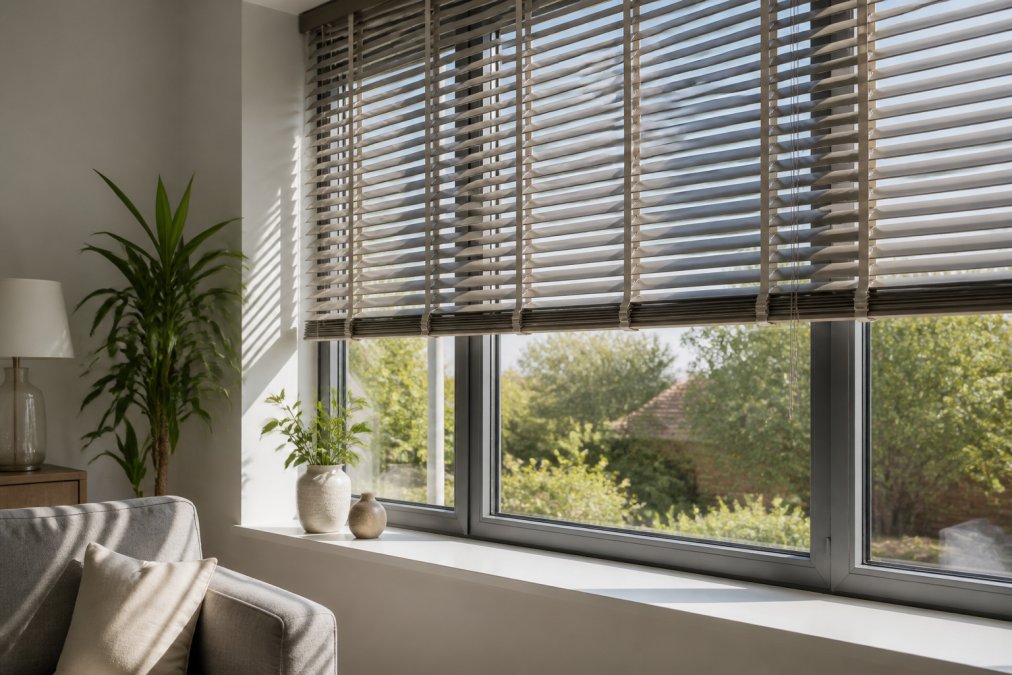
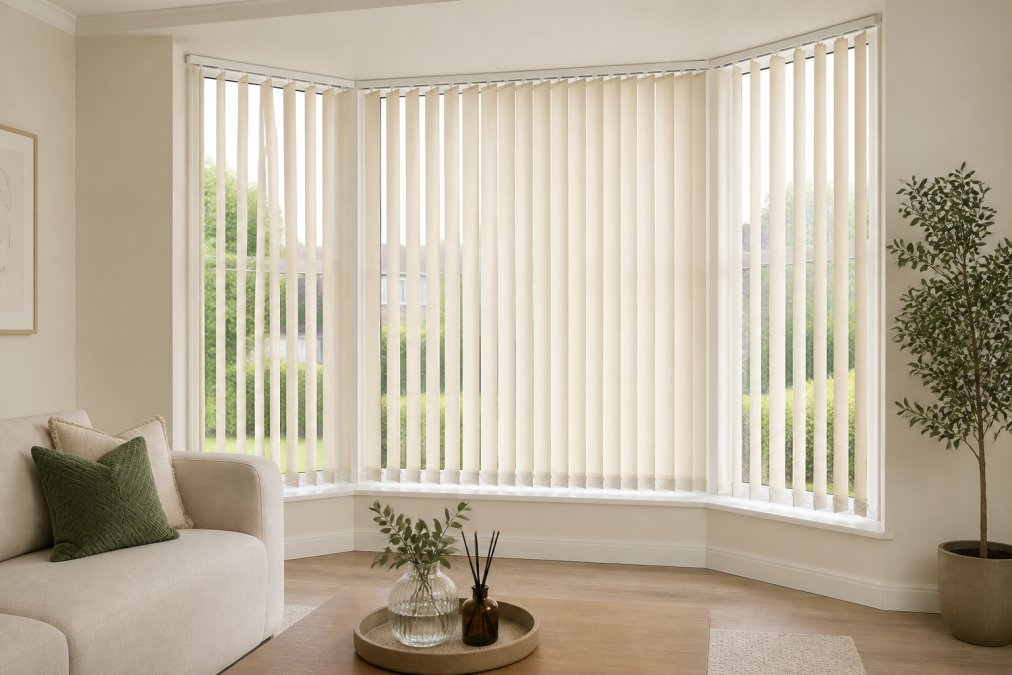
Roller blinds roll into a compact headrail and suit almost any window, making them the default for kitchens and bathrooms. Venetian blinds use tilting horizontal slats to control light direction without losing the view. Roman blinds fold into soft fabric panels and add warmth to living rooms and bedrooms, though they need more clearance above the window. Vertical blinds run on a track with louvres that rotate and draw to one side, the practical answer for patio doors and wide windows.

Roller and Day and Night Blinds
Day and night blinds, also sold as zebra blinds, use alternating opaque and sheer bands on a single roller.
Blackout roller blinds remain the simpler option for bedrooms.
Venetian, Roman and Vertical Options
Venetian slats come in 25mm and 50mm widths: wider slats look cleaner on large windows, narrower slats give finer light control on smaller panes (bsigroup.com).
Roman blinds bring fabric texture and colour that rigid slats cannot. Vertical blinds in a spongeable flatweave handle condensation well, and replacement louvres are inexpensive if one gets damaged.
Day and Night Blinds: How They Balance Light and Privacy
Day and night blinds give you two settings from one fitting: the sheer band diffuses harsh sunlight while keeping the room bright, and the opaque band blocks sightlines when you need privacy.
The trade-off: the fabric stack is thicker than a standard roller, so check headrail clearance on a shallow recess.
Where day and night blinds fall short is total darkness, the sheer sections still pass light, so a nursery or shift worker's bedroom is better served by a blackout roller or lined Roman blind.
How to Measure Windows for Blinds Without Costly Mistakes
Measuring is where most orders go wrong, and it takes about ten minutes per window. You need a metal tape measure, a pencil and a notepad, fabric tape stretches and gives a false reading.
Total time: 10-15 minutes per window Difficulty: Beginner
What You'll Need
- Metal tape measure
- Pencil and paper
- Step ladder for high windows
Step 1: Decide Inside or Outside the Recess [Time: 2 minutes]
Inside the recess gives the neatest finish. Outside mounting suits windows where the recess is too shallow for the headrail.
Step 2: Measure the Width [Time: 3 minutes]
For inside mounting, measure the recess width in three places and record the smallest figure. For outside mounting, add at least 50mm each side to reduce light bleed (which.co.uk).
Step 3: Measure the Drop [Time: 3 minutes]
Measure from the top of the recess to the sill, again in three places, and take the smallest figure. For outside mounting, decide how far below the sill you want the blind to finish.
Step 4: Check for Obstructions [Time: 2 minutes]
Look for window handles, vents and tilt mechanisms. Note the projection of anything that sits proud of the frame.
Expected Result: A width and drop pair for each window, taken at the narrowest point, ready to enter at checkout.
Ordering to your largest measurement rather than your smallest is the most common measuring error. A blind even a few millimetres too wide will not sit in the recess, and made to measure items are cut to your figures. ::: Precision is essential because even minor discrepancies in measuring your windows can compromise the fit of custom screens just as easily as they do for blinds.
Best Blinds for Living Room Spaces: Fabric, Colour and Light Control
The best blinds for a living room balance light control with the room's palette. Living rooms need flexibility: bright in the afternoon, private in the evening.
Start With Orientation, Not Colour
Start with the direction the window faces. South-facing rooms take direct sun, so a light-filtering fabric that diffuses rather than blocks works well. North-facing rooms are cooler and dimmer, so avoid heavy dark fabrics. East-facing rooms are bright in the morning and dim by evening. West-facing rooms get late, low sun.
Fabric Choice Does the Heavy Lifting
Fabric choice matters as much as colour. Spongeable flatweaves wipe clean. Linen-look and textured weaves add depth without pattern. Velvet-look and chenille suit larger living rooms but show dust and are harder to spot-clean.
Matching the Blind to the Interior Scheme
Warm minimalism and Japandi. Low-contrast, natural palettes. Light-toned wooden Venetian slats add warmth without colour.
Industrial. Exposed brick, dark metal, concrete.
Contemporary and monochrome. High contrast, clean lines.
Traditional and period properties. Sash windows, cornicing, deeper palettes.
Coastal and light-filled. Whites, blues, natural textures.
Colour Rules That Actually Hold
Cream and white remain the safest colours, while deeper tones work in larger spaces. Two rules hold: match the blind to the wall rather than the sofa if you want the room to feel larger; and if you want the blind to be a feature, make it the only strong pattern in the room.
Match the blind to the room's function first and its colour scheme second.
Blackout, Thermal and Child Safety Features Compared
Three features separate a basic blind from one that genuinely improves a room: blackout capability, thermal performance and child safety. Check all three before you order.
Blackout blinds block the vast majority of light at the fabric, right for nurseries, children's bedrooms and any room where total darkness helps sleep. Light can still creep around the edges, which is why accurate measuring matters.
Thermal blinds add insulation at the window, reducing heat loss in winter and keeping rooms cooler in summer. They work best fitted close to the glass.
Child safety is not optional. Corded blinds sold in the UK must meet child safety requirements, and cordless or wand-operated systems remove the loop entirely (gov.uk). Just Blinds offers a child safe wand system on its vertical blind range as an alternative to chain and cord control.
| Feature | What It Does | Best For |
|---|---|---|
| Blackout | Blocks most light at the fabric | Nurseries, bedrooms |
| Thermal | Reduces heat loss at the window | Cold or sunny rooms |
| Child safe wand | Removes hanging cords | Homes with young children |
| Moisture resistant | Wipes clean, resists damp | Kitchens, bathrooms |
Smart Home Integration, Sustainability and Troubleshooting
Three things determine whether you are happy with your blinds two years after fitting: how they connect to a smart home, what they are made from, and how to fix them when something goes wrong.
Smart Home Integration and Automation
Motorised blinds solve a problem manual blinds cannot: windows you cannot easily reach, tall stairwell glazing, roof lights and windows behind furniture.
There are three broad control tiers to understand before you buy:
- Remote-only motorised blinds. A handset controls raise, lower and tilt. No app, no scheduling. The simplest and cheapest tier, and often all a single awkward window needs.
- App and schedule control. Blinds connect over Wi-Fi or a proprietary bridge and can be grouped, timed and triggered. Useful for closing blinds automatically at dusk or opening them before you wake.
- Voice and hub integration. Blinds pair with the major smart home ecosystems so they respond to voice commands and can be included in routines alongside lighting and heating.
Sustainability and Eco-Friendly Materials
Sustainability in blinds comes down to three levers: what the fabric is made from, how the blind is manufactured, and how long it lasts.
Recycled fabrics. More roller and vertical ranges now use fabrics woven from recycled plastics, often recovered from bottles. They perform comparably to virgin polyester in light filtration and wipe-clean durability, so the trade-off is usually colour range rather than function.
Responsibly sourced wood and bamboo. Venetian blinds in basswood or bamboo are a renewable alternative to PVC and aluminium slats. They suit living rooms and studies but are a poor choice for bathrooms and kitchens, where humidity causes warping.
Made to measure as a waste reduction. Ready made blinds that do not fit get returned, restocked or scrapped. Made to measure blinds are cut to your sizes, so there is no surplus stock and no return journey, the single biggest sustainability argument for buying made to measure.
Longevity. The most sustainable blind is the one you do not replace. Spongeable flatweaves, replacement louvres and replacement slats all extend the life of a fitting that is otherwise sound.
Troubleshooting and Repair
Most blind faults trace back to a few causes, and most are fixable without replacing the whole blind.
A blind that will not raise. On a corded roller or Roman, the usual cause is a cord caught between fabric and headrail, or one that has jumped its pulley. Lower the blind fully, inspect the cord run and re-seat it. On a chain-operated roller, check the chain sits correctly in the sprocket.
A slat or louvre hanging unevenly. This almost always means a mounting bracket has worked loose or the headrail is no longer level. Check the brackets first, then the rail's level. Venetian slats can also be re-threaded through their ladder cords if one has slipped.
A cracked or bent vertical louvre. Vertical louvres are individually replaceable. If the headrail and carrier clips are sound, swap a single louvre in minutes rather than replacing the whole blind. Replacement louvres come in packs and fit most standard rails.
A blind that will not stay down. On spring-loaded rollers the spring tension has usually gone; on chain-operated rollers the clutch has worn. Both are headrail rather than fabric issues, and on some ranges the headrail can be replaced on its own.
Fabric that will not wipe clean. If a spongeable fabric has been marked by grease or a solvent-based cleaner, the mark may be permanent. Prevention matters more than cure: use only a damp cloth and mild detergent, and never a solvent on a coated fabric.
Just Blinds supplies replacement slats compatible with most existing rails, including Hilarys, Argos and Dunelm, and offers a child safe wand system on its vertical blind range as an alternative to chain and cord control.
Conclusion
Getting windows and blinds right comes down to measuring accurately, matching the blind type to the room, and choosing the right light-filtering grade.
Just Blinds manufactures made to measure blinds to your exact sizes, with free delivery on orders over £175, replacement slats compatible with most existing rails, and moisture-resistant options built for real homes. Whether you need blackout for a nursery or day and night blinds for a street-facing living room, you can get started with Just Blinds and fit a blind that actually fits.
Frequently Asked Questions
How do I measure my windows for made-to-measure blinds?
Use a metal tape measure and work in centimetres. For a recess fitting, measure the width at the top, middle and bottom of the window, then take the smallest figure. Measure the drop from the top of the recess to the sill in three places and use the shortest. For an exact-fit outside mount, add at least 5cm to each side and 10cm to the drop. Always order the smallest measurement to avoid gaps.
What are the benefits of day and night blinds for modern homes?
Day and night blinds use alternating sheer and opaque horizontal strips on a single headrail. You can align the opaque sections for privacy and light filtering during the day. They suit bedrooms, nurseries and living rooms where light control needs to change through the day.
Are blackout blinds effective for thermal insulation?
Blackout blinds reduce heat loss by trapping a layer of air between the fabric and the glass. They will not replace double glazing, but they can reduce draughts and keep rooms warmer in winter.
What is the average cost of blinds per window in the UK?
Costs vary by size, fabric and mechanism. Made-to-measure vertical blinds from Just Blinds start at £4.92 per blind, which makes them a cost-effective option for large windows, patio doors and offices.
