
Table of Contents
- Are Made to Measure Blinds Expensive? The Honest Cost Breakdown
- Made to Measure vs Ready Made Blinds: Price and Value Compared
- What Drives the Price of Bespoke Blinds?
- Cost of Fitting Blinds UK: DIY vs Professional Installation
- How to Measure Windows for Blinds: Avoid Costly Mistakes
- The Long-Term Value: Durability and Your Home
- Conclusion: Are They Worth the Investment?
- Frequently Asked Questions
Last Updated: September 6, 2026
Are Made to Measure Blinds Expensive? The Honest Cost Breakdown
The short answer is that made to measure blinds are often more affordable than people expect, with entry-level options starting well under £25 per window. For context, a standard vertical blind from a UK manufacturer can begin around £19.68, which is comparable to many ready-made alternatives once you factor in the cost of replacements and poor fit. At Just Blinds, we manufacture directly, which removes retail markups and makes custom-fit pricing far more accessible than the traditional perception of bespoke window treatments.

The real question isn't just the upfront price, but what you get for your money. A precision fit means no light gaps, no trimming to size, and no awkward gaps around the window recesses. Below, we'll break down the actual cost drivers, compare made to measure vs ready made blinds, and show you how to avoid the expensive mistakes that turn a budget purchase into a repeated one.
Made to Measure vs Ready Made Blinds: Price and Value Compared
The price gap between made to measure and ready made blinds is narrower than most buyers assume, and the value gap often favours the custom option. A ready-made blind might cost £10 to £15, but it comes in standard window sizes that rarely match your actual measurements. That means visible light gaps at the edges, a look that falls short of your interior design, and potentially a second purchase when you realise the fit is wrong.
Made to measure blinds are manufactured to your exact window dimensions, so the blind mechanisms align perfectly with the window recesses. This precision fit delivers better light control, improved thermal efficiency, and a cleaner aesthetic appeal that off-the-shelf options cannot match. When you consider that a well-fitted custom blind lasts years longer without the frustration of gaps or sagging, the initial price difference becomes a sound home improvement investment rather than an unnecessary premium.
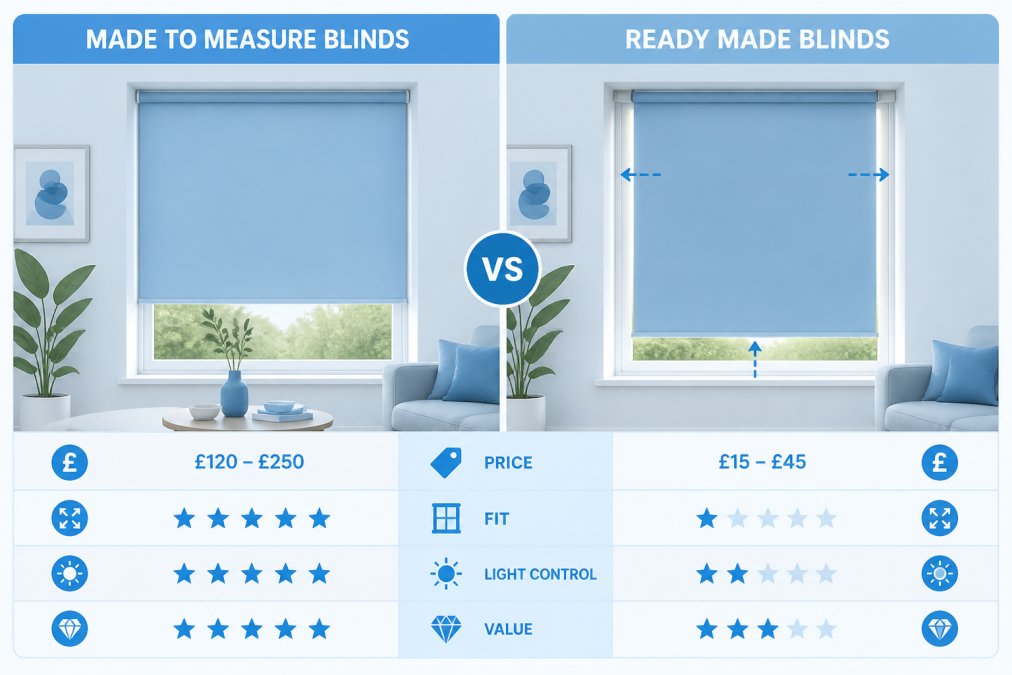
Many homeowners find that the cost of replacing a cheap ready-made blind multiple times can exceed the price of a single made-to-measure blind. The value for money becomes clear when you calculate cost per year of use rather than cost per purchase. For anyone prioritising aesthetic appeal and durable construction, the bespoke route is rarely the extravagance it first appears.
What Drives the Price of Bespoke Blinds?
Several factors determine the final price of made to measure blinds, and understanding them helps you avoid overpaying for features you do not need. The primary cost driver is the price per square meter of your chosen fabric, which varies significantly between basic polyester and designer fabrics with specialised finishes.
Material choice makes the biggest difference to your quote. Blackout material commands a premium because the dense weave and coating deliver total darkness for bedrooms and nurseries, while soft-touch fabrics and faux wood options sit at different price points based on their durability and maintenance requirements. The blind mechanisms also factor in, with child-safe wand systems and cordless options costing more than standard chain controls.
The width of your window matters more than the drop. A wide window requires more fabric and a sturdier headrail, so cost scales with width rather than height. Standard window size options are cheaper to produce, but genuinely non-standard openings still benefit from made-to-measure manufacturing because the alternative is a blind that simply does not fit.
Cost of Fitting Blinds UK: DIY vs Professional Installation
The cost of fitting blinds UK varies depending on whether you choose DIY installation or professional help, and the right choice depends on your confidence with a drill and your window type. DIY fitting is the budget option, typically costing nothing beyond your own time and basic tools, and it is perfectly achievable for standard rectangular windows with straightforward fixings.
Professional installation adds a fee on top of the blind price, but it removes the risk of damaged plaster, incorrectly positioned brackets, or blinds that sit crooked. For bay windows, tall stairwell windows, or installations requiring a ladder, professional fitting is often worth the additional cost. A common mistake is assuming all windows are simple to fit; recesses that are out of square or walls with unusual materials can turn a 20-minute DIY job into an afternoon of frustration.
| Installation Option | Cost | Best For | Risk Level |
|---|---|---|---|
| DIY fitting | Free (your time) | Standard windows, confident DIYers | Medium |
| Professional fitting | Varies by window count | Bay windows, high ceilings, multiple blinds | Low |
Before you decide, check whether your supplier offers fitting guidance or templates. Accurate measurement is the foundation of any successful installation, and the cost of fitting blinds UK becomes irrelevant if the blind itself is the wrong size.
How to Measure Windows for Blinds: Avoid Costly Mistakes
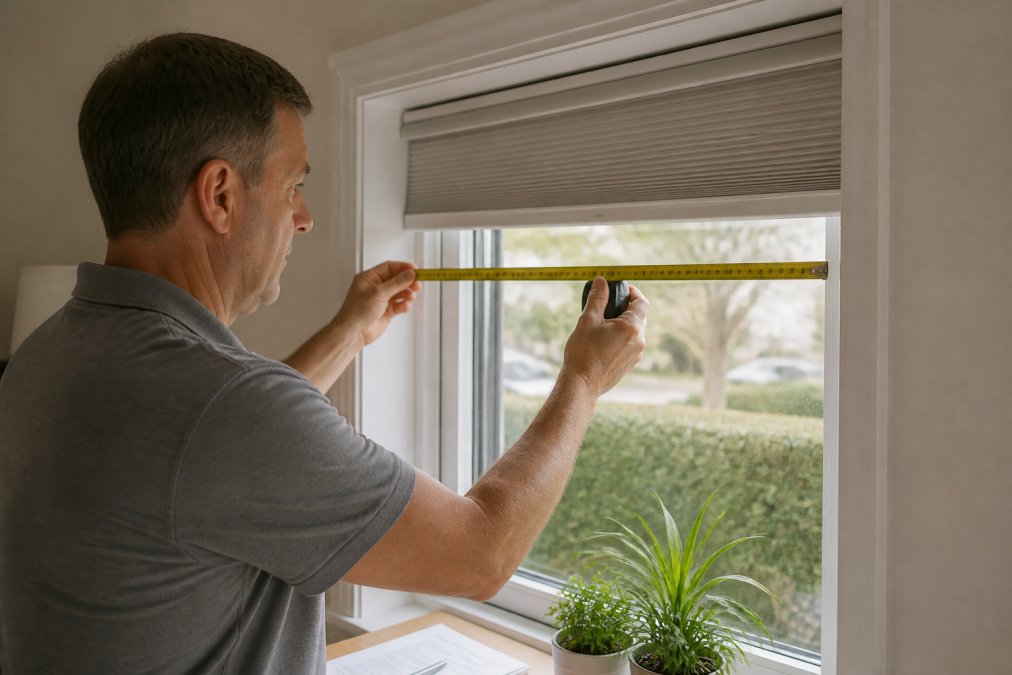
The fear of getting the measurements wrong is the single biggest psychological barrier to buying made to measure blinds. It is a valid concern: a 5mm error can render a blind useless, and unlike a faulty product, a measuring mistake on your part is rarely covered by a warranty. However, understanding the common pitfalls and how to correct them transforms this from a daunting task into a straightforward process.
The most frequent error is not the measuring itself, but the planning. Before you even pick up a tape measure, you must decide on your fitting type. This decision dictates every number you write down.
- Recess Fit: The blind sits inside the window opening. This is the most common choice for a clean, built-in look. You must measure the width at the top, middle, and bottom of the recess, as older walls are rarely perfectly square. Use the narrowest width measurement to ensure the blind will actually drop into the opening without catching. For the drop, measure from the top of the recess to the window sill at both sides and the centre. Use the longest drop measurement to ensure the blind clears the sill and doesn't let light in at the bottom.
- Exact Fit (or Outside Fit): The blind is fixed to the wall or frame outside the recess. This is ideal for bay windows, doors, or when you want to make a window look larger. Measure the full width of the area you want to cover, and then add at least 5cm on each side to ensure adequate light blockage. For the drop, decide how far below the sill you want the blind to finish and measure accordingly.
Once you have your numbers, the second most common error appears: using the wrong tools. A fabric tape measure can stretch and droop, leading to inaccurate readings. A metal tape measure is essential. Even then, a common mistake is to let the tape bend in the middle of a wide window, giving you a false reading. Always hold the tape taut and level.
Another frequent issue is rounding up or down. Blinds are manufactured to the millimetre. If you round a width of 92.4cm up to 93cm, you risk the blind being too wide for the recess. If you round down to 92cm, you will have a visible 4mm gap on each side. The correct approach is to provide the exact measurement you have taken, down to the millimetre. Do not try to 'fudge' the numbers to get a snugger fit; the manufacturing process is precise, and your measurements should be too.
Finally, a mistake that often goes unnoticed until installation: failing to account for obstructions. Window handles, tiles, and pipes can all interfere with the blind's operation. Before measuring for a recess fit, check that the blind's mechanism and fabric will have enough clearance to move freely past any protruding handles. A common workaround is to use a spacer bracket, but this is a solution you should plan for from the start, not discover after your blind has arrived.
If you are still concerned, many suppliers offer a measuring guide or a sample fitting kit. Taking advantage of these tools is a sign of a savvy buyer, not a hesitant one. It is far better to spend a few extra minutes confirming your numbers than to face the cost and hassle of a replacement.
The Long-Term Value: Durability and Your Home
The real test of whether made to measure blinds are expensive comes down to a long-term cost analysis, not just the initial price tag. While the upfront cost is higher, a deeper look at energy efficiency, longevity, and property value reveals a compelling financial argument for the bespoke option.
The Energy Savings Argument
Most cost guides ignore the thermal performance of window coverings, but this is where a precision fit pays for itself. According to the Energy Saving Trust, heat loss through windows accounts for a significant portion of a home's energy bill (energysavingtrust.org.uk). A made to measure blind with a snug recess fit creates a sealed layer of trapped air between the fabric and the glass, acting as an insulator (energy.gov). A ready-made blind that is too narrow or too short allows warm air to circulate freely around the edges, negating much of this benefit.
While the exact savings vary by window type and property, the principle is consistent: a tight fit reduces draughts. For a typical semi-detached house with multiple windows, the cumulative effect of eliminating these draughts can be noticeable on a winter heating bill. Over a decade, these savings can offset a significant portion of the initial price difference between a custom blind and a cheaper, ill-fitting alternative. This is not a niche benefit; it is a core functional advantage of a bespoke product.
Comparative Durability: Why Materials Matter
The price difference between a £20 ready-made blind and a £100 made to measure blind is not just about the fit; it is about the quality of the components. A cheap blind often uses a plastic headrail that can warp under the weight of the fabric or in direct sunlight, causing the mechanism to jam. The brackets are often lightweight and can pull away from the wall. The fabric itself may be a thin polyester that fades or loses its shape after a single season of sun exposure.
A made to measure blind from a reputable manufacturer often uses a powder-coated aluminium headrail, which is rigid and corrosion-resistant. The brackets are often heavier gauge and designed to hold the blind securely for years. The fabric may also be treated for UV resistance to prevent fading (the American Academy of Dermatology). This is not just about aesthetics; it is about the mechanism's ability to function smoothly over thousands of cycles. When you calculate the cost per year of use, a more durable blind can offer better value than a cheaper blind that needs frequent replacing.
The Property Value Angle
Beyond the physical durability, there is the impact on your home's perceived value. In the UK property market, first impressions are critical. An estate agent will often advise sellers to stage a home to look its best, and window dressings are a key part of that. A room with a made to measure blind that fits perfectly, with clean lines and no light gaps, looks considered and well-maintained. It signals to a potential buyer that the property has been cared for. In contrast, a cheap, ill-fitting blind with visible gaps can make an otherwise good room look neglected.
This effect is not limited to selling. For homeowners, the daily aesthetic benefit of a perfect fit contributes to a sense of quality and comfort that is difficult to quantify but is undeniably real. The light control is superior, the privacy is absolute, and the overall look is one of polished interior design. This is the 'value' that goes beyond the functional and enters the realm of home improvement.
Conclusion: Are They Worth the Investment?
Made to measure blinds are not inherently expensive, and when measured against their lifespan, fit quality, and the cost of repeated ready-made purchases, they often represent the more economical choice. The upfront price reflects precision engineering, quality materials, and a finish that transforms your window treatments from a functional afterthought into a feature of your home decor.
For most UK homeowners, the decision comes down to whether you value a one-time purchase that fits perfectly and lasts, or a cheaper option that may need replacing within a couple of years. At Just Blinds, we manufacture made to measure blinds to your exact specifications with affordable prices, free UK delivery on orders over £175, and options ranging from budget-friendly vertical blinds to moisture-resistant faux wood. Shop now to get the perfect fit for your space.
Frequently Asked Questions
Are made to measure blinds significantly more expensive than ready-made options?
Yes, made to measure blinds typically cost more upfront than ready-made ones. A basic made to measure vertical blind from Just Blinds starts at £19.68, while ready-made options can be found for under £10. However, the price difference buys a precision fit that eliminates light gaps and a product built to your exact window dimensions. Ready-made blinds often require trimming or leave gaps, which can undermine their function and appearance.
What factors influence the final price of made to measure blinds?
Several factors affect the final cost. The blind type is a major one: vertical blinds are generally the most budget-friendly, while Roman blinds and wooden options cost more. Fabric choice also matters, as designer or blackout materials command a premium over basic polyester. Size is key, as pricing is often calculated per square meter. Finally, the mechanism you choose, such as a child-safe wand system versus a chain, can add a small amount to the total.
Is it cheaper to fit blinds myself or hire a professional?
Fitting blinds yourself is always cheaper in direct costs, as you only need a drill, screws, and a spirit level. Professional installation avoids the risk of mistakes, but you will pay for the service. The real cost risk is measuring incorrectly, which can lead to expensive replacements. Our advice is to measure carefully and follow our guide to ensure a perfect fit the first time.
Do made to measure blinds add value to my home?
Yes, made to measure blinds can positively impact your home's aesthetic appeal and perceived value. Poorly fitting window treatments are noticeable and can detract from a room's decor. Bespoke blinds offer a polished, custom-fit look that suggests quality and attention to detail. While they may not directly increase your property's market valuation like a new kitchen, they make your home more attractive to potential buyers and contribute to a well-finished interior.
