

Table of Contents
- Quick Comparison: Affordable Blinds for Rental Properties
- No-Drill Blinds for Renters: Damage-Free Options
- Landlord Responsibilities for Window Coverings
- Made-to-Measure vs Ready-Made Blinds for Landlords
- Top Budget-Friendly Blinds for Rental Properties
- Durability, Maintenance, and Energy Efficiency
- Child Safety and UK Regulations for Rental Blinds
- Conclusion
- Frequently Asked Questions
Last Updated: September 16, 2026
Quick Comparison: Affordable Blinds for Rental Properties
Finding affordable blinds for rental properties UK means balancing low cost, damage-free fitting, tenant safety compliance and durability across tenancy changes. Vertical blinds remain the practical default, with made-to-measure options from Just Blinds starting at £4.92 per blind.
| Option | Typical Starting Price | Best For | Damage Risk | Maintenance |
|---|---|---|---|---|
| Vertical blinds (made-to-measure) | £4.92 | Patio doors, large windows, full-house refits | Low | Spongeable louvres |
| Blackout vertical blinds | £20.17 | Bedrooms, nurseries | Low | Wipe-clean PVC or spongeable fabric |
| No-drill / tension-mounted | Varies by system | Tenants who cannot drill | Very low | Light, easy to remove |
| Ready-made blinds | Low upfront | Standard window sizes only | Medium | Limited replacement parts |
No-Drill Blinds for Renters: Damage-Free Options
No-drill blinds fix without screws, using tension-mounted brackets wedged into the window recess or adhesive backing on the frame or glass. They exist because tenancy agreements commonly restrict structural alterations, and a screw hole in a UPVC frame eats into a deposit.

Landlord Responsibilities for Window Coverings
Landlord responsibilities for window coverings come down to three duties: blinds must be safe, must not create a hazard, and any fittings you install must be maintained in working order. Safety carries the legal weight.
Made-to-Measure vs Ready-Made Blinds for Landlords
Made-to-measure blinds are cut to your exact window dimensions; ready-made blinds come in fixed stock sizes. For landlords, the deciding factor is rarely the headline price but the gap, and the gap is where deposit disputes and repeat purchases live.
How to measure a window recess properly
Getting this wrong is the most common reason a made-to-measure order comes back unusable, and it is the step most landlord guides skip.
- Decide inside or outside the recess first. An inside (recess) fit looks tidier but needs a square recess at least 60mm deep. An outside (face) fit mounts on the wall or frame above the window, hides an uneven reveal, but adds width to the blind.
- For a recess fit, measure the width in three places, top, middle and bottom, order the narrowest, then deduct roughly 10mm so the blind does not bind against the plaster. Measure the drop in three places and order the longest, with no deduction for a vertical or roller blind.
- For a face fit, measure the width you want the blind to cover and add at least 50mm each side of the opening to cut light bleed, then measure the drop from the bracket mounting point to where the fabric should finish.
- Check for obstructions before ordering. Window handles, trickle vents, tilting casements and radiator tops foul blinds measured to the glass rather than the fittings. A handle projecting 40mm into the recess pushes a recess-fitted roller or Venetian out of square.
- Measure in millimetres, not centimetres. Suppliers cut to the millimetre, and a 5mm error on a 1200mm window is visible at the edge.
The replacement maths
The second factor is replacement. When one louvre on a made-to-measure vertical blind gets bent, you replace the louvre. When a ready-made blind fails, you replace the whole unit, and the size may be discontinued.
Made-to-measure vs ready-made at a glance
| Factor | Made-to-measure | Ready-made |
|---|---|---|
| Fit | Exact, closes light gaps | Fixed sizes, gaps at edges |
| Repair | Louvre or part replaceable | Whole unit replaceable |
| Reorder risk | Size held on file | Size may be discontinued |
| Upfront cost | Slightly higher | Lower |
| Five-year cost | Lower where damage occurs | Higher after one failure |
Where ready-made still makes sense
Ready-made is not automatically wrong. It suits a single small rental with standard-size windows and a short tenancy, or a temporary fix while a made-to-measure order is manufactured. The mistake is treating it as the default for a property you intend to let for years, because the saving at the till is usually smaller than the cost of the first replacement.
Top Budget-Friendly Blinds for Rental Properties
The best budget-friendly blinds for rental properties are made-to-measure vertical blinds in a neutral fabric, with blackout versions for bedrooms. They are cheap, hard-wearing and simple to repair one slat at a time.
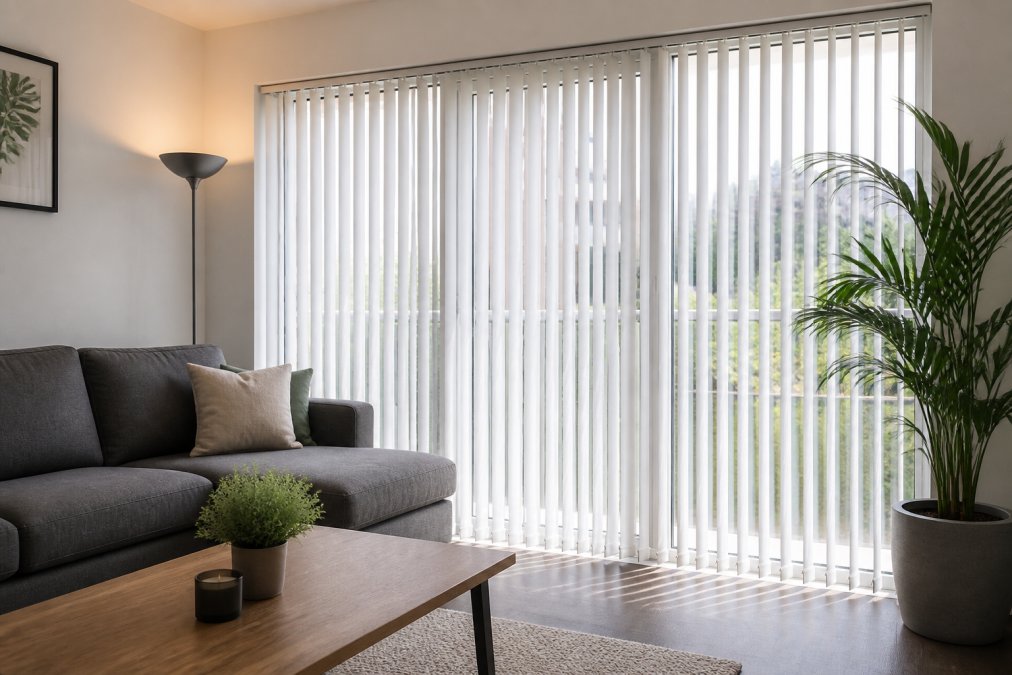
Vertical Blinds: Best for Patio Doors and Large Windows
Vertical blinds win on wide openings and patio doors because the louvres rotate to control light direction and slide clear without a large stack of fabric at one side. For a rental, that combination of light control and durability is hard to beat.
Blackout Blinds: Ideal for Bedrooms and Nurseries
Blackout blinds matter in rentals more than landlords expect. A bedroom that lets in streetlight or early summer sun is a complaint, and complaints about sleep become requests to break the tenancy early.
Durability, Maintenance, and Energy Efficiency
Durability in rental blinds comes down to three things: the headrail, the control mechanism and the fabric. Powder-coated aluminium headrails resist warping, and chain and cord or wand systems are reliable.
Made to Measure Vertical blinds in →
Durability and fair wear and tear
This is where blind choice has a direct financial effect. At the end of a tenancy, a deposit scheme adjudicator decides whether damage is "fair wear and tear", ordinary deterioration from living in a property, or tenant damage chargeable against the deposit. Blinds sit right on that line.
- Sewn louvres on an aluminium headrail hold their shape and do not delaminate at the edges, so an old blind still looks serviceable and is less likely to be reported as damaged.
- Wipe-clean PVC and spongeable flatweave mean marks from cooking, condensation or everyday handling come off at inspection rather than being logged as damage.
- Replaceable louvres let you fix a single damaged slat as routine maintenance instead of pursuing the tenant for a full blind.
Energy efficiency and EPC ratings
On energy efficiency, blinds are a secondary measure. A well-fitted blind can reduce solar gain in summer and add a small insulating layer at the glass in winter, but it does not replace loft insulation or draught-proofing. It can help in rooms with single-glazed or older windows.

Maintenance schedule for landlords
A short routine keeps blinds serviceable across tenancies and supports the wear-and-tear position if a dispute arises:
- Wipe louvres and headrails at each inspection with a damp cloth
- Check that tensioning devices are still anchored and taut
- Replace any bent or torn louvre before a new tenancy starts
- Note the blind's condition and any replacements in the inspection record
- Keep the original specification and order details on file for each property
Child Safety and UK Regulations for Rental Blinds
Child safety for rental blinds is governed by the requirement that any cord or chain loop must be eliminated or held under tension so a child cannot become entangled. Cordless wand controls and tensioned chain systems both satisfy this.
For landlords, the practical checklist is short:
- Confirm every blind has either a wand control or a fitted tensioning device
- Check that tensioning devices are actually anchored, not just clipped loosely
- Replace any blind with a free-hanging loop before a new tenancy starts
- Keep the fitting instructions and specification on file for each property
- Re-check tensioned cords at each inspection, since they loosen over time
Conclusion
The gap between a cheap blind and a cost-effective one shows up at the end of the tenancy, not at the till. Blinds that fit properly, use sewn louvres on an aluminium headrail and can be repaired one slat at a time will outlast two or three sets of ready-made alternatives, without the deposit disputes that damage-free options exist to prevent.
Frequently Asked Questions
What are the best blinds for a rental property?
The best blinds for a rental property balance cost, durability, and tenant-friendly installation. Vertical blinds are a top choice for patio doors and large windows, while blackout vertical blinds suit bedrooms. Look for made-to-measure options that fit precisely, reducing gaps and damage. No-drill or tension-mounted styles can be considered if you want to avoid permanent fixings. Materials like PVC or faux wood can be easy to clean.
Are no-drill blinds suitable for rental properties?
Yes, no-drill blinds are a practical choice for renters who cannot make permanent alterations. Tension-mounted or adhesive-backed options avoid drilling into window frames or walls, reducing the risk of deposit deductions. However, check your tenancy agreement first, as some landlords still require professional installation. No-drill blinds can be suitable for standard window recesses. They can offer a damage-free way to add privacy and light control.
Should a landlord pay for blinds?
In most cases, landlords are not legally required to provide blinds unless the tenancy agreement states otherwise. However, many landlords do install blinds to make a property more attractive and to protect against tenant-installed alternatives that could cause damage. If blinds are already fitted, landlords are typically responsible for repairs or replacement due to fair wear and tear. Clarifying this in the tenancy agreement avoids disputes later.
What are the most durable blind materials for rental units?
Durable materials for rental units include PVC, faux wood, and aluminium. PVC vertical blinds can resist moisture and are wipe-clean, making them suitable for kitchens and bathrooms. Faux wood can offer the look of real wood. Aluminium venetian blinds are lightweight and sturdy. For fabric options, spongeable or washable fabrics can be chosen. These materials can handle frequent cleaning and can last longer.
Do landlords usually replace blinds?
Landlords typically replace blinds if they are broken or worn beyond fair wear and tear. Normal wear and tear, such as slight fading or minor slat damage, is usually the landlord's responsibility. However, if damage is caused by tenant negligence, the landlord may deduct the cost from the deposit. The tenancy agreement should outline who is responsible for window coverings. Clear communication and a check-in inventory help avoid disputes.
