
Table of Contents
- Are Faux Wood Blinds Worth It? The Honest Verdict
- Faux Wood Blinds Pros and Cons: What You Gain and Give Up
- Faux Wood vs Real Wood Blinds: Which Suits Your Home?
- Are Faux Wood Blinds Waterproof? What Moisture Really Does
- How to Clean Faux Wood Blinds Without Damaging Them
- Total Cost of Ownership: What You Pay Over Five Years
- Room-by-Room Guide: Where Faux Wood Blinds Work Best
- Conclusion: Who Should Buy Faux Wood Blinds?
- Frequently Asked Questions
Last Updated: October 13, 2026
Are Faux Wood Blinds Worth It? The Honest Verdict
For most homes, are faux wood blinds worth it? They give you the look of wooden Venetian blinds, hold up in damp rooms, and cost less than real wood.
At Just Blinds, we make faux wood Venetian blinds to your exact sizes, so gaps and wonky drops are not part of the deal.
The short answer: buy faux wood for kitchens, bathrooms, and busy family rooms. Choose real wood only where the grain itself is the point.
Faux Wood Blinds Pros and Cons: What You Gain and Give Up
Faux wood blinds trade a little authenticity for practicality. Each slat is 3mm thick composite PVC, textured to copy natural wood grain, so they shrug off steam, splashes, and the occasional damp cloth.
The Pros: Moisture Resistance, Cost, and Easy Cleaning
Moisture resistance is the headline. Real timber swells and warps when it takes on water; composite PVC does not, making faux wood a sensible pick for kitchens, bathrooms, and wet rooms.
Cleaning is the second win. A damp cloth and mild detergent handle most marks, no oiling, sealing, or sanding.
Cost is the third. Our faux wood range starts at £13.36 for the Dream Stone White 50mm, which puts the wood look within reach of most renovation budgets.

The Cons: Weight, Repairs, and Resale Reality
Weight is the honest drawback. PVC slats are denser than timber, so a very wide blind needs a solid fixing and a headrail that can carry the load.
Repairs are the second limit. If a slat bends or cracks, you replace it rather than sand it out.
Resale value is the third. Faux wood will not add the premium solid timber joinery might. It is a practical upgrade, not an investment piece.
| Factor | Faux Wood | Real Wood |
|---|---|---|
| Moisture resistance | High | Low |
| Upfront cost | Lower | Higher |
| Weight | Heavier | Lighter |
| Repairability | Replace slat | Sand and refinish |
| Best rooms | Kitchens, bathrooms | Living rooms, bedrooms |
Faux Wood vs Real Wood Blinds: Which Suits Your Home?
Real wood blinds suit dry, low-traffic rooms where the grain is on show. Faux wood suits everywhere damp, busy, or budget-tight.
Side-by-Side Comparison: Cost, Durability, and Appearance
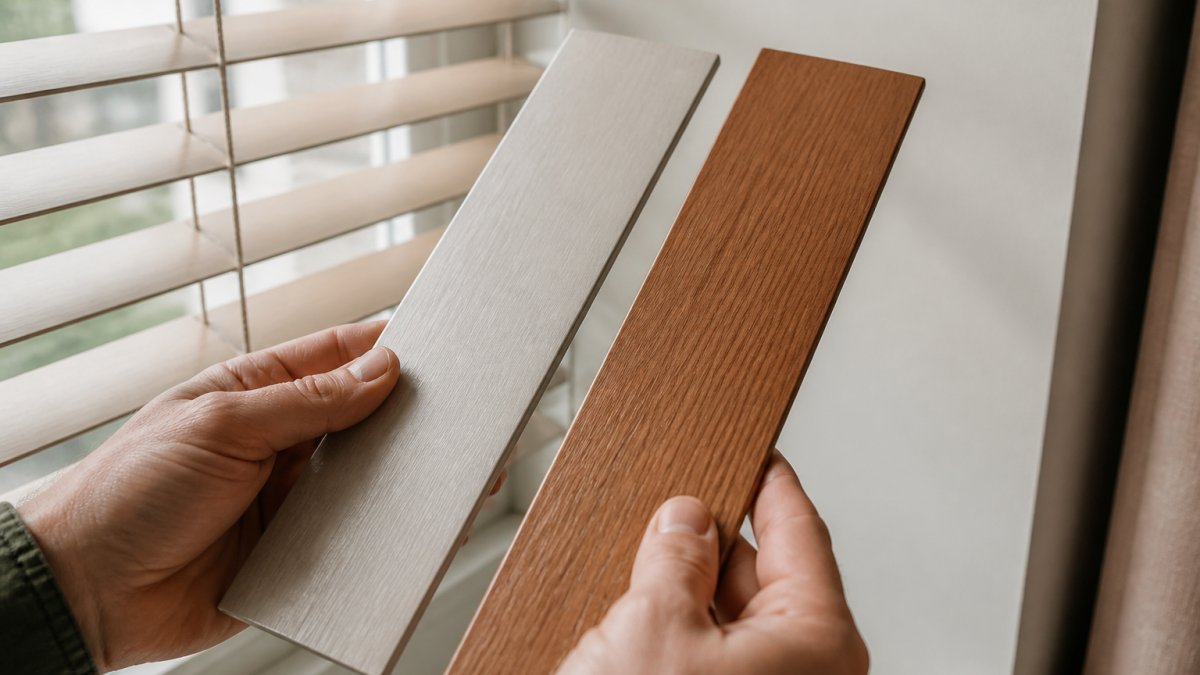
Appearance has narrowed the gap. Modern embossed finishes, such as our Alina Fine Grain White or Realm Grey, carry a subtle texture that reads as grain from across a room.

Durability favours faux wood in any room with humidity. Timber expands, contracts, and fades with temperature and sunlight; composite PVC holds its shape and colour far better.
Cost favours faux wood at the till.
How Long Do Faux Wood Blinds Actually Last?
In a dry room with normal use, a well-fitted faux wood blind commonly gives eight to twelve years before the finish or cord mechanism shows its age. In a bathroom or kitchen, that range holds up better than timber, which is why the material is often specified for wet rooms.
The variables that shorten life are predictable:
- Direct heat. A slat against a radiator or in constant strong sun can discolour or soften over several years. Composite PVC copes with temperature swings better than timber, but is not immune to prolonged heat.
- Weight on wide spans. PVC slats are denser than timber, so a very wide blind puts more load on the headrail and ladder strings. A split headrail or centre support is the usual fix.
- Cleaning method. Abrasive creams and soaking wet cloths dull the finish and corrode the cord mechanism. Mild detergent and a barely damp cloth keep slats and hardware in good order.
Warranty Terms That Actually Matter
Warranty length is a poor guide on its own. What matters is what it covers and excludes. Check these points:
- Slat versus mechanism coverage. Many warranties cover the headrail and tilt mechanism for longer than the slats, or vice versa. Read both.
- Colour fade. Some warranties exclude fading entirely, the most common complaint in sunny rooms. If fade cover matters, confirm it in writing.
- Humidity exclusions. A warranty that voids cover in bathrooms defeats the purpose of a moisture-resistant blind. Check whether damp rooms are excluded.
Where Each Material Genuinely Wins
| Factor | Faux Wood | Real Wood |
|---|---|---|
| Moisture resistance | High | Low |
| Upfront cost | Lower | Higher |
| Weight | Heavier | Lighter |
| Typical dry-room lifespan | 8-12 years | 10-15 years with upkeep |
| Typical damp-room lifespan | 8-12 years | Shortened by humidity |
| Repairability | Replace slat | Sand and refinish |
| Colour fade risk | Low | Moderate to high |
| Best rooms | Kitchens, bathrooms, family rooms | Living rooms, bedrooms, formal spaces |
Real wood wins on grain depth, refinishability, and the feel of the slat in the hand. Faux wood wins on moisture, cleaning, upfront cost, and colour stability. If your window is dry and the grain is the point, timber is the better buy. If the room is damp, busy, or budget-conscious, faux wood will still look right in a decade.
Are Faux Wood Blinds Waterproof? What Moisture Really Does
Faux wood blinds are water-resistant rather than fully waterproof. The composite PVC slats will not swell, warp, or rot when they meet steam and splashes.
That distinction matters in practice. A bathroom window catching daily steam is no problem; leaving a blind in standing water is a problem for any material.
Humidity is where faux wood pulls ahead of timber. In high-humidity areas, real wood absorbs moisture, swells, and can bow along a slat.
What Heat Really Does to Composite PVC
Heat resistance is often oversold. Composite PVC copes with temperature swings that would dry out and crack timber, but it is not heat-proof:
Dream Stone White Faux Wood Venetian Blinds | 50mm Made to Measure →
- Near a radiator or hot south-facing window, a slat can soften slightly and, over several years, discolour. White finishes yellow first; darker finishes dull rather than shift colour.
- In a conservatory or room that regularly exceeds normal indoor temperatures, slats can bow under their own weight, the most common heat-related complaint.
- In a normal kitchen or bathroom, where heat is intermittent, the material performs well and shows no meaningful degradation over a decade.
The practical rule: faux wood is fine anywhere a person would be comfortable. It is not the right choice for a space that regularly gets genuinely hot.
Real-World Failure Modes to Expect
Balanced buying guidance means naming what goes wrong, not just what goes right. The most common issues:
- Sagging on wide windows. PVC slats are denser than timber, so a wide blind puts more load on the headrail and ladder strings. Sagging in the middle is usually under-support, not a defect; a split headrail or centre support solves it.
- Discolouration. Sun and heat are the main causes. Keeping slats tilted slightly rather than fully open in strong sun reduces exposure.
- Bent or cracked slats. These cannot be sanded back like timber. The fix is a replacement slat, which is why buying spares at purchase is worth the small extra cost.
Indoor Air and Material Considerations
Composite PVC is stable and inert once formed, and does not shed fibres or need chemical treatments the way some timber products do.
Recyclability is mixed. PVC is technically recyclable, but kerbside collection rarely accepts it, so end-of-life disposal usually means a trip to a household waste recycling centre.
NHS guidance on controlling damp and condensation in the home is worth reading if condensation is a recurring issue, because ventilation often matters more than the blind itself.
How to Clean Faux Wood Blinds Without Damaging Them
Cleaning faux wood blinds takes minutes if you do it little and often. Dust weekly, wipe monthly, and never soak the headrail.
- Close the slats flat and dust both sides with a microfibre cloth or a soft brush attachment.
- Tilt the slats the other way and repeat on the reverse face.
- Mix a few drops of mild washing-up liquid in warm water.
- Wring a cloth until it is barely damp, then wipe each slat from the centre outwards.
- Dry immediately with a clean cloth so no water sits in the ladder strings.
- Spot-clean grease marks in kitchens with the same solution, then dry.
For everyday upkeep, a quick pass with a duster keeps them sharp. Our faux wood range is built for low-effort maintenance, which is why it holds up in kitchens and bathrooms.
Total Cost of Ownership: What You Pay Over Five Years
Total cost of ownership is where faux wood quietly wins. Purchase price is only part of the story; replacement and upkeep make up the rest.
Our Dream Stone White 50mm starts at £13.36, and the Alina and Realm finishes start at £14.02, so a whole-room refresh stays affordable.
Fit matters too. Made-to-measure sizing removes the gaps and light leaks of off-the-shelf sizes, and free delivery applies on orders over £175.
| Cost Area | Faux Wood | Real Wood |
|---|---|---|
| Upfront price | From £13.36 | Higher |
| Cleaning products | Mild detergent | Specialist oil or wax |
| Repairs | Replacement slat | Refinishing or replacement |
| Damp-room lifespan | Long | Shortened by humidity |
Room-by-Room Guide: Where Faux Wood Blinds Work Best
Kitchens and bathrooms are the obvious fit. Steam, splashes, and grease are routine there, and moisture-resistant PVC takes all three without complaint.
Family rooms and hallways come next. Our Realm Grey Embossed finish suits a contemporary living space, while Alina Smooth White keeps things crisp.

Bedrooms need a note of caution.
Wide windows and patio doors need a plan. Because PVC slats are heavier, check the fixing and consider a split headrail on very wide spans.
Conclusion: Who Should Buy Faux Wood Blinds?
Buy faux wood blinds if you want the wood look without the wood upkeep. They suit kitchens, bathrooms, wet rooms, busy family spaces, and any window where damp or heavy use would ruin timber.
Just Blinds makes faux wood Venetian blinds to your exact sizes, from £13.36, with an aluminium headrail, cord tilt and lift control, and braided ladder strings matched to the slat colour.
Frequently Asked Questions
Are faux wood blinds better than real wood blinds?
It depends on the room. Faux wood blinds handle moisture, humidity, and temperature swings far better than real wood, so they suit kitchens and bathrooms where wooden Venetian blinds can warp or crack. Real wood offers a natural grain finish that composite PVC cannot fully replicate, which matters in a living room or dining room. For most homes, faux wood blinds deliver the look of real wood at a lower upfront cost and with less maintenance.
Are faux wood blinds waterproof?
The slats themselves are moisture resistant because they are made from composite PVC, so splashes and steam will not swell or warp them the way real wood does. The cords, ladder strings, and aluminium headrail are not waterproof, so avoid spraying water directly onto the mechanism. A damp cloth is enough for routine cleaning. This is why faux wood blinds suit bathrooms, kitchens, and wet rooms where wooden Venetian blinds would struggle.
How long do faux wood blinds last?
The slats resist warping, cracking, and fading better than real wood in humid or sunny spots, but the cords and tilt mechanism wear out first. Replacement slats and cord repairs extend the life of the blind considerably, which is worth factoring into your decision.
How do you clean faux wood blinds?
Dust the slats weekly with a microfibre cloth or a blind duster, working from top to bottom with the slats tilted flat. For greasy kitchen film or bathroom residue, wipe each slat with a cloth dampened in warm water and a drop of washing-up liquid, then dry immediately. Avoid soaking the cords and headrail, and skip abrasive cleaners, which can dull the wood-like finish. A monthly deeper clean keeps them looking new.
Are faux wood blinds worth the money compared with other blind types?
For most rooms, yes. Faux wood blinds start from around £13 to £14 per blind in made-to-measure sizes, which is well below real wood. They resist moisture, hold their shape, and need only occasional wiping. The main trade-off is weight on very wide windows and a less convincing finish up close. If you need a durable, low-maintenance blind that looks like wood, they are strong value.
Choosing between materials is the easy part; getting the measurements right is where most projects go wrong. Just Blinds takes the guesswork out with made-to-measure faux wood Venetian blinds, free delivery on orders over £175, and replacement slats that work with most existing rails. Browse the Dream Stone White, Alina, and Realm finishes, then order your sizes and get a fit that finally closes the gap.
