
Table of Contents
- Why Bay Windows Need Different Blind Solutions
- Vertical Blinds for Wide Window Spans
- How to Measure Bay Windows for Blinds
- Made to Measure Bay Window Blinds: Precision and Fit
- Fitting Blinds in a Bay Window: Installation Essentials
- Light Control, Privacy and Thermal Efficiency
- Choosing Between Roller Blinds and Venetian Options
- Conclusion
Why Bay Windows Need Different Blind Solutions
Bay windows project outward at an angle, creating multiple planes that standard blinds can't accommodate. Off-the-shelf blinds leave gaps, hang unevenly, and won't operate smoothly across curved or angled surfaces. The best blinds for large bay windows require precision engineering and made-to-measure fitting to eliminate light leakage and maintain a professional appearance.
At Just Blinds, we offer solutions for homeowners facing this challenge. The solution isn't forcing a standard blind into an awkward space, you need a system designed specifically for the bay's geometry. Vertical blinds with curved rails follow the window's contour and stack neatly at the sides. The key insight most people miss: the best blinds for large bay windows aren't about fabric or colour, they're about how the system accommodates the window's angle and projection depth.

Vertical Blinds for Wide Window Spans
Vertical blinds are the most popular choice for bay windows. The vertical slats hang independently from a headrail, allowing them to follow the bay's contours without bunching or twisting. When opened, they stack neatly at one or both ends, maximising light and providing complete coverage when needed.

89mm and 127mm slat widths for different bay configurations
The 89mm slat width is the industry standard and works beautifully for most bay windows. These narrower slats provide excellent light control precision and hang elegantly in tighter bays. The British Blind Association guidance on slat sizing confirms that 89mm remains the most versatile choice for residential applications.
For larger bay windows spanning more than 2 metres, the 127mm slat width becomes attractive. Wider slats create a contemporary aesthetic, require fewer individual slats, and provide slightly better insulation properties. The trade-off is less granular light control.
Just Blinds' Cameo Cream Vertical Blinds in 89mm offer a neutral backdrop starting at £4.92. For a bolder statement, the Chatsworth Black Vertical Blinds in 89mm feature a striking leaf pattern at £22.12. For the 127mm option, the Unicolour Charcoal Vertical Blinds deliver sophisticated styling at £21.17.

Curved rails for smooth bay angles
A standard straight headrail won't follow a bay window's curve. You need a curved rail that bends to match your window's geometry. Just Blinds manufactures curved rails made to measure to your exact bay angle and width. The Curved Rail For Vertical Blinds costs £207.00 and arrives in two halves, each with its own control mechanism, allowing you to open the blinds from the centre like curtains.
The curved rail requires three precise measurements: total width, projection depth (how far it extends from the wall), and height. The projection depth must not exceed 50% of the width ([EXTERNAL_LINK: BSI Group standards | standardsdevelopment.bsigroup.com]). If your bay is too deep relative to its width, use individual straight rails on each panel instead.
How to Measure Bay Windows for Blinds
Measuring incorrectly is the most common reason blinds don't fit. The geometry is more complex than a flat window, and small errors compound quickly.
Inside mount vs outside mount for bay configurations
An inside mount places the headrail inside the window recess, attached to the inner frame edges. An outside mount extends beyond the frame, with the headrail attached to the wall or external bay edges.
Inside mounts look neater and maximise light when open, but require a deep enough recess (typically 8-10cm). Many bay windows have shallow recesses, making inside mounts impossible. Outside mounts are more forgiving and provide better light blocking because the blind extends beyond frame edges. For bay windows, outside mounts are often the better choice because they accommodate projection depth more easily.
Accounting for bay angle and projection depth
Measure the width at three points: top, middle, and bottom. Bay windows often taper slightly, so use the widest measurement and note the variation. Measure the projection depth, the distance from where the window frame meets the wall to the furthest point of the bay. Finally, measure the bay angle by placing a straight edge across the width and measuring the perpendicular distance to the window frame at the midpoint.
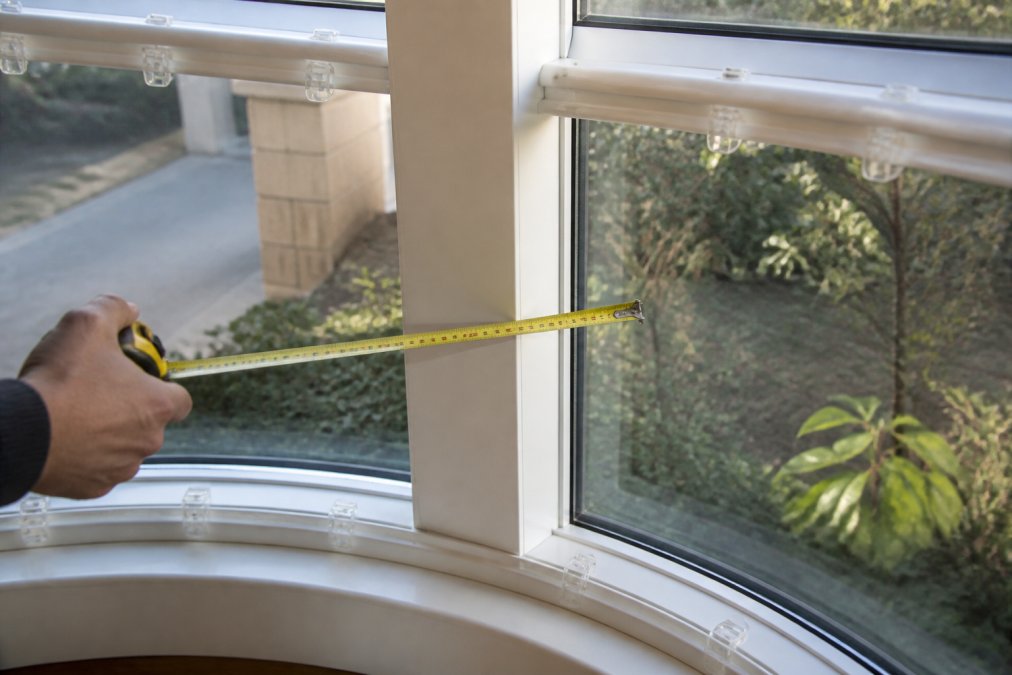
Document measurements carefully and include them with your order. Just Blinds' made-to-measure approach means your blind is manufactured to your exact dimensions.
Made to Measure Bay Window Blinds: Precision and Fit
Made-to-measure means your blind is manufactured specifically for your window, eliminating gaps and light leakage that plague off-the-shelf alternatives. A bespoke curved rail is engineered to your bay's exact width and angle. Slats are cut to your exact drop height, with no excess bunching or gaps.
A properly fitted blind seals against your window frame, critical for blackout blinds in bedrooms or nurseries. Thermal efficiency improves because the blind sits flush against the frame, reducing heat loss. Made-to-measure blinds often cost less than expected, Just Blinds' basic vertical blinds start at £4.92, with the curved rail adding £207.00.
Just Blinds manufactures replacement slats compatible with most standard rails, including those from Hilarys, Argos, and Dunelm. Your investment is protected; if a slat gets damaged years later, you can replace just that component.
Fitting Blinds in a Bay Window: Installation Essentials
Installation is where many people stumble. A perfectly manufactured blind can still fail if installed incorrectly.
Bracket clearance and headrail positioning
The headrail must be positioned so the blind hangs vertically when closed. In a bay window, this means accounting for the bay's angle. For a curved rail system, this is built into the design. For individual straight rails on each panel, position each rail perpendicular to that panel's plane, not to the room's horizontal plane. living room design.
Bracket clearance is equally critical. Brackets must clear any window furniture, handles, or architrave. Measure the distance from the window frame to the furthest projection of any obstruction, then ensure brackets extend at least that far.
Avoiding common installation mistakes
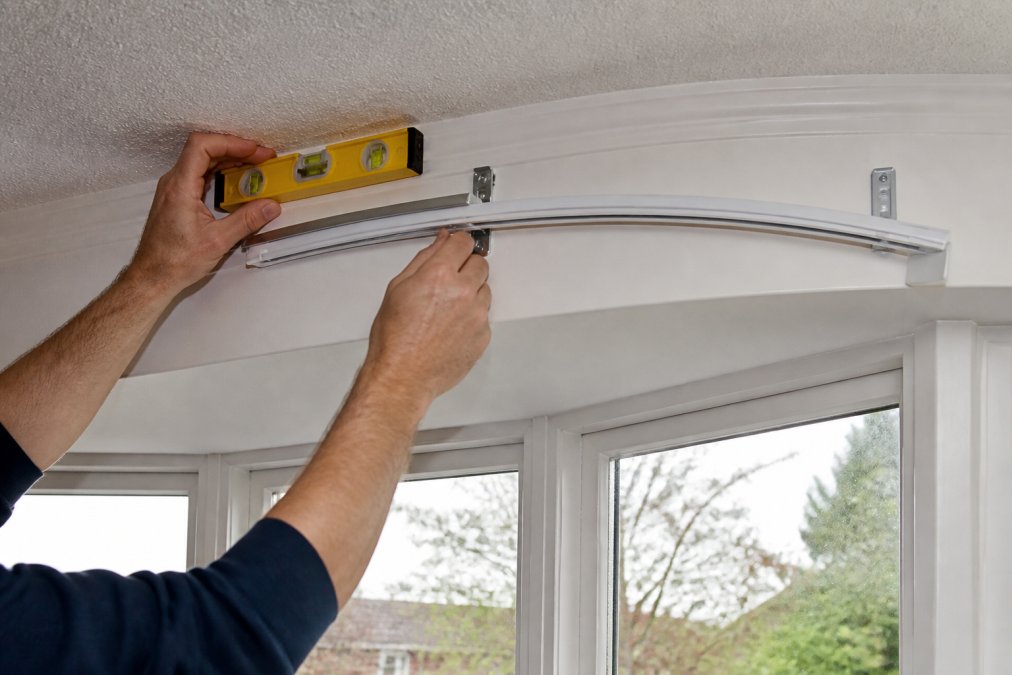
The most frequent error is failing to use a spirit level when mounting the headrail. Even a 2-3 degree tilt becomes obvious when looking at the slats. Another common mistake is under-drilling or using inadequate fixings. Bay windows have large spans, and the headrail bears significant weight. Use the fixings recommended by your supplier, typically heavy-duty plugs and screws for plasterboard, or masonry fixings for brick or stone.
Child safety is a regulatory consideration. All blinds sold must comply with BS EN 13120, which sets standards for cord and chain safety ([EXTERNAL_LINK: BSI Group on internal blinds safety | knowledge.bsigroup.com]). Just Blinds' vertical blinds offer both chain-and-cord control and child-safe wand systems. Test the operation before finishing, the slats should track smoothly and the tilt control should feel responsive.
Light Control, Privacy and Thermal Efficiency
Light control refers to adjusting how much light enters the room. Vertical blinds excel here, you can tilt slats from full light to complete darkness. The 89mm slat width provides finer control than 127mm.
Privacy is about preventing people outside from seeing in. Vertical blinds provide good privacy when closed because slats overlap. However, when tilted open, there's still some visibility through gaps. Blackout roller blinds are more effective for absolute privacy.
Thermal efficiency is increasingly important. A bay window is inherently less efficient because it extends outward, creating more external surface area. A well-fitted blind reduces heat loss by creating an insulating air layer. Vertical blinds with wider slats (127mm) provide slightly better thermal performance, though proper fit matters more than slat width.
The best approach for most bay windows is combining systems. Use vertical blinds for everyday light control and privacy, then add a roller blind or thermal blind as a secondary layer for maximum insulation in winter.
Choosing Between Roller Blinds and Venetian Options
Roller blinds are simple, a single piece of fabric rolls up and down on a spring-loaded mechanism. For bay windows, install individual roller blinds on each panel, avoiding curved rail complexity. They're easier to clean but don't offer the light control precision of vertical blinds, and they take up more headroom when rolled up.
Venetian blinds (horizontal slats) work less well in bays because slats don't stack neatly to the side when open. They roll up at the top, taking up headroom, and cord control is more difficult across angled planes. For most bay windows, vertical blinds remain superior, they're engineered for this configuration, stack efficiently, and provide the best balance of light control, privacy, and thermal performance.
| Blind Type | Light Control | Privacy | Thermal Efficiency | Ease of Clean | Best For |
|---|---|---|---|---|---|
| Vertical (89mm) | Excellent | Good | Good | Moderate | Most bay windows |
| Vertical (127mm) | Good | Good | Very Good | Moderate | Large bays over 2m |
| Roller | Poor | Moderate | Moderate | Excellent | Individual panels |
| Venetian | Excellent | Good | Moderate | Difficult | Period properties |
Conclusion
Selecting the best blinds for large bay windows comes down to three principles: match the blind type to the bay's geometry, measure with precision, and install with care. Vertical blinds with a curved rail represent the most elegant and functional solution for most homeowners. Just Blinds' made-to-measure approach ensures your blind fits perfectly the first time, eliminating gaps and light leakage. With options ranging from the understated Cameo Cream Vertical Blinds at £4.92 to the premium Chatsworth Black design at £22.12, and the engineered Curved Rail at £207.00, Just Blinds delivers precision, affordability, and the professional fit your bay window deserves. Get started with Just Blinds and transform your bay window into a perfectly dressed focal point with complete light control and timeless elegance.
Frequently Asked Questions
What type of blinds are best for a large bay window?
Vertical blinds are the most practical choice for large bay windows because they span wide openings without gaps and allow you to control light across the full width. The vertical slats (louvres) can be drawn from the centre outwards, making them ideal for bay angles. Made-to-measure vertical blinds with 89mm or 127mm slats deliver a precise fit that eliminates light leakage at the edges, a common problem with off-the-shelf options. For curved bays, a curved rail system delivers seamless coverage that follows the window's natural contour.
How do I measure my bay window correctly to avoid gaps?
Measure three key dimensions: the width of the entire bay (deducting 2.5cm for control mechanisms), the projection depth from the back of the window frame to where the bay angle begins, and the drop height. For bay angles, the projection must not exceed 50% of the width. Measure at the top, middle and bottom of each pane, as bay windows are rarely perfectly square. Use a metal tape measure, not cloth. If measuring feels uncertain, professional measuring services are available in the North West of England to verify your dimensions before manufacture, eliminating the risk of costly errors.
Can I install made-to-measure blinds myself in a bay window?
Yes, most made-to-measure vertical blinds can be fitted by homeowners with basic tools. The curved rail for bay windows arrives in two halves, each with its own control mechanism, allowing you to open blinds from the centre like curtains. Bracket clearance is critical: ensure brackets are positioned to avoid contact with the window frame or any obstacles. Common mistakes include not allowing enough space for the control chain or wand, and not checking that the headrail sits level before tightening brackets. If you're uncertain, professional fitting services are available in the North West of England.
What's the difference between inside and outside mount for bay windows?
Inside mount blinds sit within the window recess, creating a neat, built-in appearance and maximising the view of the glass. They work best when the bay recess is deep enough (at least 5cm) to accommodate the headrail and controls. Outside mount blinds are fitted above and beyond the window frame, covering the entire bay area. Outside mount is preferable for shallow recesses, curved bays where an inside fit is impractical, or when you want to block light completely at the edges. Made-to-measure options give you the flexibility to choose based on your specific bay configuration.
Are made-to-measure blinds worth the cost for a bay window?
For bay windows, made-to-measure is the most cost-effective long-term choice. Ready-made blinds rarely fit bay angles properly, leaving gaps that compromise privacy and light control. You'll either live with poor performance or replace them repeatedly. Made-to-measure vertical blinds start from £4.92 per slat, and a curved rail for a bay costs £207.00. The precision fit means no wasted material, no light leakage, and blinds that last years longer because they're engineered for your exact window shape. Free UK delivery on orders over £175 also reduces the final cost.
This article was written using GrandRanker
