
Table of Contents
- Why Accurate Measurement Matters for Bay Windows
- Best Tools for Measuring Windows
- Identifying Your Bay Window Type: Angled, Square, and Box Bays
- Step-by-Step Instructions: How to Measure Bay Windows for Blinds
- Common Measuring Mistakes for Bay Windows
- Tips for Accuracy and Avoiding Gaps
- Inside Mount vs. Outside Mount for Bay Windows
- Conclusion
Last Updated: August 18, 2026
Why Accurate Measurement Matters for Bay Windows
Getting your bay window measurements right is the difference between blinds that fit perfectly and ones that leave frustrating gaps. Bay windows project outward at angles, which means standard measuring techniques don't apply. Incorrect measurements result in blinds that don't cover the full window or sit too tight against the frame, compromising both function and appearance.
When you order made-to-measure blinds, there's typically no second chance without incurring additional costs. Accurate measurement determines whether you can choose an inside mount or outside mount, affects how your blinds operate, and influences the overall aesthetic of your room. A room with properly fitted blinds looks intentional and polished; one with ill-fitting blinds looks rushed and unfinished.
Best Tools for Measuring Windows
A metal tape measure is your primary tool, it's rigid enough to hold its shape across angles and won't sag like a fabric tape. Look for one at least 5 metres long. A pencil for marking key points, a notepad for organizing numbers, and a plumb line or spirit level help verify vertical alignment, particularly when measuring recess depth.
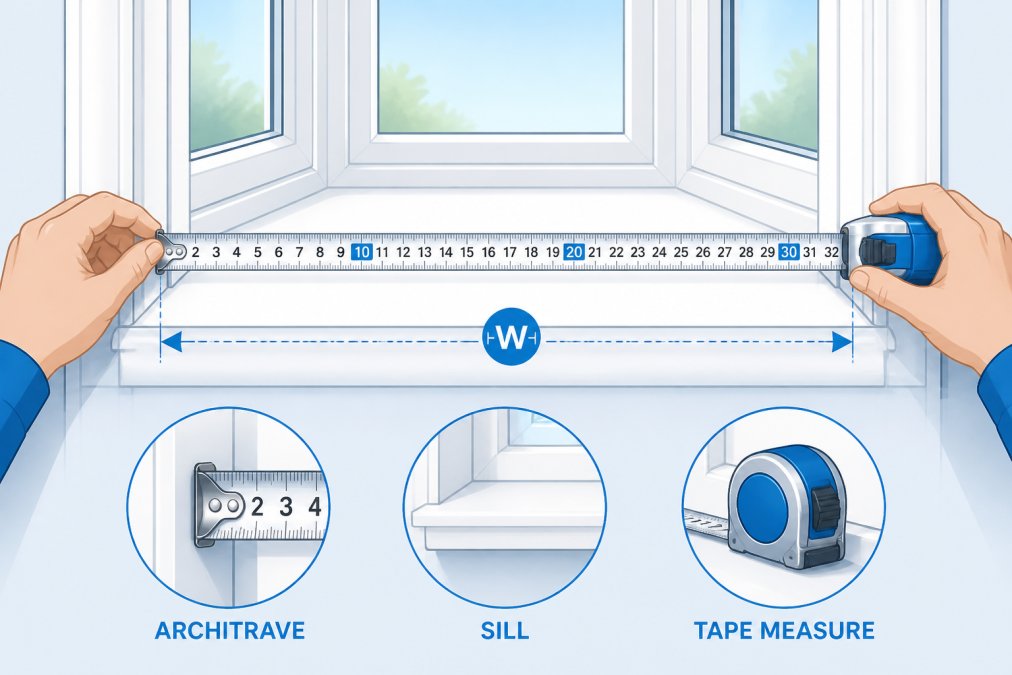
Write down every measurement as you take it. Don't trust your memory, and don't estimate. Even small errors compound when dealing with multiple angles and sections of a bay window.
Identifying Your Bay Window Type: Angled, Square, and Box Bays
Bay windows come in three main configurations, each requiring a slightly different measuring approach.
Angled bay windows are the most common. They project outward at an angle, typically 135 degrees or steeper, creating two angled corners where the bay meets the main wall. Even a 5mm error at the corner can result in visible gaps.
Square or box bay windows project straight out from the wall at a 90-degree angle, creating a flat front face. The challenge is ensuring your measurements account for window handles and obstructions that might interfere with blind operation.
Box bays combine elements of both angled and square configurations, making them slightly more complex to measure.
Measuring for Angled Bay Windows
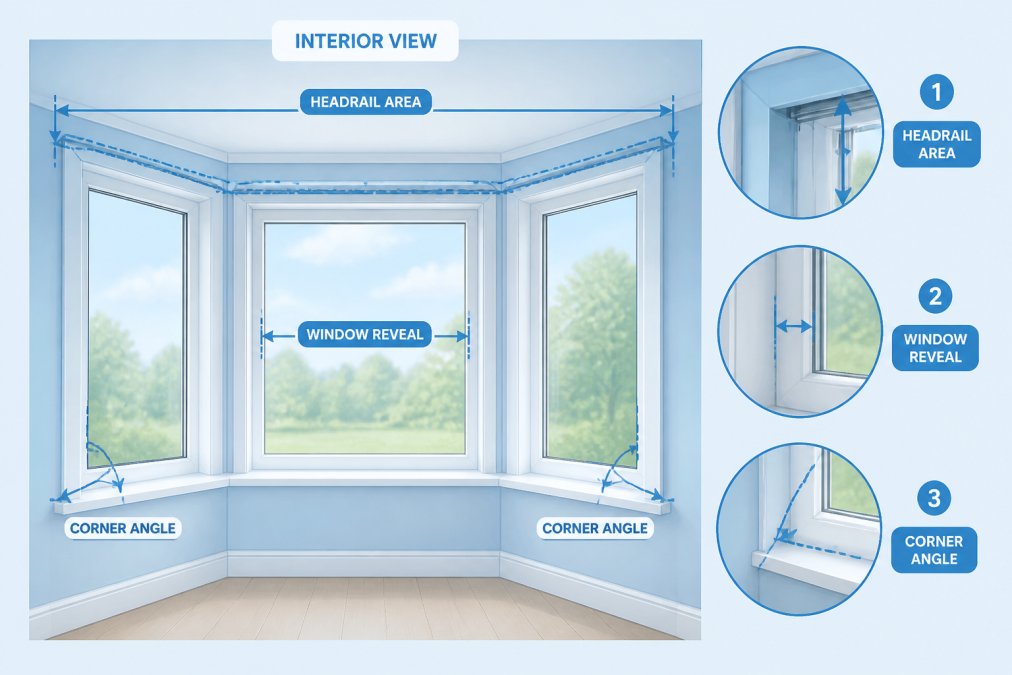
Angled bays require you to measure each section separately because the angle means the width changes depending on where you measure. Identify the three main sections: the two angled sides and the central section (if present).
For each angled section, measure the width at the window sill, then at the headrail. These measurements will differ slightly due to the angle. Measure at the actual mounting points where your blind rail will sit. Measure the recess depth from the front of the window frame to the back wall at multiple points to ensure you capture any variation.
Measuring Square Bay Windows
Measure the width of each flat section at both the sill and headrail level. If they don't match, your window frame may not be perfectly square, which is common in older properties.
Measure the recess depth at the top, middle, and bottom of the window to identify any variation. Also measure the distance from the corner of the bay to the adjacent wall on both sides to determine exact positioning and prevent gaps.
Step-by-Step Instructions: How to Measure Bay Windows for Blinds
Step 1: Prepare your measuring sheet. Write down your window type, location, and date. Create separate sections for each part of the bay.
Step 2: Measure the width at the sill. Position your tape measure horizontally along the window sill at the point where your blind rail will mount. For inside mounts, measure the interior width. For outside mounts, measure the full width including the frame. Record to the nearest millimetre.
Step 3: Measure the width at the headrail. Repeat the width measurement at the top of the window. This should match the sill measurement in a square bay but may differ slightly in an angled bay.
Step 4: Check for parallel lines. If measurements differ by more than 5mm, your window frame may not be perfectly vertical. Note this, as it affects how your blinds will operate.
Step 5: Measure recess depth at three points. Measure from the front of the window frame to the back wall at the top, middle, and bottom to capture any variation.
Step 6: Measure from the corner to adjacent walls. For angled bays, measure the horizontal distance from each corner to the nearest wall to prevent blinds from sitting crooked.
Step 7: Account for window handles and obstructions. Measure the height and projection of any window handles and note any permanent fixtures that might interfere with blind operation.
Step 8: Verify all measurements. Remeasure each critical dimension. Double-checking at this stage saves problems later.
Measuring Points and Recess Depth
The most important measurements are the width at the sill and headrail, and the recess depth. Recess depth is the distance from the front face of your window frame to the back wall. If your recess depth is shallow (less than 100mm), you may need an outside mount instead of an inside mount.
Measure recess depth at multiple points because bay windows often have slight variations. For angled bays, measure the recess depth of each angled section separately.
Accounting for Obstructions and Window Handles
Measure the height of your window handle from the sill. If the handle projects more than 20mm from the window frame, your blind slats or fabric need to clear it. Check for radiators, shelves, or other fixtures near your bay window. Radiators generate heat that can damage certain blind materials, so positioning matters.
For inside mounts, ensure there's enough clearance around the window frame for the blind mechanism to operate.
Common Measuring Mistakes for Bay Windows
Not measuring at multiple points. Measure at the sill, headrail, and middle to capture width variation in bay windows.
Ignoring the angle. In angled bays, the angle between sections affects how blinds fit. Blinds that don't account for this leave visible gaps.
Forgetting to account for window handles. Check whether the blind will clear the handle when closed.
Measuring to the wrong reference points. For inside mounts, measure interior dimensions only. For outside mounts, include the frame.
Not checking for square. If your window frame isn't perfectly vertical or horizontal, blinds that don't account for this will look crooked.
Underestimating recess depth variation. A 15mm variation missed during measuring can prevent blinds from fitting properly in some sections.
Tips for Accuracy and Avoiding Gaps
Always measure twice. If the two measurements match, you're confident. If they differ, measure a third time.
Use a metal tape measure, not a fabric one. Fabric tapes sag, especially when measuring vertical distances.
Measure at the actual mounting points where your blind rail will sit, not in the middle of the glass.
Write measurements down immediately in millimetres.
Check for obstructions before finalizing your measurements. Identify anything that might interfere with blind operation or fitting.
Measure recess depth in a straight line perpendicular to the window frame using a spirit level or plumb line to ensure you're measuring vertically.
Inside Mount vs. Outside Mount for Bay Windows
Your measuring approach changes depending on whether you're planning an inside mount or outside mount.
Inside mounts position the blind inside the window recess, with the blind rail mounted to the inside edges of the window frame. This creates a clean, integrated look. Inside mounts work best when your recess depth is at least 100mm and your window frame is in good condition. For inside mounts, measure the interior width at the sill and headrail and verify recess depth is sufficient.
Outside mounts position the blind outside the window recess, with the rail mounted to the wall or window frame exterior. This works for windows with shallow recesses, irregular frames, or where an inside mount isn't practical. Outside mounts also allow you to cover more of the wall, making windows appear larger.
For bay windows specifically, outside mounts are often the better choice because they simplify the geometry. A single outside-mounted blind can cover the entire bay window instead of fitting individual sections into each angled section.
Just Blinds can manufacture blinds for either mounting method. When you order, specify whether you're planning an inside or outside mount and provide measurements accordingly.
Conclusion
Measuring bay windows for blinds accurately is entirely achievable if you follow a systematic approach and avoid common pitfalls. The 20 minutes you invest in careful measuring now prevents frustration and additional expense later.
When you're ready to order, Just Blinds makes the process straightforward. Our made-to-measure blinds are manufactured to your exact specifications. Shop Now and get free UK delivery on orders over £175.
Frequently Asked Questions
How do I measure a bay window accurately for made-to-measure blinds?
Measure the width at three points: top, middle, and bottom of each panel. Use a metal tape measure and record in millimetres. For recess depth, measure from the window frame to the innermost point of the recess. Take measurements on the same day and check all angles are parallel. Many gaps occur when measurements are taken at different times or from inconsistent points. Just Blinds made-to-measure blinds account for these variations, but accuracy at your end ensures the perfect fit.
What's the difference between measuring square and angled bay windows?
Square bay windows have 90-degree angles at each corner, making measurements straightforward. Angled bay windows have corners at less than 90 degrees, requiring you to measure the corner angle itself and account for the projection on each side. With angled bays, measure from the corner point outward to establish the true width of each panel. Angled bays are more complex because blinds must follow the actual angle of the window frame, not a standard square measurement.
What should I do if I'm unsure about my measurements or worried about gaps?
Double-check your measurements on a separate day to confirm consistency. Photograph your window from multiple angles with a ruler in frame for reference. If you're uncertain, most made-to-measure suppliers, including Just Blinds, offer professional fitting services in many areas. Our team can visit and measure for you, eliminating the risk of error. This is especially valuable for complex bay windows where angles, obstructions, or window handles complicate the measurement process.
Do I need to account for window handles and vents when measuring?
Yes. Window handles and tilt vents reduce the usable blind width and must be measured around. Measure the clear space between the handle and the window frame on both sides. If your blind will overlap the handle, ensure you measure the projection of the handle itself so the blind can clear it when raised or lowered. This is a common mistake that results in blinds catching or not closing fully. Note the exact position and size of any obstructions on your measuring sheet.
This article was written using GrandRanker
