
Table of Contents
- Are Replacement Blind Slats Universal?
- How to Measure Vertical Blind Slats
- Standard Vertical Blind Slat Widths
- Identifying Your Headrail Type and Hanger System
- Vertical Blind Slat Hangers Replacement
- Step-by-Step Replacement Guide
- Choosing the Right Fabric or Material
- Common Mistakes to Avoid
Last Updated: August 25, 2026
Are Replacement Blind Slats Universal?
No, replacement blind slats are not universal. Compatibility depends on three critical factors: slat width, hanger system type, and drop length. Many homeowners assume any slat will fit any blind, but this misconception leads to expensive mistakes.

Most vertical blinds fall into a small number of standard categories, but "standard" doesn't mean interchangeable across all brands and models.
The good news: if you measure correctly and identify your headrail type, finding compatible replacement blind slats becomes manageable.
How to Measure Vertical Blind Slats
Two measurements matter: drop length and width. Get either one wrong, and your new slats won't fit properly.
Measuring drop length requires measuring from the top of your headrail to the bottom of the window. Use a steel tape measure, not a fabric one, fabric measures stretch and give inaccurate readings ([EXTERNAL_LINK: guidance from the Centers for Disease Control and Prevention | cdc.gov]). Measure at three points: left, centre, and right. Record the longest measurement; your slats should reach the full drop.
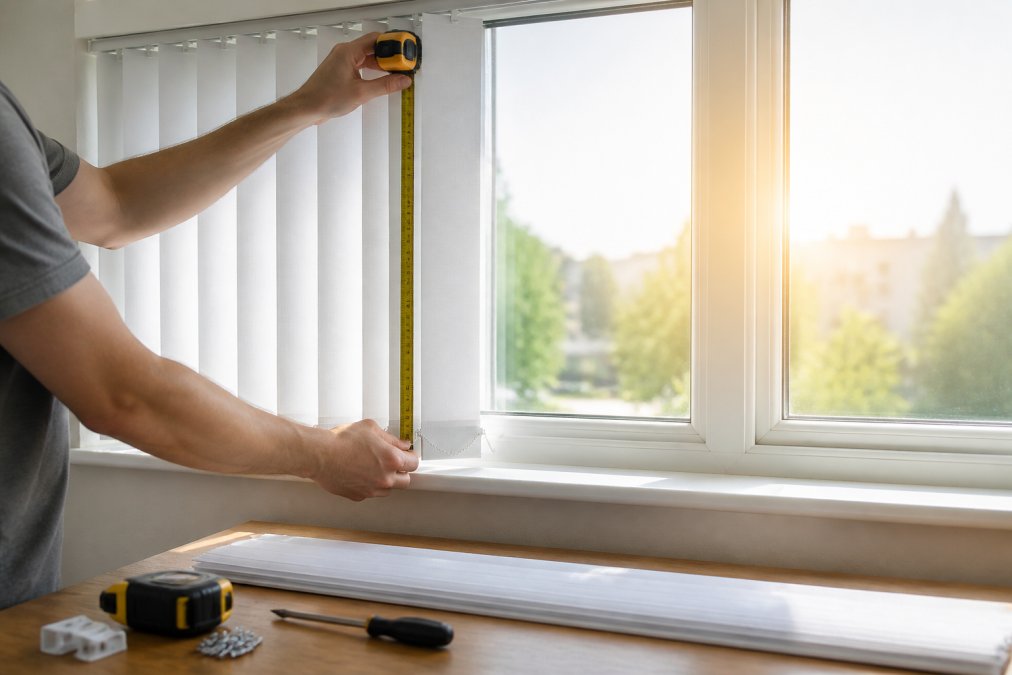
Recording the width means measuring the slat itself, not the window. Hold your tape measure horizontally across one of your existing slats at its widest point. Standard widths are 89mm or 127mm. Measure at the top, middle, and bottom, they should be consistent.
Write down both measurements clearly. Never estimate or use old paperwork; your window may have settled slightly over the years.
Standard Vertical Blind Slat Widths
The most common vertical blind slat widths are 89mm and 127mm.
89mm slats are the most popular width for domestic use. They're lighter, which means less strain on the mechanism over time, and work well in smaller windows. Most budget-friendly replacement blind slats come in this width.
127mm slats are wider and heavier. They're often chosen for larger windows or commercial spaces. The wider profile provides better light control because there's less gap between slats when closed.
Some suppliers offer 100mm slats as a middle ground, but these are far less common. Bespoke widths exist but are expensive and usually only justified if your existing blind is non-standard.
Identifying Your Headrail Type and Hanger System
The headrail is the track that runs across the top of your window. The hanger system determines whether a replacement slat will work with your existing blind.
Hook-on hangers are the most common system. The slat has a small hook or clip on top that physically hooks into a carrier on the headrail track. You can see these hooks if you look at the top of your slat. If your blind uses hook-on hangers, most standard replacement slats will work, provided the width matches.
Sewn-in hangers mean the slat is permanently stitched or glued to a fabric carrier that hangs from the headrail. These are less common in modern blinds. With sewn-in systems, you cannot simply swap out a slat; you'd need to replace the entire carrier.
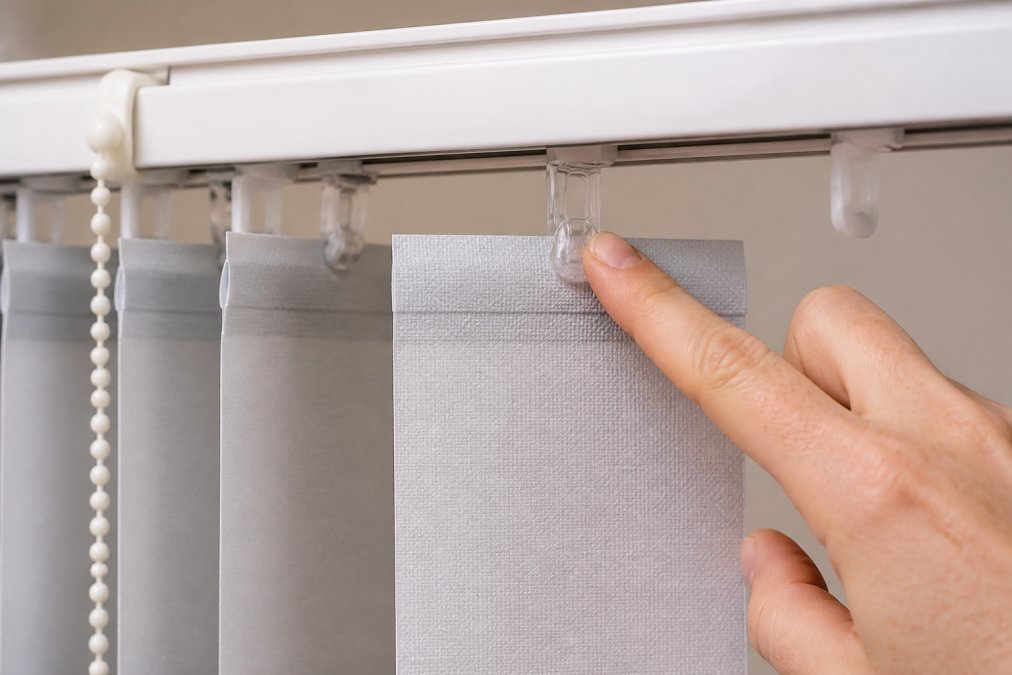
To identify your system, look at the top of one of your existing slats. If you see a small plastic hook or clip, you have hook-on hangers. If the slat appears to be sewn into a fabric strip, you have sewn-in hangers.
Vertical Blind Slat Hangers Replacement
Replacing the hanger itself is less common but sometimes necessary. Carriers are the small plastic components that slide along the headrail track and hold your slats. Over time, they can crack, become misaligned, or stop sliding smoothly.
Replacing carriers requires removing the slats first, then sliding the old carriers out of the track and new ones in. This is a DIY job for most people. You'll need to know your headrail type and the spacing of your carriers, information usually printed on the headrail itself.
For most homeowners, replacing carriers is worth attempting only if you have multiple damaged ones. If just one is broken, replacing that single slat is often simpler and cheaper.
Step-by-Step Replacement Guide
Replacing vertical blind slats is straightforward and takes 20-30 minutes.
What you'll need:
- Your new replacement blind slats (measured to your exact drop length and width)
- A stepladder or stable chair
- A soft cloth (to clean the headrail while you work)
Removing old slats starts by standing on your stepladder so you can see the headrail clearly. If it's a hook-on system, gently lift the slat upward; the hook should disengage from the carrier. Some slats require a slight twist or wiggle to come free. Don't force it.
Installing new slats is the reverse process. Hold your new slat directly under its corresponding carrier. Align the hook with the carrier opening, then push upward gently until the hook seats fully. You'll feel a small click when it's seated correctly.
Once all slats are installed, test the blind by opening and closing it a few times. All slats should move together smoothly.
Choosing the Right Fabric or Material
Vertical blind slats come in several materials, each with different properties.
PVC slats are the most common and affordable option. They're moisture-resistant, making them suitable for kitchens and bathrooms. PVC won't warp or swell when exposed to humidity and is easy to wipe clean ([EXTERNAL_LINK: peer-reviewed research on PVC applications | pmc.ncbi.nlm.nih.gov]). The downside is that PVC can become brittle in very cold conditions and may discolour if exposed to intense direct sunlight for years.
Fabric slats offer a softer appearance and better light diffusion. They're available in countless colours and patterns. Fabric doesn't have the industrial look of PVC, which appeals to homeowners seeking a warmer feel. The trade-off is durability; fabric can absorb moisture, fade in sunlight, and requires more careful cleaning.
Blackout fabric slats are engineered to block nearly all light. If you're replacing slats in a bedroom or nursery where darkness matters, blackout material is worth the extra cost.
Just Blinds offers replacement slats in white, cream, and grey PVC finishes, all made to measure to your exact drop length, starting from £0.85 per slat.

Common Mistakes to Avoid
Confusing slat width with window width is the most frequent mistake. You must measure the actual slat itself, not your window opening.
Ordering without confirming hanger type leads to incompatible slats arriving. Confirm your hanger type by looking at your existing slat before you buy.
Measuring only once causes problems when you order. Measure at three points and use the longest measurement.
Assuming all 89mm slats are identical ignores the fact that hanger systems vary. When in doubt, ask the retailer whether their slats are compatible with your specific headrail.
Not checking whether your blind is bespoke before ordering standard sizes wastes money. If your blind was custom-made to non-standard dimensions, standard replacement slats won't fit.
Ignoring bottom weights and stabilising chains can cause problems after replacement. Take a photo of your blind before disassembling it, especially if it has multiple components.
Replacing vertical blind slats doesn't require professional help or specialist knowledge. The key is measuring accurately, identifying your hanger type, and ordering slats that match your existing system. Most homeowners complete the job in under an hour with no tools beyond a stepladder.
If you're ready to refresh your blinds without the expense of replacing the entire system, Just Blinds offers made-to-measure replacement slats in standard widths and colours. With our range of replacement slats starting from £0.85, you can restore your blind's appearance and function at a fraction of the cost of a new blind. Measure your drop length and width, confirm your hanger type, and order with confidence knowing your new slats will fit your existing headrail system.
Frequently Asked Questions
Are vertical blind slats interchangeable between different brands?
Not always. While replacement blind slats compatible with most rails (including Hilary's, Argos, and Dunelm) are often available, compatibility depends on your headrail type and hanger system. Hook-on hangers are more likely to accept universal slats, but sewn-in hangers are usually brand-specific. Always measure your existing slats' width and identify your headrail before ordering replacements to ensure they fit properly.
How do I know if my replacement slats will fit my current track system?
Check three things: the slat width (typically 89mm or 127mm), the drop length, and your hanger type. Measure your existing slats from edge to edge, then measure the vertical distance from headrail to the bottom weight. Identify whether your hangers are hook-on (removable) or sewn-in (permanent). Made-to-measure replacement slats cut to your exact dimensions eliminate guesswork and ensure compatibility with your existing rails.
Can I use different width slats on my existing headrail?
No. Your headrail is designed for a specific slat width, and mixing widths will cause gaps, misalignment, and poor operation. Standard widths are 89mm and 127mm. If you're unsure of your current width, measure one slat edge-to-edge. When replacing, always match the original width to maintain proper fit and function.
Is it cheaper to replace just the slats or buy a whole new blind?
Replacing slats is significantly more affordable. Made-to-measure replacement slats start from £0.85 per slat, making a full set cost just a fraction of a new blind. Replacement makes sense if your headrail, carriers, and track are still in good condition. However, if your headrail is damaged, carriers are broken, or the blind mechanism no longer operates smoothly, replacing the entire blind is the better choice.
This article was written using GrandRanker
