
Table of Contents
- What Are Perfect Fit Blinds for Bi-Fold Doors?
- No-Drill Blinds for Bi-Fold Doors: How Installation Works
- Click Fit vs Perfect Fit Blinds: Key Differences
- Measuring Bi-Fold Doors for Blinds: The Right Way
- Beading Depth and Handle Clearance: Technical Considerations
- Durability and Long-Term Performance
- Frequently Asked Questions
Last Updated: September 22, 2026
What Are Perfect Fit Blinds for Bi-Fold Doors?
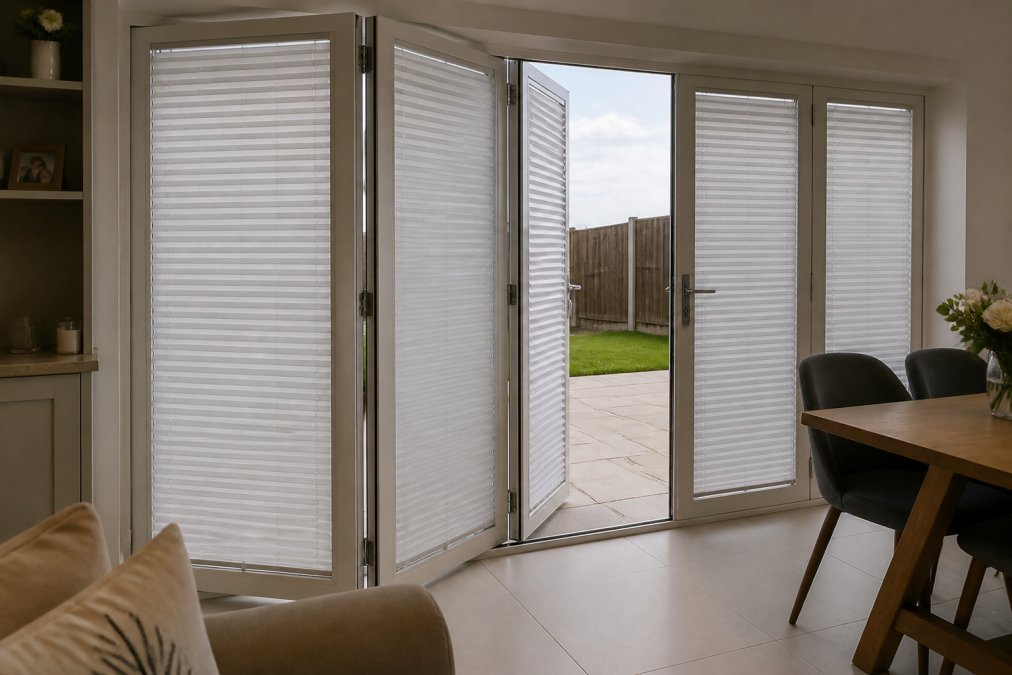
Perfect fit blinds for bi-fold doors review shows they slot directly into the glazing bead of UPVC frames without drilling, screws, or permanent fixtures. They're engineered for UPVC windows and doors, including bi-fold systems, where traditional bracket-mounted blinds would obstruct door movement.
The blind sits within the frame's gasket channel, held by spring-loaded clips or adhesive-backed brackets. This no-drill approach suits rental properties, listed buildings, and homeowners avoiding structural changes. For bi-fold doors, perfect fit blinds solve a critical problem: standard blinds interfere with folding, while perfect fit systems sit flush within the frame, leaving the door fully functional.
Just Blinds offers perfect fit pleated blinds in a range of colours and finishes, including the Neat Fit Pleated Blind in Infusion Coffee, which combines the no-drill convenience with warm-toned aesthetics suitable for most interiors. The system works across UPVC conservatories, porches, windows, and bi-fold door applications.

Perfect fit blinds deliver a cleaner aesthetic than frame-mounted alternatives: no visible hardware, no protruding brackets, and no gaps, just a seamless blind integrated into the frame.
No-Drill Blinds for Bi-Fold Doors: How Installation Works
No-drill blinds clip directly into the existing gasket running around the inside edge of your UPVC frame. Installation takes minutes and requires no tools, holes, or permanent alterations.
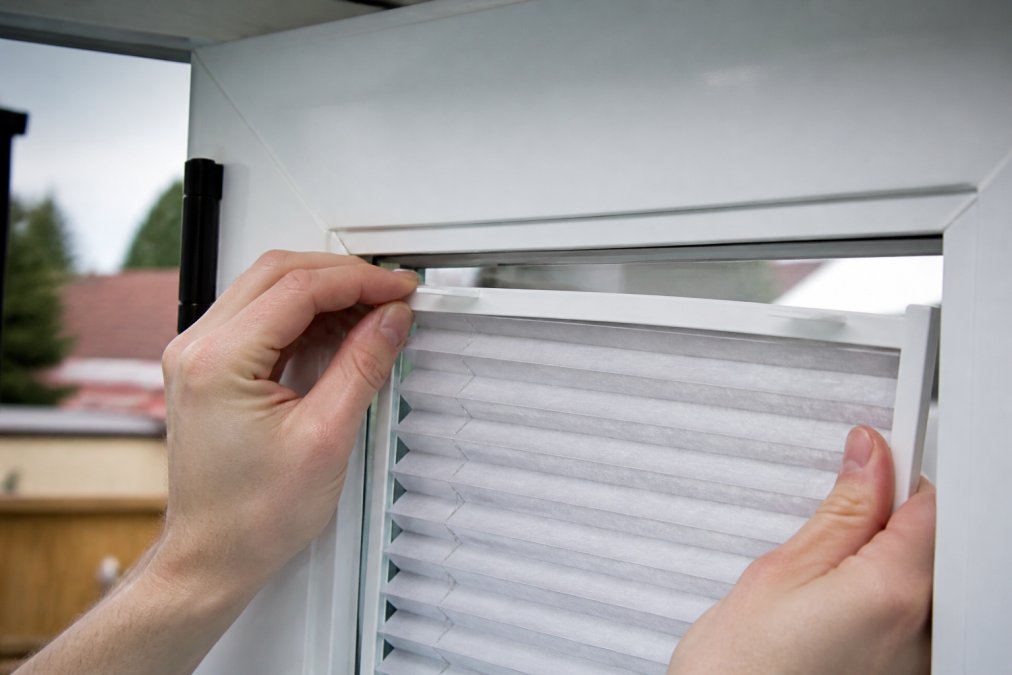
Measure the frame opening width and height between the glazing beads. The blind is manufactured to those exact dimensions. When it arrives, position it within the frame and push the clips or adhesive brackets into place; the tensioned system holds it securely.
For bi-fold doors, perfect fit systems sit within the frame recess, leaving the door clear for unobstructed opening and closing. The blind moves independently of the door mechanism, eliminating collision, jamming, and functionality issues.
Spring-loaded clips grip the gasket and are preferred for bi-fold applications because they're removable and leave no residue. Adhesive brackets bond to the frame but require careful surface preparation.
Common mistakes include measuring the wrong dimension, failing to account for handle clearance, or not checking beading depth before ordering. Measure accurately, order to size, and clip into place.
Click Fit vs Perfect Fit Blinds: Key Differences
Perfect fit blinds use spring-loaded clips that grip the gasket channel running around the inside of your UPVC frame. The blind is completely removable and leaves no marks or residue.
Click fit blinds sometimes denote systems where the blind's frame clicks into a dedicated track, or adhesive-backed systems where the frame adheres directly to the UPVC surface. Terminology varies between suppliers, so confirm the exact fixing method when ordering.
Spring-loaded clip systems are most flexible: you can remove the blind in seconds to access the frame or replace it later. Adhesive systems are permanent and require careful removal if you want to change them.
Both methods eliminate visible brackets and deliver a flush, integrated appearance. The choice depends on whether you prioritise easy removal (clips) or a slightly cleaner appearance with no visible clip hardware (adhesive).
Measuring Bi-Fold Doors for Blinds: The Right Way
Accurate measurement is the foundation of a perfect fit. Incorrect measurements result in jamming or gaps. For bi-fold doors, measure carefully and account for handle clearance and beading depth.
Step 1: Measure the frame opening width. Using a metal tape measure, measure the horizontal distance between the inside edges of the left and right glazing beads at three points: top, middle, and bottom. Use the smallest dimension.
Step 2: Measure the frame opening height. Measure the vertical distance from the top glazing bead to the bottom glazing bead at three points: left, centre, and right. Use the smallest measurement.
Step 3: Check handle clearance. Measure the handle height from the bottom of the frame. Your blind's bottom edge must sit above the handle to avoid collision. Most handles require 50-80mm clearance; if the handle is low, you may need a blind that doesn't extend the full frame height.
Neat Fit Pleated Blind – Infusion Ecru →
Step 4: Verify beading depth. This is critical and often overlooked. The gasket channel where your blind clips must be deep enough to accommodate the blind's frame. Beading depth typically ranges from 8mm to 12mm on standard UPVC frames. If your frame has shallow beading (less than 8mm), a standard perfect fit blind may not clip securely. Measure the depth of the gasket channel using a small ruler or calliper. If you're unsure, contact Just Blinds with a photo, the team can advise whether your frame is compatible.
Step 5: Account for frame profile variations. Older UPVC frames sometimes have slightly different gasket profiles than modern ones. If your doors are more than 10-15 years old, it's worth taking a close-up photo of the gasket profile and checking with the supplier before ordering.
Write down all measurements in millimetres and double-check each one. Many suppliers allow you to order based on these dimensions, and the blind is manufactured to your exact specifications. Measure twice, order once.
Beading Depth and Handle Clearance: Technical Considerations
Beading depth and handle clearance are the two technical factors that determine whether a perfect fit blind will actually work on your bi-fold doors. Both are easy to assess but often overlooked, leading to compatibility issues after purchase.
Beading depth is the depth of the gasket channel running around the inside edge of your UPVC frame. This channel is where the perfect fit blind's frame clips into place. Standard UPVC frames typically have beading depths between 8mm and 12mm. Your blind's frame must fit within this channel with enough grip to stay secure.
Most modern perfect fit blinds are designed for standard beading depths of 9-11mm. If your frame has unusually shallow beading (less than 8mm), the clips may not grip effectively, and the blind could slip or rattle. Conversely, if your frame has deep beading (over 12mm), some blind frames may sit too loosely within the channel.
To measure beading depth, insert a small ruler or calliper into the gasket channel at a corner of the frame. Measure from the outer edge of the gasket to the inner surface of the frame. If you're unsure about your measurement, photograph the frame profile and contact the supplier, they can confirm compatibility before you order.
Handle clearance is equally important. Bi-fold doors have handles mounted on one or more panels. When the door opens, the panel swings outward. If your blind extends too far down the frame, it will collide with the handle, preventing the door from opening fully.
Measure the height of the handle from the bottom of the frame. A typical handle sits 800-1000mm from the bottom. Your blind should not extend below the handle's lowest point. If your handle is particularly low, you may need to order a blind that covers only the upper portion of the frame, leaving the lower section clear for door operation.
Some homeowners find this limitation frustrating, particularly if they want full-height blackout coverage. In those cases, alternative solutions include frame-mounted blinds on the adjacent wall or a combination approach: perfect fit blinds on the frame itself, with a secondary blind on the wall to provide additional coverage and light control.
Durability and Long-Term Performance
Perfect fit blinds are designed to last, but their longevity depends on the quality of the system and how well the installation is maintained. Most well-manufactured perfect fit blinds remain fully functional for 5-10 years with normal domestic use, though the pleated fabric itself may show signs of wear earlier.
The adhesive-backed bracket systems are generally considered the weakest point. UPVC adhesive bonds weaken over time, particularly in areas exposed to direct sunlight or temperature fluctuations. A blind that was secure at installation may gradually loosen after 2-3 years as the adhesive degrades. Spring-loaded clip systems avoid this issue entirely, they rely on mechanical tension rather than adhesive, so they maintain consistent grip throughout their lifespan.
Pleated blinds themselves are vulnerable to dust accumulation and moisture.
| Consideration | What to Check | Why It Matters |
|---|---|---|
| Frame opening width | Measure at top, middle, bottom; use smallest | Ensures blind fits within frame without jamming |
| Frame opening height | Measure at left, centre, right; use smallest | Prevents gaps and ensures full coverage |
| Beading depth | Measure gasket channel depth (8-12mm typical) | Confirms clips will grip securely in frame |
| Handle clearance | Measure handle height from frame bottom | Prevents blind from blocking door operation |
| Frame age | Note if frame is over 10-15 years old | Older frames may have non-standard profiles |
| Fixing method | Confirm clip-based vs. adhesive system | Clips are removable; adhesive is permanent |
Frequently Asked Questions
Do perfect fit blinds work on all bi-fold door types?
Perfect fit blinds work best on UPVC bi-fold doors with standard glazing beads. They slide into the bead groove without drilling. However, compatibility depends on beading depth and frame profile. Aluminium bi-fold doors or non-standard frames may not accommodate perfect fit systems. Always measure your beading depth before ordering to confirm fit. If your frame is unusual, contact the supplier to verify compatibility before purchase.
Can you install perfect fit blinds without drilling into bi-fold frames?
Yes. Perfect fit blinds use a no-drill tensioned system that clips directly into the glazing bead of UPVC frames. The blind slides into place within seconds using spring-loaded brackets or clip-in mechanisms. No holes, screws, or tools are required. This preserves your frame integrity and makes removal simple if needed. Installation is straightforward enough for DIY, though some people prefer professional fitting to ensure smooth operation and correct tensioning.
How do I measure my bi-fold doors accurately for perfect fit blinds?
Measure the width inside the glazing bead from left to right at three points: top, middle, and bottom. Use the smallest measurement. For depth, measure from the front of the bead to the back, this is your beading depth, which determines which blind system fits. Measure the height from the top bead to the bottom bead. Take measurements in millimetres and double-check each one. Accuracy prevents gaps and ensures smooth operation on your bi-fold doors.
What's the difference between perfect fit and click-fit blinds for doors?
Perfect fit blinds slide into the glazing bead groove of UPVC frames and are held by spring tension, no clips visible from outside. Click fit blinds use visible clip-in brackets that attach to the frame face. Perfect fit offers a cleaner, more minimalist aesthetic because brackets are hidden. Click fit is often easier to remove and adjust. Both are no-drill options, but perfect fit suits bi-fold doors better because it doesn't obstruct the door's operation or interfere with handles. Choose based on your frame type and aesthetic preference.
