

Table of Contents
- Why Standard Roller Blinds Fall Short in Bedrooms
- Day and Night Blinds: Adjustable Light Control for Bedrooms
- Blackout Curtains vs Blinds: Which Blocks More Light?
- The Benefits of Plantation Shutters for Bedroom Windows
- Venetian and Roman Blinds: Slat Control and Fabric Warmth
- No-Drill and Rental-Friendly Bedroom Window Treatments
- Child Safety, Acoustics and Energy Efficiency in Bedrooms
- Choosing the Right Bedroom Window Treatment
- Frequently Asked Questions
Last Updated: October 3, 2026
Why Standard Roller Blinds Fall Short in Bedrooms
Standard roller blinds are the default bedroom choice, but they fail at the one job a bedroom needs most: proper darkness.
That gap matters more than people expect: light leaks around the edges and lands on the pillow. At Just Blinds, we make made-to-measure window treatments, and the question we hear most often is simple: what actually blocks the light?
Light Gaps, Privacy and the Limits of a Single Fabric
A roller blind is one piece of fabric on one roller tube, which creates three bedroom problems.
- Side gaps. Fabric sits inside the recess, so light escapes down both edges.
- Bottom gap. The fabric hangs slightly away from the wall, letting light pool on the floor and up onto the bed.
- Fixed opacity. One fabric does one thing. You cannot switch between privacy and a view without changing the blind.
Privacy suffers too. A standard roller blind offers a single privacy level, so daytime use means either full cover or full exposure. The British Blind and Shutter Association guidance on window coverings and child safety sets out how cord and chain operated blinds must be supplied, which is worth checking before you buy anything corded.
Day and Night Blinds: Adjustable Light Control for Bedrooms
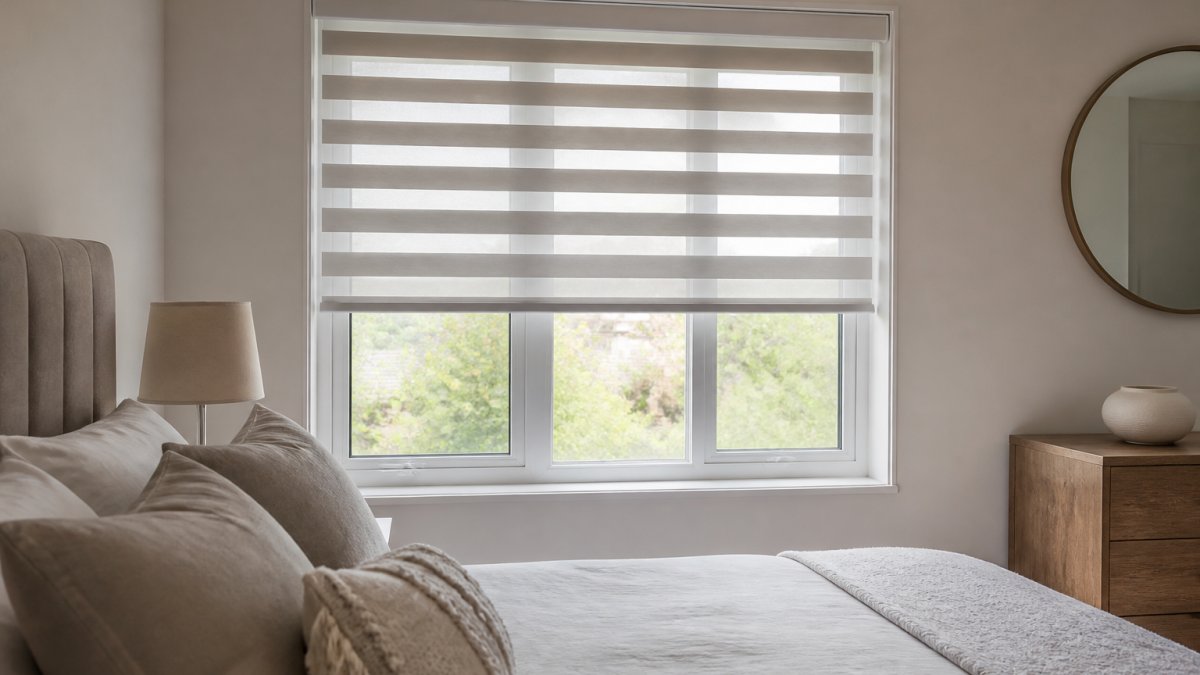
Day and night blinds are a dual-layer roller blind that switches between a clear view and full privacy by aligning or offsetting two strips of fabric, solving the fixed-opacity problem standard roller blinds create.
How the Dual-Layer Fabric Works
Two layers of fabric sit on one roller tube: one translucent, one opaque. Line the strips up and light passes through; offset them and the opaque strips close the gaps.
The result is light filtration you control by hand, from a soft daytime glow to near-total privacy at night. Our day and night blind range uses this open-and-close effect, and each blind arrives with a child-safe control cleat and a fascia that conceals the roller tube.
| Feature | Standard Roller Blind | Day and Night Blind |
|---|---|---|
| Light control | Fixed opacity | Adjustable by alignment |
| Privacy levels | One | Multiple |
| View when raised | Head box visible | Rolls into neat head box |
| Child safety | Varies by model | Supplied with control cleat |
| Best for | Simple cover | Bedrooms needing flexibility |
Blackout Curtains vs Blinds: Which Blocks More Light?
Blackout blinds block more light than blackout curtains when fitted correctly, because they sit closer to the glass and cover the recess edge.
The trade-off is warmth and softness: curtains add fabric, texture and sometimes acoustic damping, while blinds give a cleaner line and better edge control. Many bedrooms end up with both.
If total darkness is the goal, a made-to-measure blackout option wins. Our blackout and made-to-measure blind options are cut to your exact sizes, which is the single biggest factor in closing the gaps a standard roller blind leaves behind.
The Benefits of Plantation Shutters for Bedroom Windows
Plantation shutters are solid, hinged panels of horizontal slats fitted directly to the window frame or recess. They give the finest light control here, because you tilt the slats rather than raise or lower a whole panel.
Venetian and Roman Blinds: Slat Control and Fabric Warmth
Venetian and Roman blinds sit between the roller blind and the shutter. One gives you slat control; the other gives you fabric warmth.
Venetian Blinds: Tilt, Lift and Light Gap
Venetian blinds use horizontal slats you tilt to control light and lift to open the window. Tilt them flat for privacy with light still coming through; angle them up to bounce light off the ceiling.
Where they fall short is the light gap. In a bedroom, that means a Venetian blind alone rarely achieves full darkness. Our washed wood look aluminium Venetian blind uses 25mm aluminium slats with a wood-effect finish, right-hand cord tilt and lift control, and colour-matched ladder strings.

For a warmer, more natural look, the Sunwood Acacia real wood Venetian blind offers a consistent acacia grain in 50mm slats with matching tapes and cords. If you want the wood look without the upkeep, the Alina Fine Grain white faux wood blind and the Realm Grey embossed faux wood blind use 3mm composite PVC slats that wipe clean, which suits bathrooms and wet rooms as well as bedrooms.


Roman Blinds and Fabric Linings
Roman blinds are fabric panels that fold up in neat horizontal pleats, bringing softness and colour that slats and rollers cannot match.
No-Drill and Rental-Friendly Bedroom Window Treatments
For renters, the biggest barrier is the drill. Most tenancy agreements prohibit holes in the window frame or wall, and even where a landlord is flexible, patching and repainting at the end of a tenancy is a cost and a hassle.
The rental-friendly answer is a family of non-permanent fixings, each with a different mechanism, weight limit and failure mode.
Tension Mounting and Perfect-Fit Options
A perfect-fit blind slides into the window frame behind the glass gasket and holds there under its own tension: no holes, no screws, no damage.
Our Neat Fit pleated blind in Infusion Coffee works exactly this way. It slides into place behind the gasket of the glass and suits UPVC windows, doors, bi-fold doors, conservatories and porches. The minimum width is 20cm, and it takes seconds to fit.
The trade-offs are worth knowing before you order:
- Frame type matters. Perfect-fit blinds need a rebate or gasket to grip. They suit most modern UPVC and aluminium windows, but older timber frames with putty glazing or flush sashes often have nothing for the blind to sit behind.
- Handle clearance. On tilt-and-turn or casement windows, check that the blind's side channels do not foul the handle when the window opens. A common pattern is to order a slightly narrower blind on the handle side.
- Weight limits. Tension alone holds a pleated or cellular fabric well. Heavier blackout roller fabrics and wide spans can sag or pull free, so perfect-fit is best kept to narrower windows or lighter fabrics.
Tension Rods and Adhesive Fixings
Where a perfect-fit blind will not work, two other no-drill routes are common.
Tension rods are spring-loaded poles that wedge between two opposing surfaces, usually inside the recess. They hold by friction, so they need parallel, solid surfaces and a span that is not too wide. A tension rod with a blackout curtain is a genuine bedroom option, but expect more edge light than a fitted blind because the curtain hangs in front of the recess.
Washed Wood Look Aluminium Venetian Blind | Made to Measure →
Adhesive brackets use high-bond tape or removable pads to hold a lightweight track or bracket to the frame or wall. They are genuinely removable, but:
- They suit light fabrics only. A heavy blackout roller or lined Roman will exceed most adhesive ratings.
- Surface preparation decides success. The frame must be clean, dry and free of release agent or silicone, or the pad will fail within weeks.
- Removal can lift paint or leave residue on some finishes, so test on an inconspicuous area first.
What Actually Works for a Dark Bedroom You Rent
If total darkness is the goal and you cannot drill, the hierarchy is:
- Perfect-fit blind where the frame allows it, because it sits closest to the glass and controls edge light best.
- Tension rod plus a generously sized blackout curtain that overlaps the recess on all sides, accepting some top and side leakage.
- Adhesive-fixed lightweight blind as a last resort, with realistic expectations about weight and longevity.
A useful trick that costs nothing: whatever you fit, overlap the recess by a few centimetres on each side and along the top. That overlap, not the fabric's blackout rating, decides how dark the room gets.
Child Safety, Acoustics and Energy Efficiency in Bedrooms
Three factors separate a bedroom blind that works from one that just covers the glass: child safety, noise, and heat. Each has a concrete mechanism behind it, and each changes which blind you should buy.
Child Safety: Cords, Chains and the Cordless Option
Looped cords and chains are a strangulation risk for young children: a loop a child can reach can tighten around the neck, silently.
The British Blind and Shutter Association guidance on window coverings and child safety sets out how cord and chain operated blinds must be supplied, which is worth checking before you buy anything corded.
In practice, you have four options, in order of safety:
- Cordless. The blind is operated by hand, a spring, or a motor. There is no cord to reach, so there is no loop risk. This is the simplest safe choice for a nursery.
- Tensioned control. A cord or chain runs in a closed loop held under tension against the wall or frame, so it cannot form a free-hanging loop. It must be installed with the tension device fitted as designed.
- Cord with a cleat. The cord is wound around a cleat fixed high on the wall, out of a child's reach, after each use. It works, but it relies on the adult remembering every single time.
For any bedroom or nursery, look for a cleat or a cordless mechanism as a minimum.
Acoustics: What Actually Dampens Noise
Blinds are not soundproofing. A single sheet of roller fabric does very little to outside noise, because sound passes through the thin material and around the edges. What helps is mass, a tight seal, and an air gap.
Ranked by how much they typically help in a bedroom:
- Plantation shutters. Solid panels, a tight fit to the frame, and a sealed air gap between the slats and the glass. The mass and the seal are what do the work.
- **** The lining adds a second layer of fabric, and the pleats create a soft, irregular surface that scatters some sound. Better than a roller, not as effective as shutters.
- Cellular or honeycomb blinds. The trapped air in the cells adds a small insulating and acoustic benefit, though the effect is modest.
The single biggest acoustic improvement is not the blind at all: it is closing the gap between the blind and the frame. A tight-fitting treatment outperforms a heavier one that hangs loose.
Energy Efficiency: The Still Air Pocket
A blind creates a still air pocket between the glass and the room, which reduces heat loss through the window.
This is why made-to-measure matters: the closer the fit, the better the insulation and the smaller the light gap.
For the best thermal result in a bedroom, combine a close-fitting blind with a curtain: the blind handles the edge light and the air pocket, while the curtain adds a second layer of fabric and a further air gap.
Choosing the Right Bedroom Window Treatment
Match the treatment to your priority, not the trend.
- Total darkness for a nursery: a made-to-measure blackout blind, fitted tight to the recess, with a child-safe control.
- Flexible light and privacy: day and night blinds with adjustable dual-layer fabric.
- Warmth and finish: lined Roman blinds, or Venetian blinds in a wood or faux wood finish.
The throughline is fit. Whichever option you choose, the gap between the blind and the frame decides how dark the room gets. A made-to-measure blind cut to your exact sizes beats a standard size every time.
Standard roller blinds leave light gaps that a bedroom cannot afford, and fixing that means choosing a treatment built around a tighter fit. Just Blinds makes made-to-measure blinds cut to your exact sizes, with options that solve each bedroom problem: day and night blinds for adjustable light control, faux wood and aluminium Venetians for warmth with easy care, and perfect-fit pleated blinds for no-drill, rental-friendly fitting.
Frequently Asked Questions
What are the best window coverings for bedroom privacy?
For full privacy at night, blackout-lined options work best, whether that is a blackout roller blind or a Roman blind with a lined fabric. Day and night blinds offer a middle ground, because the two layers of translucent and opaque fabric let you diffuse light during the day and close the fabric down for privacy after dark. Layering a sheer with a heavier blind gives you the most control over both light and privacy levels.
Are day and night blinds better than standard roller blinds?
They give you more control. A standard roller blind is either up or down, so you choose between full light and full shade. Day and night blinds use two layers of fabric that slide against each other, so you can diffuse light as little or as much as you like and still see outside when the fabric is open. For a bedroom that needs daytime privacy and a darker feel at night, that flexibility is usually worth the higher price.
Can I use curtains instead of roller blinds in a bedroom?
Yes, and blackout curtains are one of the most effective ways to darken a bedroom. The trade-off is bulk: curtains need space at the sides and a track or pole, and light can still creep in at the top and edges unless you fit them wall to wall and overlap the window. Blinds sit closer to the glass, take up less room and are easier to wipe clean, which is why many bedrooms use a blind plus a curtain for the best of both.
Do plantation shutters provide better insulation than roller blinds?
A standard roller blind with no thermal lining offers less resistance, so if warmth retention matters in your bedroom, a thermal-lined blind will usually perform better.
How do Roman blinds compare to roller blinds for bedrooms?
Roller blinds are slimmer and cheaper to replace, so the choice usually comes down to whether you want the decorative finish or the simpler profile.
