
Table of Contents
- Blackout Curtains vs Blinds: Key Differences
- Light Leakage and Edge Gaps: Which Blocks Better
- Benefits of Blackout Window Treatments for Sleep
- How to Measure Windows for Blackout Blinds
- Made-to-Measure Blackout Blinds: Installation and Fit
- Maintenance, Cleaning, and Durability
- Noise Reduction, Thermal Insulation, and Climate Control
- Layering for Total Blackout: Combining Curtains and Blinds
- Frequently Asked Questions
Last Updated: September 30, 2026
Blackout Curtains vs Blinds: Key Differences
When you're choosing window treatments for a bedroom, the decision between blackout curtains and blinds shapes everything from your sleep quality to your energy bills. Both deliver darkness and privacy, but they work in fundamentally different ways.
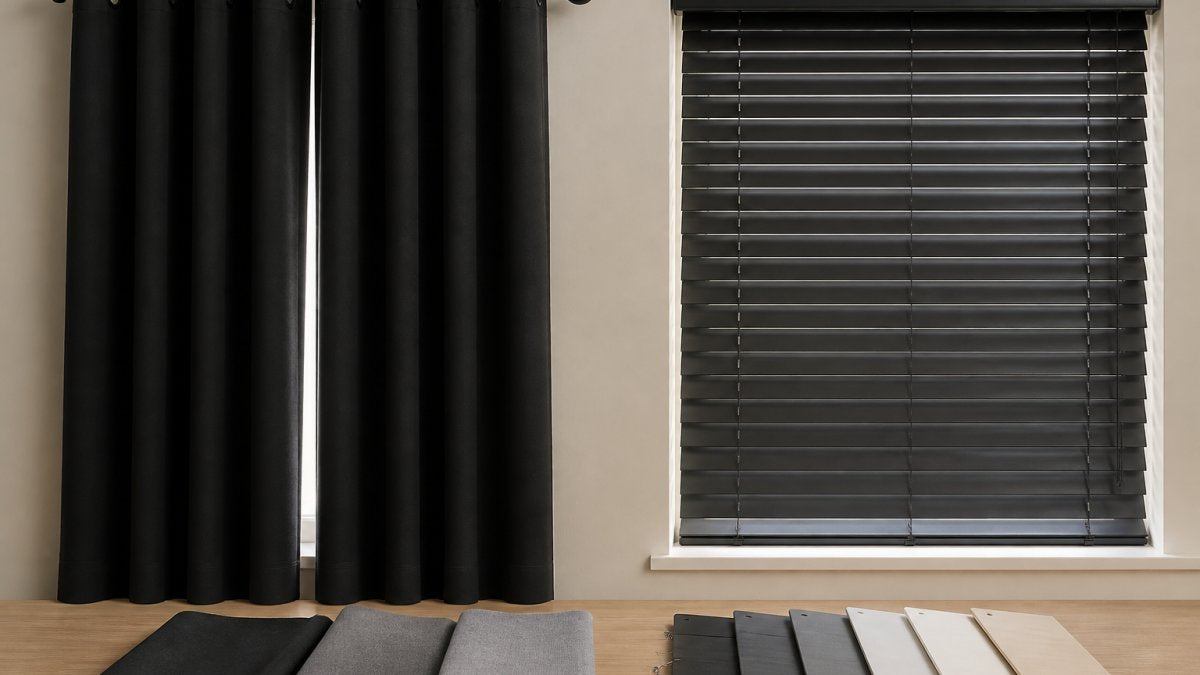
Blackout curtains hang from a pole or track and use dense, light-blocking fabric to stop sunlight. Blinds sit inside or outside your window frame with adjustable louvres or a roller mechanism that controls light by tilting or rolling. The real difference comes down to how they handle light leakage, how they feel in your space, and what maintenance they demand.
At Just Blinds, we help UK homeowners navigate this choice. The answer depends on your window shape, your budget, and whether you prioritise total darkness or design flexibility.
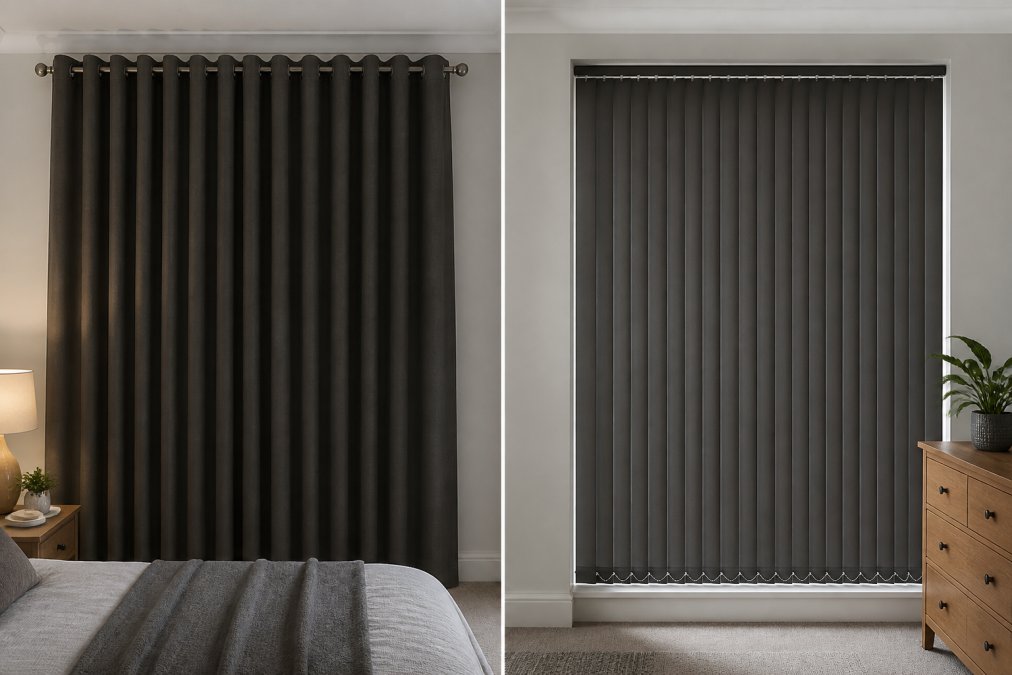
Blackout curtains excel at creating a cocoon. They drape fully across your window and beyond, blocking light at the edges where it typically escapes. The fabric itself is engineered to absorb light rather than reflect it. This makes them the go-to choice for nurseries, shift workers, and anyone serious about total darkness.
Blackout blinds offer precision control. You adjust the louvres to let in exactly as much light as you want, or close them completely for near-total blackout. They take up less visual space than curtains and work better in rooms where you want flexibility, opening them during the day to let natural light in, then sealing them shut at night.
The trade-off: curtains give you darkness, blinds give you control. Neither is objectively better. Your choice depends on what matters more to your daily routine.
Light Leakage and Edge Gaps: Which Blocks Better
Light doesn't just come through the fabric, it creeps in around the edges. This is where blackout curtains and blinds diverge most sharply.
Blackout curtains win on edge sealing. When you hang them properly, they extend well beyond your window frame on both sides and reach all the way to the floor or sill. This overlap creates a barrier that stops light from sneaking around the sides. Many people who've struggled with light leakage from blinds switch to curtains specifically for this reason.
Blackout blinds have an inherent weakness here: light escapes through the gaps between the louvres when they're closed, and around the edges where the blind meets the window frame. Even the best-fitted made-to-measure blinds can't fully eliminate these gaps. If your window recess is deep, you'll get some light creeping in at the edges.
The solution is layering. Combine blackout blinds with blackout curtains to seal the remaining gaps. This approach gives you the precision control of blinds plus the edge protection of curtains. It's not essential for every bedroom, but it's the only way to achieve true, laboratory-grade darkness.
For nurseries and bedrooms where light control is non-negotiable, layering blackout window treatments is standard practice. Made-to-measure blinds from Just Blinds can be paired with curtains to eliminate light leakage entirely.
Benefits of Blackout Window Treatments for Sleep
Darkness triggers melatonin production (Checking your browser). Your body's circadian rhythm depends on it. When light enters your bedroom at night, even a small amount, it suppresses melatonin and fragments your sleep cycles.
Blackout window treatments address this directly. They create the consistent darkness your sleep hygiene requires. This isn't theoretical, people who invest in proper light control report falling asleep faster and waking fewer times during the night.
Beyond sleep, blackout treatments reduce glare on screens, protect furniture and flooring from UV damage, and lower your heating and cooling costs. The thermal insulation benefit comes from the fabric itself and the air gap between the treatment and the window. In winter, this layer helps retain heat. In summer, it reflects sunlight and reduces the load on air conditioning.
For shift workers and night-shift nurses, blackout treatments are essential. They let you sleep during daylight hours when your body naturally wants to stay awake. Parents of young children use them to maintain consistent nap schedules. Anyone dealing with early summer mornings or late evening sunsets benefits from controlling natural light.
The investment in proper blackout treatments pays for itself in sleep quality and energy efficiency within a year or two.
How to Measure Windows for Blackout Blinds
Measuring wrong is the most common mistake. A blind that's even 5mm too narrow leaves a visible gap. One that's too wide won't fit inside your window recess.
Unilux Cream PVC Blackout Vertical →
Start by deciding whether you want an inside mount (blind sits inside the window recess) or outside mount (blind sits on the wall above and beside the frame). Inside mounts are cleaner and more discreet. Outside mounts work better for shallow recesses or windows where you want maximum light coverage.
For inside mount: Measure the width at three points: top, middle, and bottom of your window recess. Use the smallest measurement. Measure the drop (height) at the left, centre, and right. Again, use the smallest. This accounts for windows that aren't perfectly square, which is most of them.
For outside mount: Measure the width of your window frame and add 10-15cm on each side to ensure the blind extends past the frame edges. For the drop, measure from where you want the blind to start (usually above the window frame) to where it should end.
Always measure in millimetres. Always measure twice. If you're uncertain, round down on width and up on drop, it's easier to adjust a blind that's slightly short than one that's too wide.
Many people find professional measuring easier. Just Blinds offers made-to-measure blinds where you provide measurements. This removes the guesswork and eliminates costly mistakes.
| Measurement | Inside Mount | Outside Mount | Common Mistake |
|---|---|---|---|
| Width | Smallest of 3 points | Frame width + 10-15cm each side | Using the largest measurement |
| Drop | Smallest of 3 points | Top of frame to desired end point | Forgetting to account for uneven walls |
| Unit | Millimetres | Millimetres | Mixing inches and centimetres |
Made-to-Measure Blackout Blinds: Installation and Fit
Off-the-shelf blinds come in standard sizes. They rarely fit perfectly. Made-to-measure blinds are manufactured to your exact window dimensions, eliminating gaps and ensuring professional appearance.
The process is straightforward. You provide measurements (or have them taken professionally). The manufacturer builds your blind to those exact specifications. It arrives ready to install with all brackets and hardware included.
Installation typically takes 15-20 minutes per window for someone with basic DIY skills. Brackets mount to the window frame or wall using screws. The blind slides into the brackets. For inside-mount blinds, the fit is so precise that you get a clean, built-in appearance.
Just Blinds manufactures made-to-measure blackout blinds in vertical and roller styles. Vertical blinds like the Bella Snow White Blackout Vertical Blinds (£22.12) feature sewn louvres and high-quality aluminium headrails.

Maintenance, Cleaning, and Durability
Blackout curtains need regular laundering. Dust accumulates in the fabric, which dulls the appearance and reduces light-blocking effectiveness. Most blackout curtains can be machine washed on a gentle cycle, though some require dry cleaning. Check the care label. Over time, repeated washing can fade the fabric and weaken the blackout coating. Maintaining these textiles is essential because even minor degradation of the material can compromise your ability to achieve total darkness, a challenge that mirrors the difficulty of blocking light leaks when using wearable sleep accessories.
Noise Reduction, Thermal Insulation, and Climate Control
Heavy fabrics absorb sound. Blackout curtains, particularly those made from dense, interlined material, reduce noise pollution from outside traffic, neighbours, and weather. This benefit compounds when you layer curtains over blinds, the air gap between treatments acts as additional insulation.
Layering for Total Blackout: Combining Curtains and Blinds
Here's how to layer effectively:
Install your made-to-measure blackout blind first, fitted inside or outside your window recess. Close it completely to eliminate direct light through the louvres. Then hang blackout curtains from a pole or track mounted above the window frame, extending them well beyond the frame on both sides and reaching to the floor or sill.
Frequently Asked Questions
Are blinds or curtains better for bedrooms?
It depends on your priorities. Blackout blinds offer precise light control with minimal edge gaps and are easier to clean, making them ideal for those wanting a low-maintenance solution. Blackout curtains provide superior thermal insulation and noise reduction, plus a softer aesthetic. Many people layer both for maximum darkness and comfort. Consider your room's window frame style, how much maintenance you're willing to do, and whether you prioritise aesthetics or pure functionality.
Should bedrooms have blackout curtains or blinds?
Yes, bedrooms benefit significantly from blackout window treatments. They block sunlight that disrupts circadian rhythm, improve sleep quality, and provide privacy. Blackout blinds deliver total light block with minimal edge gaps, while blackout curtains offer superior thermal insulation and noise pollution reduction. For optimal results, many use both: blinds for precise control and curtains layered over them for complete darkness, better temperature regulation, and sound dampening.
What is the best way to measure windows for blackout blinds?
Measure the width at the top, middle, and bottom of your window recess (if mounting inside), taking the smallest measurement. For depth, measure from the window frame to the wall. If mounting outside the recess, measure the entire frame plus 10-15cm on each side for full light block. Use a metal tape measure for accuracy. Made to measure blackout blinds are cut to your exact dimensions, eliminating gaps. Just Blinds provides made to measure options starting from £20.17, ensuring a perfect fit every time.
What are the downsides of blackout curtains and blinds?
Blackout curtains require regular laundering or dry cleaning, can accumulate dust, and take up wall space when drawn. They may feel heavy and restrict views. Blackout blinds have less aesthetic appeal than curtains, can show dust more visibly on louvres, and may have minor edge gaps if not installed correctly. Blinds also require wand or cord operation, whereas curtains offer easier one-handed opening. Neither option is perfect, the best choice depends on your priorities for maintenance, aesthetics, and light control.
