
Table of Contents
- What Are Bespoke Blinds and How Do They Differ from Ready-Made?
- Types of Bespoke Blinds: Roller, Roman, Venetian, and Vertical
- How to Measure for Blinds Accurately
- Bespoke Blinds Cost: What to Expect and How to Budget
- Fitting Made to Measure Blinds: DIY vs Professional Installation
- Materials, Sustainability, and Long-Term Care
- Smart Home Integration and Motorised Options
- Conclusion
- Frequently Asked Questions
Last Updated: September 29, 2026
What Are Bespoke Blinds and How Do They Differ from Ready-Made?
Bespoke blinds are window coverings manufactured to the exact measurements of your window, rather than cut down from a set of standard sizes. The difference matters more than most shoppers expect: a made-to-measure blind sits flush inside the window recess or mounts cleanly to the frame, eliminating the light gaps and awkward overhangs that come with off-the-shelf options.
Just Blinds manufactures every order to your specified width and drop. Ready-made blinds come in a handful of nominal sizes, which means you either accept a loose fit or trim the slats yourself.
The trade-off is lead time. Custom-built window treatments typically take longer to arrive than a boxed product from a shelf.
The Made-to-Measure Manufacturing Process
Ordering bespoke blinds follows a predictable sequence. You measure the window recess or frame, choose your fabric and control system, and place the order with those exact dimensions. The manufacturer then cuts the headrail, sews or cuts the louvres, and assembles the finished unit.
A common mistake is measuring the window itself rather than the recess. The recess is the opening; the window is the glass and frame.
All louvres on Just Blinds vertical products are sewn rather than glued. Glued louvres can separate at the seam over time, particularly in rooms with fluctuating humidity.
Types of Bespoke Blinds: Roller, Roman, Venetian, and Vertical
Four styles cover the vast majority of made-to-measure orders, and each suits different rooms and light requirements.
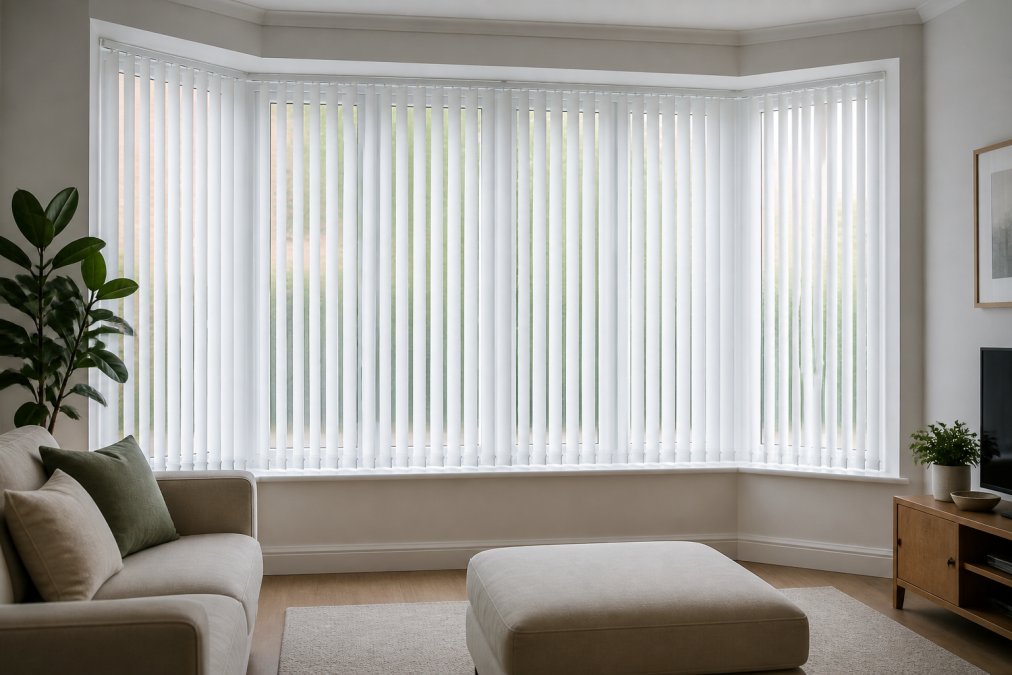
- Vertical blinds: Vertical louvres that draw to one side. The practical choice for patio doors and wide windows where horizontal slats would be awkward.
Pros and Cons of Each Blind Style
| Style | Best For | Main Advantage | Main Drawback |
|---|---|---|---|
| Roller | Bedrooms, offices | Simple, low-profile, blackout options | Limited light adjustment |
| Roman | Living rooms, bays | Soft, decorative folds | Fabric can fade in strong sun |
| Venetian | Kitchens, bathrooms | Precise light control, moisture-resistant options | Slats need regular dusting |
| Vertical | Patio doors, wide windows | Covers large spans efficiently | Less traditional look |
Vertical blinds remain the most cost-effective way to cover a wide opening. Just Blinds offers made to measure vertical blinds in washable white from £19.68, with a powder-coated aluminium headrail and a choice of chain-and-cord or child-safe wand control.

How to Measure for Blinds Accurately
Measuring for blinds comes down to two numbers: width and drop. Get both right and the blind fits; get either wrong and you are returning it.
For an inside recess fit, measure the width in three places (top, middle, bottom) and use the smallest figure. Do the same for the drop (left, centre, right) and again take the smallest. Old houses rarely have square recesses, and the smallest measurement prevents the blind catching on the reveal.
For an outside or face fix, measure the full width you want the blind to cover and add an overlap of roughly 5cm on each side to reduce light bleed. Top fix mounts to the ceiling or the top of the recess; face fix mounts to the wall or window frame.
- Measure width at top, middle, and bottom
- Measure drop at left, centre, and right
- Record the smallest figure for each
- Decide inside recess or outside mount
- Add overlap if mounting outside the recess
- Double-check before ordering
Bespoke Blinds Cost: What to Expect and How to Budget
Bespoke blinds cost varies with size, fabric, and control system.
What drives the price. Four factors account for most of the variation:
- Size. Fabric is priced by the square metre. A large patio door can use more fabric than three small bedroom windows combined, so a single wide blind often costs more than several narrow ones.
- Fabric type. A basic flatweave costs a fraction of a blackout-lined thermal fabric or a natural wood weave. Blackout and thermal linings add cost but also add function.
- Control system. Chain-and-cord is the cheapest option. Wand control and cordless systems cost more but are safer in homes with young children. Motorisation adds the most.
- Headrail material. Powder-coated aluminium costs more than plastic but resists warping and lasts longer, particularly in humid rooms.
A practical budget framework. Budget by room rather than by unit. Measure the total square metres of window you need to cover, then multiply by the fabric cost per square metre for your chosen style. Add the headrail and control system cost per blind. This gives a realistic figure before you start comparing quotes.
Entry-level made-to-measure vertical blinds start at a few pounds per unit, Just Blinds offers made to measure vertical blinds in Fiesta Cream from £4.92, with made to measure vertical blinds in washable white from £19.68. Free delivery applies on orders over £175. Larger Roman or motorised options sit at the higher end.
Bespoke vs ready-made: the real comparison. A ready-made blind costs less upfront, but the comparison is not like-for-like. A ready-made blind that does not fit properly lets light leak around the edges. A bespoke blind fits the first time, and a repairable headrail with replaceable slats can be maintained for years rather than replaced.
Made to Measure Vertical blinds in →
Fitting Made to Measure Blinds: DIY vs Professional Installation
Fitting made to measure blinds is a realistic DIY job for most standard windows. The brackets screw into the recess or frame, the headrail clips in.
Professional installation makes sense when the windows are awkward: very tall openings, bay windows with angled returns, or anywhere you cannot safely reach with a drill.
The deciding factor is usually the window itself, not your confidence. A straight recess with a solid fixing point is a straightforward DIY task.
| Situation | Recommended Approach |
|---|---|
| Standard recess, solid wall | DIY |
| Bay window, multiple returns | Professional |
| Very tall or hard-to-reach | Professional |
| Rented property | Check with landlord first |
Materials, Sustainability, and Long-Term Care
Fabric choice affects how long a blind lasts as much as how it looks. Spongeable flatweave fabrics wipe clean with a damp cloth, which suits kitchens and busy family rooms. Faux wood resists moisture, making it a practical alternative to real wood in bathrooms.
Replacement slats extend the life of a vertical blind considerably, letting you swap a damaged louvre rather than replace the whole unit.
Maintenance is simple. Spot-clean fabric blinds as needed, and check the cord or chain tension every few months. Cordless and wand-operated systems avoid tangled cords entirely and are the safer choice in homes with young children.
Smart Home Integration and Motorised Options
A motorised headrail lets you schedule blinds to open at sunrise, close at dusk, or respond to voice commands.
Automated blinds help with energy saving in winter by closing at dusk to retain heat, and with privacy in ground-floor rooms. For hard-to-reach windows, motorisation removes the need for a pole or a ladder entirely.
If you are unsure whether your window suits it, ask before you buy rather than after.
Conclusion
Getting bespoke blinds right comes down to accurate measuring, the right fabric for the room, and a fit that suits how you actually use the space.
At Just Blinds, every order is manufactured to your exact width and drop, with blackout options for nurseries, moisture-resistant faux wood for bathrooms, and replacement slats that fit most existing rails. Free delivery applies on orders over £175.
Get started with Just Blinds and fit your windows properly the first time.
Frequently Asked Questions
How much do bespoke blinds cost?
Bespoke blinds cost varies by size, fabric, and style. At Just Blinds, made-to-measure vertical blinds start from just £4.92, with a washable white fabric option at £19.68. Factors affecting the final price include window dimensions, material choice, and added features like blackout lining or motorisation. Always request a quote based on your exact measurements for an accurate figure.
What are the main benefits of choosing bespoke blinds over ready-made options?
Bespoke blinds offer a tailored fit for your window recess or face fix, eliminating gaps that let in light. They provide better light control and privacy. Ready-made blinds come in standard sizes, which often leave uneven edges. Made-to-measure blinds also let you choose from a wider range of fabrics and finishes to match your interior design.
How do I accurately measure my windows for bespoke blinds?
Use a metal tape measure. For a recess fit, measure the width at the top, middle, and bottom, then use the smallest figure. Measure the drop from the top of the recess to the sill on the left, centre, and right, again using the smallest. For a face fix, measure the exact width and drop you want the blind to cover. Always double-check before ordering.
Are bespoke blinds more expensive than standard blinds?
Bespoke blinds often cost more than ready-made because they are custom-built to your exact width and drop. Just Blinds offers made-to-measure vertical blinds from £4.92, making bespoke options accessible. Consider the investment as part of your home decor.
