
Last Updated: October 23, 2026
Quick Summary
Faux wood blinds are the closest and most affordable alternative to wooden shutters, using composite PVC slats textured to imitate natural grain for a fraction of the price. Venetian, day and night, and energy-efficient cellular blinds are the other main options, each trading something away on looks, moisture resistance or light control. Match the material to the room and you get most of the look and function without solid-timber prices.
- Faux wood Venetian blinds start at £13.36 in the Dream Stone White finish, with 3mm composite PVC slats.
- A single bay window in wooden shutters can easily exceed £500 fitted, so whole-house savings are substantial.
- Composite PVC is moisture resistant and flame retardant, making it the sensible pick for kitchens and bathrooms.
- A competent DIYer can fit a Venetian blind in under an hour with a drill and a spirit level.
- Renters should choose tension-fit or no-drill brackets so the blind can be removed at the end of the tenancy.
Table of Contents
- Why Homeowners Look Beyond Wooden Shutters
- Faux Wood Blinds: The Closest Look for Less
- Venetian Blinds: Slat Control Without the Shutter Price
- Day and Night Blinds: Layered Light Control
- Energy-Efficient Blinds: Cutting Heat Loss at the Window
- Cost Comparison: What You Actually Pay
- DIY vs Professional Fitting, Rentals and Material Lifespan
- Choosing the Right Alternative for Each Room
- Frequently Asked Questions
Why Homeowners Look Beyond Wooden Shutters
Wooden shutters look superb in a period home, but the price often stops the conversation. A single bay window can swallow a renovation budget before you have chosen a floor. That is why so many homeowners now search for affordable alternatives to wooden shutters for windows, and why the market has filled with convincing lookalikes. At Just Blinds, we make made-to-measure blinds every week, and the question we hear most is simple: can I get the same warmth and light control without paying solid-timber prices?
The answer is yes, with caveats. The alternatives fall into four families: faux wood, Venetian, day and night, and energy-efficient cellular designs. Each trades something away.
This guide compares them on cost, moisture resistance, light blocking and lifespan. Below, we break down what each option actually delivers, where it falls short, and which rooms suit it best.
Faux Wood Blinds: The Closest Look for Less
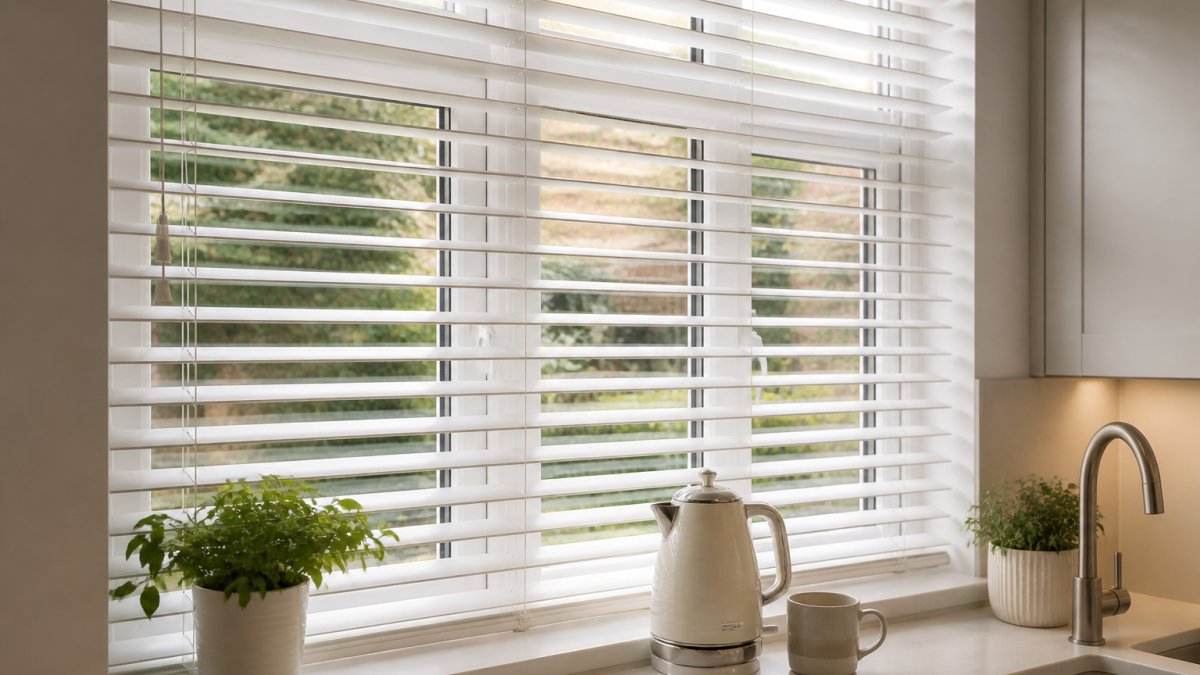
Faux wood blinds are the nearest visual match to timber shutters at a budget price. They use composite PVC slats textured to imitate natural grain, so from a metre away most guests cannot tell the difference. For a direct side-by-side breakdown, see our faux wood vs real wood blinds comparison. Our Dream Stone White Faux Wood Venetian Blinds start at £13.36, and each slat is 3mm thick composite PVC with an aluminium headrail and cord tilt control.
The honest limitation is weight and feel. Composite slats are denser than hardwood, and a wide blind can feel heavier to tilt. Where a timber shutter feels warm to the touch, PVC feels neutral.
Moisture, Heat and High-Traffic Rooms
This is where faux wood wins outright. Timber swells, warps and stains in steamy rooms; composite PVC shrugs it off. Our faux wood range is moisture resistant, flame retardant and wipes clean with a damp cloth, which makes it the sensible pick for kitchens, bathrooms, wet rooms and busy hallways. If you are weighing them up for a steamy room, read are faux wood Venetian blinds good for bathrooms.
Venetian Blinds: Slat Control Without the Shutter Price
Venetian blinds give you the same slat-by-slat light control as shutters, usually for less. Tilt the slats flat for privacy, angle them upward to bounce daylight off the ceiling, or pull them clear of the glass entirely. That flexibility is why Venetian blinds remain one of the most popular window treatments in British homes.
The trade-off is the cord. Shutters sit in a fixed frame; Venetians hang from a headrail and stack at the top. On a deep recess that stack can eat into your view. Made-to-measure sizing solves most of this, which is why we cut every blind to your exact recess rather than selling standard drops.
Day and Night Blinds: Layered Light Control
Day and night blinds combine a sheer fabric panel with a solid one on the same headrail. Slide the panels to alternate opaque and translucent stripes, and you get privacy with daylight, or full room darkening at night, without a second window dressing. For bedrooms and nurseries, that layered control is hard to beat. Our day and night blinds buyer's guide covers the options in more depth.
Where they fall short is the look. Day and night blinds read as contemporary, not period. In a Georgian or Victorian room with original coving, they can feel out of place.
Energy-Efficient Blinds: Cutting Heat Loss at the Window
Energy-efficient blinds target the weakest point in any room: the glass. Honeycomb or cellular blinds trap a pocket of still air between the fabric cells, which slows heat escaping in winter and reduces solar gain in summer. Paired with close-fitting installation, they make a measurable difference to how a room feels.
Be realistic about the scale. Blinds support your heating rather than replace it, and the gain depends on fit, recess depth and how often the blind stays closed. A loose-hanging blind with gaps at the edges does very little. Made-to-measure sizing and a snug frame matter more than the fabric's marketing claims.
Cost Comparison: What You Actually Pay
Price is where the alternatives separate sharply, and vague rankings do not help anyone budget. The table below gives indicative UK price bands for a typical 120cm × 120cm window, based on made-to-measure ranges rather than off-the-shelf drops. Treat them as planning figures: window size, slat width, fabric grade and cassette style all move the final bill.
Dream Stone White Faux Wood Venetian Blinds | 50mm Made to Measure →
| Option | Indicative price per window | Light control | Moisture resistance | Best rooms |
|---|---|---|---|---|
| Faux wood Venetian | £13-£60 | Strong, slat adjustable | Excellent | Kitchens, bathrooms, hallways |
| Standard aluminium Venetian | £15-£55 | Strong, slat adjustable | Good | Living rooms, offices |
| Day and night | £30-£90 | Layered, room darkening | Moderate | Bedrooms, nurseries |
| Cellular, energy-efficient | £40-£120 | Good, diffused | Moderate | North-facing rooms, studies |
| Wooden shutters | £250-£600+ | Excellent, fixed frame | Poor in wet rooms | Period living rooms, bays |
Our faux wood Venetian range starts at £13.36 for the Dream Stone White and Desert Oak finishes, and £14.02 for the Alina and Mirage fine-grain options. Free delivery applies on orders over £175. A single bay window in wooden shutters can easily exceed £500 fitted, so the saving on a whole house is substantial.
The hidden line in any quote is fitting. A traditional timber shutter needs a frame fixed into the recess, which usually means a fitter, and that labour can rival the product cost.
DIY vs Professional Fitting, Rentals and Material Lifespan
Fitting is the hidden cost in any window project, and it is where the affordable alternatives pull furthest ahead. A traditional timber shutter needs a frame fixed into the recess, which usually means a fitter, and that labour can rival the product cost.
Rentals change the calculation entirely, and this is where most buying guides go quiet. Shutters are a fixture and rarely suit a tenant's lease. No-drill brackets and tension-fit blinds let you dress a window and take it with you, which is why renters lean toward Venetian and day and night styles. Look for tension-fit systems that grip the recess without screws, or adhesive brackets rated for the blind's weight.
On lifespan, the material matters more than the mechanism. Composite PVC and aluminium resist moisture and hold their shape, while timber needs dry, stable rooms to last. A well-fitted faux wood Venetian should give years of service in a bathroom; a timber shutter in the same room may swell within a season.
Choosing the Right Alternative for Each Room
Match the material to the room and the decision becomes straightforward. For a wider shortlist, browse our affordable window treatment ideas for every room. Wet rooms want composite PVC. Bedrooms want layered or blackout fabric. Period living rooms want a finish that respects the architecture. Get that right and the price question answers itself.
For everything else, here is how we would decide:
- Kitchen or bathroom: faux wood Venetian, moisture resistant and easy to wipe.
- Bedroom or nursery: day and night or blackout, for full room darkening.
- Living room in a period home: faux wood in a warm oak or cream grain to echo timber.
- North-facing or draughty room: cellular, to slow heat loss at the glass.
- Rental flat: no-drill Venetian or roller, removable at the end of the tenancy.
Every blind we make is cut to your sizes, so a bay window gets a bay-window fit rather than a compromise. Replacement slats are also available for most common rails.
Wooden shutters remain a beautiful choice, but they are not the only one. The real challenge is matching material to room without overspending on a window that will spend most of its life behind a sofa. Just Blinds manufactures made-to-measure faux wood, Venetian, day and night and blackout blinds, with moisture-resistant composite slats, cord tilt and lift control, and free delivery on orders over £175. Get started with Just Blinds and dress every window in the house for less than one shutter quote.
Frequently Asked Questions
What is the cheapest alternative to wooden window shutters?
Faux wood Venetian blinds are usually the lowest-cost route to a shutter-style look. Just Blinds' made-to-measure 50mm faux wood ranges start at £13.36 for the Dream Stone White and Desert Oak finishes, with the Alina and Mirage options from £14.02. Each slat is 3mm composite PVC on an aluminium headrail, so you get the wood effect without solid timber prices. Off-the-shelf roller and pleated blinds can cost less again, but they rarely fit recesses as neatly as a made-to-measure product.
Are faux wood blinds cheaper than wooden shutters?
Yes. Faux wood blinds are built from composite PVC rather than hardwood, which keeps the material and manufacturing cost down. A made-to-measure faux wood Venetian blind from Just Blinds starts at £13.36, while timber shutters are a bespoke joinery product with a much higher unit cost. The trade-off is that PVC will not match the grain depth of real oak, but it will not warp in a steamy bathroom either, and it wipes clean with a damp cloth.
Are Venetian blinds a good alternative to shutters?
They are for most rooms. Venetian blinds give you the same slat-by-slat control over light and privacy that makes shutters popular, and you can tilt the slats to cut glare while keeping the view. The difference is mounting: shutters sit in a fixed frame, while Venetian blinds hang from a headrail with cord tilt and lift. In a bay window or a period home, made-to-measure Venetian blinds in a warm oak or crisp white finish keep the look traditional without the shutter outlay.
Which blinds are best for privacy and light control in a bedroom?
Day and night blinds suit bedrooms. They combine a sheer panel with a opaque panel on one continuous loop, so you can align them for total privacy or offset them to let soft light in. For a nursery, pair them with a blackout lining or choose a dedicated room-darkening option. Measure the narrowest point of the recess, allowing for tiles or dado rails.
Do energy-efficient blinds really reduce heat loss?
A blind close to the glass creates a still air pocket that slows heat escaping through the window, and honeycomb or cellular styles trap air in their cells for a similar effect. The gain is modest compared with double glazing, so treat it as a supporting measure rather than a replacement. The practical steps that matter most are fitting the blind close to the window frame, keeping it lowered after dark in winter, and choosing a made-to-measure fit so there are no gaps at the sides.

